The Role of Lighting in Professional Paint Correction
Paint correction is part science, part craft, and almost entirely dependent on what you can actually see. A technician who works in poor light is like a surgeon with fogged glasses. The buffer might be moving, the compound might be cutting, but without clear, revealing illumination, you are guessing at defect depth, coverage, and finish quality. Good lighting does not just help, it shapes every decision from pad choice to final wipe.

Lighting is not one-size-fits-all. Different paints, colors, and finishes respond to different wavelengths, intensities, and angles of light. Sunlight might betray sanding marks on a white SUV that looked perfect indoors, while a cool white LED can spotlight holograms on a black coupe that direct sun will not show. A serious paint correction workflow builds lighting into the process, not as an afterthought, but as a diagnostic tool and a final quality check.
Why light reveals what touch cannot
Your fingertips cannot feel a two micron swirl, and even a trained eye misses plenty in ambient shop light. Swirls, scratches, etching, pigtails, and texture distort reflections in unique ways, and certain light sources exaggerate those distortions better than others. Micro-marring tends to bloom under narrow beam lighting from a low angle, while sanding marks appear as linear, high contrast tracks under raking light. Holograms from a rotary buffer show up as smeared crescents in cool temperature LEDs, especially when viewed slightly off axis.
On repainted panels, solvent pop and dieback often hide under warm, diffuse light. Tilt a bright, high CRI LED across that same surface and the difference in texture jumps out. If you correct without purpose-built lighting, you risk chasing the wrong defect or, worse, declaring a job finished that will fail the moment it rolls into harsh outdoor light.
Understanding color temperature, CRI, and beam pattern
Color temperature, measured in Kelvin, influences what your eye perceives. Many detailers gravitate to 5000 to 6500 K because it mimics noon daylight. That range tends to enhance clarity on darker colors and reveal holograms. Slightly warmer lights, around 4000 to 4500 K, can be helpful on lighter silvers and whites, where overly cool light headlight restoration may hide faint trails. Using a mix of temperatures throughout a job increases the chance you will see everything.
CRI, or color rendering index, matters more than most think. A CRI above 90 allows colors and defects to appear more truthful to real-world viewing. A lower CRI, even at the right Kelvin, can wash out micro-defects and give a false sense of gloss. Beam pattern is the final leg of the tripod. A tight, focused beam will act like a probe for checking small zones, while a wider flood helps assess overall uniformity. For paint correction, you need both. The combination lets you chase a scratch without losing sight of the broader finish.
In practical terms, a compact handheld light with adjustable output, 400 to 1500 lumens, and a spot beam is indispensable for swirl finding. Panel floods at 2000 to 5000 lumens, ideally on stands, are great for coverage and consistency checks. Overhead lighting is useful for general work but rarely sufficient for final inspection of a corrected finish.
The choreography of light position and angle
Where you put the light matters as much as which light you use. On a black hood, for example, aim a handheld light across the surface at a shallow angle from the side rather than pointing it straight down. This raking approach exaggerates surface irregularities. Rotate your viewing angle as you move the light. You will see holograms vanish when viewed head on, then reappear when you step two feet left.
Cross-lighting, using two sources from different angles, reduces the chance you are being fooled by glare. For metallic and pearl finishes, cross-lighting helps separate texture in the clear from the sparkle of the metallic flake. If you only check one angle, it is easy to mistake orange peel or haze for flake refraction.
A practical rhythm: inspect a panel with flood lighting to identify global issues, cut your test section, then move to the spot light for fine defect checks. After refining, return to the flood for uniformity. Step into daylight if available, or simulate it with a high CRI 5500 K source from a distance. The back and forth is not indecision, it is triangulation.
Mobile detailing realities: making portable lighting work
In mobile detailing, space and power are at a premium. Battery powered floods and handhelds keep the process moving, but output and consistency can fall off as batteries drain. If you rely on cordless lights, keep spare batteries staged and rotate them on a schedule, not just when they die. Tripods that adjust from 20 to 70 inches give you reach without precarious balancing acts on wheels and steps.
Wind and dust are real. A light hitting a dusty panel at a low angle can exaggerate airborne particles and mislead your assessment of haze. Build a simple workflow: finish compounding on one panel, blow off or wipe nearby areas that might shed dust, then inspect. In mobile setups, white canopy walls can double as large reflectors, softening floods for a more even read on texture. Secure lights against gusts. There is nothing worse than a tripod falling into a freshly corrected quarter panel.
Casework under the lamp: color and clear coat behavior
Not all paints behave the same under light. Soft jet black on many Japanese cars will mar if you breathe on it wrong. Under cool LED light, you will see micro-marring even from overly aggressive microfiber towel work. Harder ceramic clears on certain German models can laugh at medium compounds under the same light but will bloom with holograms if you push a wool pad too hard. Swap to warmer lighting for a cross check and you might catch haze on lighter colors that the cool light underplayed.
On tri-coat pearls, especially whites, tight beam lights can trick you into mistaking pearl flop for haze. Pull back, widen the beam, and use a warmer tone to evaluate whether you are seeing optical effect or true micro-marring. Older single stage reds and blues chalk under light in a way that clear coated finishes do not. High CRI lights help you separate oxidation from swirls. A single stage panel that looks dull under a flood may revive with a single pass, but under a spot light you will still see leftover etching that warrants a second refine.
How Hugo's Auto Detailing calibrates lighting for paint correction
At Hugo's Auto Detailing, years of trial, error, and plenty of shop talk shaped our lighting choices. We keep a mix of compact spotlights at 4500 and 6000 K with 90 plus CRI for hand inspection, and sturdy stand-mounted floods at 5000 K for panel coverage. For dark colors, the spotlights come first. On a recent black coupe, the overheads made the car look good enough to deliver, but the handheld 6000 K spot at a 30 degree angle revealed a faint ribbon of hologram along the shoulder line. Another quick refine, same pad but a longer set at lower speed, cleared it.
Battery life is a real constraint during mobile detailing appointments. We learned to stage lights opposite the sun and never rely on daylight alone. Afternoon sun is often too high or veiled by thin clouds, muting the contrast you depend on. The crew packs a set of suction cup mounts that hold narrow beams on vertical panels, freeing two hands for machine work and reducing shadows. That small change cut our tape and flashlight juggling, and it shaved twenty minutes off an average two step correction.
Distinguishing defects: what different lights tell you
You can use light to categorize issues quickly. Acid rain etching shows as round, fractal-edged spots that remain even after compounding, especially under cool, tight beams. RIDS, or random isolated deep scratches, stand stark from a distance with a spot light and remain visible under a flood post correction. Holograms love to hide head on, so check with the light positioned to the side of your viewing axis. Pigtails from sanding show as repeating cursive S shapes, most visible under raking light. If you are seeing haze that disappears under a warmer light but returns in cool, you likely have micro-marring from pad or compound choice.
To avoid chasing ghosts, work a test section and observe it under two different temperatures and at least two positions. Keep the variables small. Change only one item between sets, pad, liquid, speed, or pressure, and use the same lighting angles for evaluation. Good light amplifies your method. It does not replace it.
The handshake between lighting and product choice
Compound and pad choices have personalities under certain lights. Diminishing abrasives can look perfect under a flood but still show a fog under a tight beam, especially on softer clears. Non-diminishing abrasives may cut clean yet leave a crisp trail that only shows with a cool LED. Microfiber pads add bite but can tint the finish with faint micro-lines under raking light. Foam finishing pads with ultra fine polishes clear that fog, but they can struggle to remove the last of a deeper defect. If a spot light demands a third refine, you either change your initial cut or accept that you are preserving clear coat at the cost of a single scratch that will not compromise the car’s look.
Technicians who ignore light tend to overwork panels. They chase every last whisper of marring with heavy compounds and aggressive pads because they are not seeing the balance point. Under good lighting, you learn when to stop, either because the scratch is through the clear, or because you are risking thin edges. Use a paint thickness gauge to corroborate what the light suggests, and treat edges like a different planet. Light them carefully and rarely cut them the same as flats.
Hugo's Auto Detailing workflows for varied finishes
Different finishes ask for different lighting choreography. On a matte wrapped car, the goal is uniformity without shine. We lean on wide floods with medium Kelvin, positioned far enough to prevent hot spots. For gloss metallic, we prefer cross-lighting to avoid misreading flake as haze. On a deep black sedan, the station is darkened, and only the inspection lights are used. This kills ambient reflections that can hide trails.
One memorable job involved a freshly repainted panel with trace orange peel. Under a broad flood, it mimicked the factory finish. A raking spot light could not be fooled, and the texture difference was glaring. We discussed options with the owner and opted for light leveling by hand, then refined with a foam pad. Without tunable lighting, that conversation would not have happened, and the mismatch would have become a driveway discovery weeks later.
The bridge from correction to ceramic coating
Ceramic coating thrives or fails on surface prep. Lighting verifies cleanliness as much as it verifies correction. Oils from compounds can sit invisibly in shop light, then smear or cause high spots when the coating is applied. After a panel wipe, we scan under a tight, cool LED at oblique angles. That angle exposes any streaks or lint that a flood might hide. During application, the early flash of many coatings is easier to judge under moderate, diffuse light rather than a piercing spot. Too harsh a beam can reflect off solvents and camouflage leveling issues. After leveling, we return to the spot light to search for high spots. A quick pass at 6000 K, then a second at 4500 K, catches most misses before cure.
Infrared lamps have a place, but be careful. Heat can soften some clears momentarily, masking micro-marring. Do not inspect immediately after IR curing. Allow the panel to cool and stabilize, then scan with your spot light again. The extra ten minutes can prevent a comeback.
Specialties that also live or die by lighting
Headlight restoration is essentially paint correction on polycarbonate. Sanding marks from 600 through 3000 grit stack up with a particular signature. A tight spot light held at a low angle reveals whether you carried the previous grit fully to the edge. Many restorations fail at the perimeter or along ridges where sanding was timid. Before sealing or coating, a cool white LED will tell you whether micro-haze remains that will dull the final clarity. The improvement is not just cosmetic. Better lenses throw a cleaner beam at night, which drivers feel immediately.
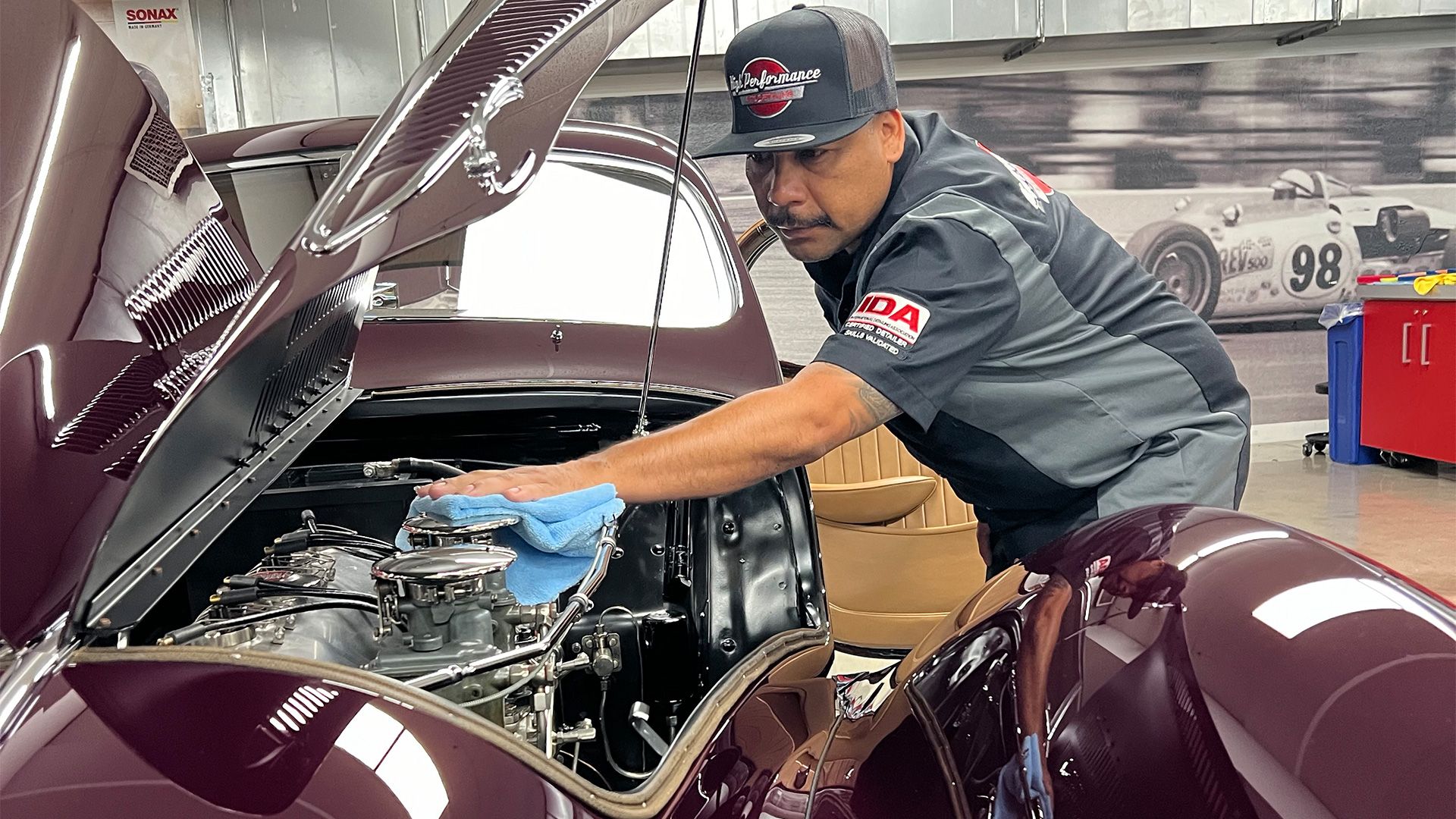
Engine detailing has its own lighting needs. Bright floods help identify grease streaks and missed zones, but too much light bouncing off chrome or wet hoses can hide grime. A mid-intensity, high CRI work light, positioned low, will highlight texture changes on cast aluminum and reveal oily films along seams. Good lighting also helps avoid water pooling in connectors and supports safer work around belts and fans. We once caught a weeping valve cover on a dark engine because the raking work light showed the shimmer of fresh oil. Without it, the detail would have masked the issue and sent the customer home to a lingering smell.
Common traps and how to sidestep them
Too much light all the time can be as bad as too little. A shop bathed in bright overheads flattens perspective and makes it hard to isolate defects. Darken the bay during inspection. Another trap is inspecting too close. Pull the light and your eyes back for context. If it only looks perfect at eight inches, it might disappoint at eight feet outdoors.
Do not trust a single Kelvin or a single tool. Rotate temperatures and beam profiles for a full picture. Beware of chasing perfection on thin factory edges and body lines. A raking light exaggerates defects there. If the gauge says you are near the floor, accept a minor blemish that will never be seen at casual viewing distance.
Finally, remember that clean lenses and housings on your lights are essential. Compound dust on a lens changes diffusion and can mute contrast. Wipe lights as you would tools, and protect them as shop assets, not disposable gadgets.
A compact toolkit that covers most scenarios
Two handheld inspection lights with adjustable output, one at 4500 K and one at 6000 K, both 90 plus CRI Two panel floods at 5000 K with stands that reach hood height One raking light mount, such as a magnetic or suction base, for doors and quarters Spare batteries and a charging station, rotated on a schedule Optional IR unit for controlled coating cure, used with cooling time before final inspection
Training the eye: practices at Hugo's Auto Detailing
The best lighting is wasted if the user does not know what to look for. At Hugo's Auto Detailing, technicians shadow an experienced lead through full corrections, narrating what each light angle reveals. We deliberately set up trap scenarios, like a hood that looks flawless under a flood, then ask trainees to find what the flood hides with the spot. They learn to walk a panel in a consistent pattern, top to bottom, with set pauses to check from near and far.
We also log tricky cases. A hard white pearl SUV that showed faint marring only under warmer light at a specific angle, or a freshly coated black sedan that revealed a high spot only after the panel cooled. Those notes help the team avoid repeating mistakes and build instincts that translate across makes and models. The fastest path to efficiency in car detailing is not rushing the pass, it is learning exactly when a finish is ready for the next step because the light told you so.
What customers notice, even if they do not know why
Owners rarely ask about color temperature or CRI. They notice the paint looks deep at sunset, not plasticky under a gas station canopy. They notice that a swirl-free finish lasts beyond the first wash. They notice the clarity of a ceramic coating that was leveled properly, without humps that grab dust. Lighting has a quiet role in those outcomes. It guided the correction, confirmed the prep, and policed the final look.
In auto detailing, the best compliments often come weeks later. A client sends a photo, proud of the reflection of their house shingles in a black hood at noon. That clarity is a product of technique illuminated by intelligent light.
Bringing it together without chasing ghosts
A disciplined approach to lighting creates honest feedback. You see what is truly there, not what you hope to see. Set your stage to match the work. Use floods for coverage, spots for truth. Check in warm and cool, near and far. Respect the paint’s limits. When working outdoors in mobile detailing conditions, control what you can, stabilize what you cannot, and use light as your compass.
The craft of paint correction lives in that last walk around the car. The bay is quiet. You kneel, you stand, you tilt the light, you change your angle. If no trail, haze, or rogue scratch breaks formation under any of those views, you have earned your confidence. The next morning’s sun will not surprise you.
Supplemental notes on broader detailing tasks
Some habits transfer across tasks. During headlight restoration, mark your progress at each grit under raking light. It prevents the classic error of jumping too soon to polish and leaving deep marks that will not clear. For engine detailing, check your degreaser rinse under a mid-level flood and then a tight beam along seams and plugs. The tight beam catches what the flood hides, especially under plastic shrouds.
In car detailing that includes interior and exterior, good lighting indoors helps with trim dressing control and streak-free glass. Glass hides streaks under diffused light but reveals them harshly in sunlight or under a cool beam at night. Before delivery, set a bright hand light inside and scan the glass from the outside at a low angle. It takes seconds and avoids a tap on the shoulder after the first drive.
Where ceramic coating is part of the package, keep one light strictly for inspection after panel wipe. Avoid contaminating that lens with coating residue, which can shift diffusion and fool your eye into thinking a smear is on the paint when it is on your tool.
The quiet ROI of proper lighting
Good lights cost money, and the temptation is to make do. The cost of a comeback dwarfs the price of a quality handheld. Lighting reduces rework, speeds accurate diagnosis, and improves finish quality you can defend. It also protects you from over-correction. When your light shows a defect has bottomed at a safe point, you stop before you thin the clear to a future failure.
For any shop or solo operator, the return is measured in trust and repeat work. That trust begins under your own lights, long before the customer ever sees the car in theirs.
Final pass: a simple inspection loop
Scan each panel with a flood at mid height for uniformity Switch to a tight beam at a shallow angle for micro-defects Cross-check with a second color temperature and from a different viewing angle Step back six to eight feet and re-scan for global holograms After any heat or coating cure, allow cool down and perform a fresh spot light pass
Good lighting will not do the correction for you. What it will do, when used with intent, is tell the truth. In the end, that is the most valuable tool in a professional’s kit, as essential as the machine polisher in your hand and the judgment in your head.
High Performance Auto Detail
790 S Coast Hwy 101, Encinitas, CA 92024
(760) 994-3462
FAQs
How Long Does Car Detailing Take?
Car detailing typically takes between 2 and 8 hours, depending on vehicle size, condition, and whether paint correction or ceramic coating is included.
Is Paint Correction Required Before Ceramic Coating?
Paint correction is recommended when surface defects are present, as proper preparation helps ensure optimal performance of the ceramic coating.
What Does A Full Boat Detail Include?
A full boat detail typically includes exterior washing, surface decontamination, oxidation removal as needed, and interior cleaning. Protective treatments are then applied based on the boat’s materials, usage, and coastal exposure conditions.