Why system balance matters more than raw accelerator speed for AI performance
What determines real-world AI performance?
When people talk about AI performance computing, the first number that often comes up is the clock speed of the accelerator, whether that is a GPU, a neural processing unit, or a dedicated AI chip. But in practice, the speed of a single component tells only part of the story. A system that pairs a very fast accelerator with a slow memory subsystem, a narrow data path, or an unbalanced software stack can deliver far less useful work than a more modestly clocked but well-integrated machine. The real measure is throughput, the amount of data the system can process in a given time, and latency, the delay before a result starts to arrive. Both depend on the entire chain from input to output.
How data moves through the system
An AI workload, whether it is training a large language model or running inference on a live video feed, involves moving huge volumes of data between storage, system memory, the accelerator's own memory, and the compute cores. Each transfer takes time. If the accelerator finishes a calculation in a fraction of a nanosecond but then waits for the next batch of data to arrive, the effective speed is determined by the slowest link in the chain. This is why memory capacity and bandwidth matter so much. A large model may not fit entirely in the accelerator's local memory, forcing the system to swap data in and out of main memory or even disk. That swapping, called paging, can add milliseconds to every step, a huge relative delay when the compute step itself lasts microseconds.
Parallel processing and scalability
Modern AI accelerators achieve their speed by performing many calculations at once, parallel processing. But to keep all those parallel lanes busy, data must be fed to them without interruption. This requires not only fast memory but also a memory hierarchy designed for the access patterns of AI algorithms. For example, a neural network layer may need to read the same set of weights repeatedly. If those weights are stored in a cache that is too small, the accelerator may stall. Similarly, scalability, the ability to add more accelerators and see proportional gains, depends on how well the system's interconnect and software distribute the workload. If communication between accelerators is slow, adding more hardware can actually hurt overall throughput because the overhead of coordination outweighs the extra compute power.

Reliability and power consumption
Accelerator speed also interacts with reliability and power consumption. Running a chip at its maximum clock speed generates heat and draws more power, which can trigger thermal throttling, a protective mechanism that reduces speed to prevent damage. In a dense data centre rack, a system that pushes every component to its limit may run hot enough to force the cooling system to work harder, which adds to operational cost and can reduce the lifespan of nearby hardware. A well-designed system balances the speed of the accelerator with the power delivery and cooling capacity so that it can sustain high performance without hitting thermal limits. This is especially important for long training runs that can last days or weeks: a brief thermal throttle can add hours to the total time.
Benchmarks and real workloads
Standard benchmarks often report peak accelerator speed in teraflops or similar metrics. While those numbers are useful for comparing raw compute capacity, they rarely reflect what a user will see in practice. Real AI workloads include data preprocessing, model checkpointing (saving intermediate state), and communication between nodes. A benchmark that runs a perfectly batched synthetic task may skip those steps. When evaluating hardware for AI performance computing, it is more informative to look at end-to-end benchmarks that include data loading and output processing, or better yet, to test with the actual model and data size you plan to use.
Software and the driver layer
The operating system, drivers, and AI frameworks (such as PyTorch or TensorFlow) all influence how efficiently the hardware is used. A well-optimised software stack can schedule operations to overlap data transfers with computation, hide latency, and make better use of the accelerator's memory. Conversely, a poorly tuned framework can leave the accelerator idle while waiting for data. Many performance issues that look like hardware problems are actually software configuration problems. For example, setting the batch size too small can underutilise the accelerator, while setting it too large can exhaust memory and cause a crash. The same hardware can show wildly different throughput depending on the software version and settings.
The role of the memory subsystem
Accelerator speed is often cited in marketing materials, but the memory subsystem, its size, bandwidth, and latency, is equally important. A system with a large, fast memory can hold the entire model and dataset in high-speed storage, avoiding slow transfers. Some modern AI systems use a tiered memory approach, where the accelerator has a small, very fast memory (like HBM, high-bandwidth memory) and the system has a larger, slightly slower memory pool. The software must manage which data goes where. If the accelerator's local memory is too small, the system may spend more time moving data than computing. This is why some high-end accelerators have multiple gigabytes of dedicated memory, and why memory bandwidth (measured in GB/s) is a key specification alongside compute speed.
Power delivery and thermal design
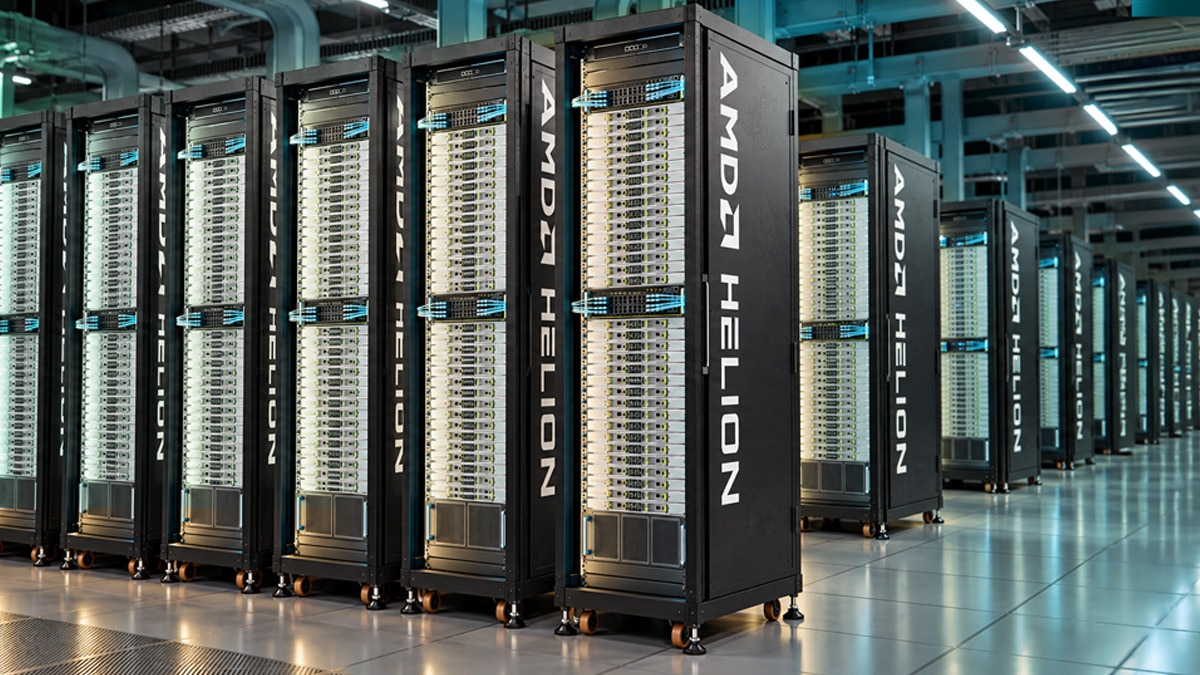
A system that can deliver consistent power to the accelerator without voltage droop or thermal throttling will outperform one that peaks briefly then slows down. This is a design consideration at the server level, not just the chip level. Vendors like AMD design their platforms with balanced power and cooling in mind, so that the accelerator can run at its rated speed for extended periods. When choosing a system for AI workloads, it is worth looking at the thermal design power (TDP) of the accelerator and ensuring that the server chassis, power supply, and cooling solution can handle it without compromise.

Putting it together: what matters for the reader
If you are planning to run AI workloads, whether training a custom model or deploying inference for an application, the key takeaway is that you should evaluate the whole system, not just the accelerator's clock speed or flop count. Look at memory capacity, memory bandwidth, interconnect speed (how fast accelerators talk to each other and to the rest of the system), thermal design, and the quality of the software stack. A balanced system with a moderately fast accelerator but generous memory and good software will often outperform an unbalanced system with a top-of-the-line accelerator that is starved for data or throttled by heat. The goal is to keep the accelerator fed and cool, so it can do what it does best: compute.