How to Read the Anion Gap in Ketoacidosis
Reading the anion gap is one of the most useful steps in evaluating an acidosis-related state. An Anion Gap Calculator can speed up the math, but clinical interpretation still depends on the complete pattern of lab values, symptoms, and the acid-base picture. In ketoacidosis, the anion gap helps show whether unmeasured anions are accumulating because of ketone production, whether the problem is really metabolic acidosis, and whether treatment is effective.
This guide walks through the lab logic in stages so you can interpret the diagnostic pattern with more confidence. It also describes how albumin changes the result, why beta-hydroxybutyrate is important, and how to tell ketoacidosis apart from other causes of high anion gap metabolic acidosis.
What Is the concept of
This anion gap serves as a derived value based on the main ions in a serum chemistry or electrolyte panel. It shows the gap between measured cations and measured anions, assisting identify unmeasured anions in the blood. The classic calculation uses serum sodium, serum chloride, and serum bicarbonate.
The basic idea is straightforward: serum sodium represents the major measured positive charge, while serum chloride and serum bicarbonate represent the major measured negative charges. When the gap increases, it often means additional acids or unmeasured anions are present. That makes the anion gap a central part of acid-base interpretation, especially when you are trying to confirm metabolic acidosis.
In practice, the anion gap is a lens into the body’s acid-base balance. A normal value does not guarantee normal physiology, but a high value strongly suggests a metabolic derangement involving unmeasured anions. That is why the anion gap calculator is helpful as a quick check, but not a substitute for full clinical interpretation.
Keep in mind that lab reference ranges can vary by method, but the overall concept remains the same. The anion gap helps determine a practical question: are there extra acids in the bloodstream that are not reflected directly in the standard electrolyte panel?
Why the Anion Gap Matters in Ketoacidosis
This condition is a state in which ketones build up enough to produce metabolic acidosis. In this setting, the body produces organic acids, and those acids lead to high anion gap metabolic acidosis. The gap rises because ketones act as hidden anions.
This is especially important in diabetic ketoacidosis, where insulin deficiency leads to ketone production, dehydration, and worsening acid-base disturbance. As ketones build up, bicarbonate is depleted buffering the acid load, and acidemia appears. The result is a pattern that often includes a low serum bicarbonate, elevated anion gap, and a low pH on blood gas testing.
The anion gap matters because it helps differentiate ketoacidosis from other forms of metabolic acidosis. A patient can have hyperglycemia, ketones, and acidemia, but the gap provides a more precise picture of severity and underlying mechanism. It also helps with treatment response: as ketones fall, the gap should narrow if therapy is effective.
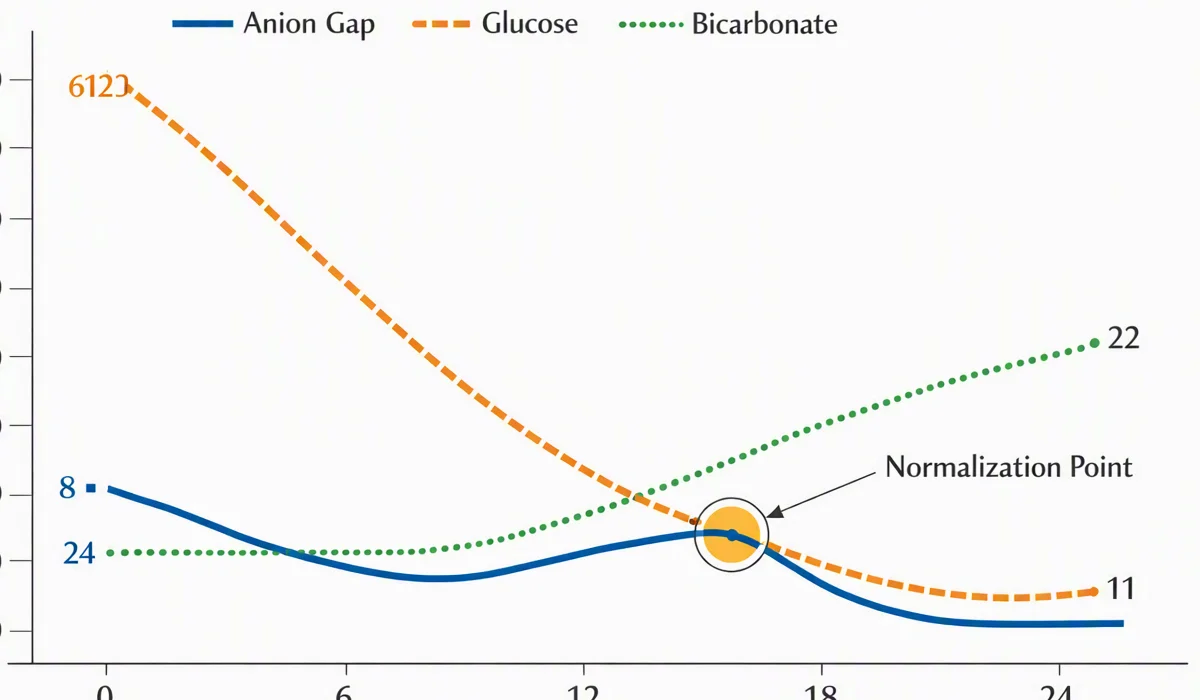
From a clinical interpretation standpoint, the gap is not just a number. It reflects the load of unmeasured anions and the degree of metabolic derangement. In ketoacidosis, a rising anion gap usually means worsening acid buildup, while a closing gap suggests recovery.
Calculating the Anion Gap
The anion gap formula is usually expressed as:
Anion gap = serum sodium - (serum chloride + serum bicarbonate)
Some clinicians apply a version that includes potassium, but the sodium-based formula is the most commonly used because it is simple to use and matches routine laboratory practice. Anion Gap Calculator can perform the arithmetic instantly, but understanding the formula leads to better interpretation.
When evaluating electrolytes, look at the overall laboratory context rather than the gap alone. Sodium, chloride, and bicarbonate each provide clues about the direction of the acid-base disturbance. For example, a low serum bicarbonate with a high anion gap often indicates accumulation of unmeasured anions rather than a simple isolated electrolyte issue.
Albumin is a key unmeasured anion, so low albumin can make the calculated gap appear inappropriately normal or only mildly elevated. That is why albumin correction matters. A corrected anion gap adjusts the measured value upward when albumin is low, revealing hidden anion gap elevation that might otherwise be missed.
A common correction adds about 2.5 mEq/L to the anion gap for each 1 g/dL drop in albumin below normal, though exact formulas may vary. The key point is that albumin influences interpretation. Without correction, you may underestimate the severity of high anion gap metabolic acidosis, especially in sicker patients.
So, the calculation is not just math. It is a tool for medical interpretation that must be considered alongside electrolytes, albumin, and the full acid-base picture.
Characteristic Testing Results in Diabetic ketoacidosis
Diabetic ketoacidosis commonly presents with a characteristic picture across blood sugar, serum bicarbonate, and blood gas values. Glucose is commonly increased, sometimes significantly, but the defining feature is not elevated glucose alone. The defining feature is the mix of ketones, acidosis, and a high anion gap.
The bicarbonate is usually low because bicarbonate is depleted buffering the excess acids. An arterial blood gas often shows low pH and low bicarbonate, with respiratory compensation in the form of a low pCO2. A venous blood gas may also be useful for evaluating pH and bicarbonate in many cases, especially when repeated measures are needed during treatment.
Standard lab interpretation looks like this:
Increased blood glucose in many, but not each, cases Decreased serum bicarbonate level High anion gap Detectable ketones or elevated beta-hydroxybutyrate Low pH on arterial blood gas or venous blood gas
beta-hydroxybutyrate requires particular attention because it is the main ketone in many patients with diabetic ketoacidosis. Urine ketone tests can miss severity early on because they may not show beta-hydroxybutyrate well. A direct beta-hydroxybutyrate level is often more clinically informative for diagnosis and treatment response.
Respiratory compensation is another important clue. Patients often breathe faster to decrease carbon dioxide and partially mitigate the acid load. That compensation does not correct the problem, but it helps explain why the pH may be somewhat less severe than expected given the low bicarbonate and high anion gap.
Taken together, the diagnostic pattern in DKA is a high anion gap metabolic acidosis driven by ketones, with lab findings that suggest insulin deficiency and dehydration.
How the Anion Gap Varies During Treatment
During care, the anion gap should start decreasing as ketone production slows and existing ketones are removed. Insulin therapy is the main driver of this improvement because it suppresses lipolysis and reduces ketone production. As insulin restores metabolic control, beta-hydroxybutyrate falls and gap closure follows.
Fluid replacement also plays a significant role. Dehydration worsens perfusion and limits renal clearance of acids and ketones, so fluids help improve circulation and support recovery. In many cases, the earliest signs of improvement are seen in the serum chemistry: the gap narrows, bicarbonate begins to rise, and blood glucose trends down with treatment.
It is essential not to focus on blood glucose alone as the marker of recovery. Blood glucose may improve before the ketoacidosis fully resolves. A patient can have a lower glucose but still have persistent ketones and an elevated anion gap. That is why treatment response should be assessed using https://anion-gap-chart290.iamarrows.com/how-accurate-is-an-anion-gap-calculator the full clinical picture, including acid-base status, beta-hydroxybutyrate, and laboratory trend monitoring.
As the gap closes, repeat testing with an Anion Gap Calculator can help confirm that therapy is working. If the gap remains elevated, clinicians should think about ongoing ketone production, inadequate insulin therapy, persistent dehydration, or another cause of high anion gap metabolic acidosis.
In short, gap closure is a practical marker of resolution, but it should be interpreted alongside pH, bicarbonate, and the general lab trajectory.
How to Distinguish Ketoacidosis From Alternative Causes of High Anion Gap
Not every high anion gap metabolic acidosis is ketoacidosis. The most useful way to differentiate causes is to match the lab pattern with the clinical context and verify which unmeasured anions are likely present.
Lactic acidosis is a frequent alternative cause. It often occurs with hypoperfusion, sepsis, or severe physiologic stress. The lactate level helps identify this cause, and ketones may be absent or only mildly elevated. In ketoacidosis, beta-hydroxybutyrate is usually far more prominent.
Renal failure can also cause a high anion gap because retained acids accumulate when kidney excretion is impaired. In that setting, the pattern may intersect with other metabolic derangements, so creatinine, blood urea nitrogen, and clinical history become important.
Toxic alcohols such as methanol or ethylene glycol can produce severe high anion gap metabolic acidosis. They may also cause an osmolar gap early on. The history of ingestion, neurologic findings, and lab screening are critical clues because the presentation can resemble other acidotic states.
Salicylates can create a mixed acid-base disorder with both respiratory alkalosis and metabolic acidosis. That makes interpretation more complicated than simple ketoacidosis. A salicylate level and careful review of arterial blood gas findings are helpful when the story does not fit classic diabetic ketoacidosis.
To separate these conditions, ask:
Are ketones or beta-hydroxybutyrate clearly elevated? Is blood glucose high enough to support diabetic ketoacidosis? Is the lactate elevated enough to explain the gap? Is there evidence of renal failure or toxin exposure? Does the arterial blood gas show a mixed pattern?
The best clinical interpretation comes from combining the anion gap with the rest of the workup, not using the number in isolation.
Typical Assessment Pitfalls
One common mistake is assuming a normal anion gap excludes ketoacidosis. This is not always the case. Early-stage disease, a mixed acid-base disturbance, or low albumin can obscure the expected elevation. A patient may still have ketosis and metabolic acidosis even if the gap seems normal at first glance.
A second pitfall is overlooking albumin correction. Because albumin contributes to the measured equilibrium of ions, low albumin can conceal a true anion gap elevation. If albumin is low, the corrected anion gap may uncover clinically meaningful acidosis that the raw value misses.
Another error is overlooking a mixed acid-base disorder. For example, vomiting can create a metabolic alkalosis that partially offsets the acidosis. In that case, pH may look less abnormal even though the patient has ongoing ketoacidosis. The delta gap can assist in identifying this situation by comparing the rise in anion gap to the fall in bicarbonate.
The delta gap is most useful when the clinical picture is confusing. If the gap is elevated more than expected relative to bicarbonate reduction, another metabolic process may be present. If the changes do not match, consider mixed acid-base disorder rather than presuming a single diagnosis.
Finally, do not rely on a single value. Lab interpretation is most reliable when you review serial values, not just one snapshot. Trends in bicarbonate, beta-hydroxybutyrate, pH, and the anion gap are more revealing than any single result.
Good clinical interpretation means understanding the pattern, the correction, and the underlying physiology rather than just plugging numbers into an Anion Gap Calculator.
FAQ: Anion Gap and Ketoacidosis
What anion gap value suggests ketoacidosis?
A value above the local reference range raises concern for ketoacidosis, especially when it occurs with ketones, low serum bicarbonate, and acidemia. The exact cutoff depends on the laboratory method, so interpretation should use the lab’s normal range and the overall clinical picture rather than a single universal number.
Does a standard anion gap eliminate ketoacidosis?
It does not. A normal anion gap does not fully rule out ketoacidosis. Early-stage disease, albumin correction issues, or a combined acid-base disorder can hide the elevation. If symptoms and other lab values suggest metabolic acidosis, check ketones, beta-hydroxybutyrate, pH, and bicarbonate closely.
Why do you correct the anion gap for albumin?
Albumin is a important unmeasured anion, so low albumin can make the anion gap look falsely normal or less elevated than it really is. Correcting for albumin refines lab interpretation and helps reveal hidden high anion gap metabolic acidosis.
In what way does the anion gap change after insulin treatment starts?
With effective insulin therapy, ketone production decreases, beta-hydroxybutyrate decreases, and the anion gap should slowly close. Fluid resuscitation also supports recovery by improving perfusion and renal clearance. If the gap does not improve, consider again for ongoing ketoacidosis or another cause of metabolic acidosis.
Which other conditions can cause a high anion gap besides ketoacidosis?
Common alternatives include lactic acidosis, renal failure, toxic alcohols, and salicylates. Each has its own diagnostic pattern, so the best approach is to pair the anion gap with blood gas results, lactate, kidney function, toxin history, and the overall acid-base balance.