Why Your Electric Stove Burner Stopped Heating
Why Your Electric Stove Burner Stopped Heating
When an electric stove burner stops heating in a Des Plaines kitchen, the disruption is immediate. Dinner plans change. Pans sit cold. The clock keeps moving. In this city, most failures trace back to a small set of electrical and component causes that a trained technician can confirm quickly. The difference between a simple part swap and a safety risk often comes down to what lives behind the glass or beneath the coil, and the condition of the 240 volt supply feeding the range.
This article lays out how electric ranges fail in Des Plaines homes, what the pattern looks like in 1950 to 1985 housing stock, and how to think about single burner failures, two-burner outages, or a cold cooktop that seems to have died overnight. It is written for homeowners across 60016, 60018, 60017, and 60019 who need clarity before they schedule electric stove repair in Des Plaines IL.
The local pattern behind a cold burner in Des Plaines
Des Plaines relies on a mature housing base. Cumberland, Oakton Manor, Apollo, Parkwood Estates, and the Lake Park area were largely built from the 1950s through the 1970s. That timeline matters for electric stoves. Many homes still use original or first-replacement 240 volt receptacles. These outlets have seen decades of plug insertion cycles and thermal stress. The contacts loosen with time. The plug prongs on the range cord dull and arc. The result is heat damage at the outlet or the range terminal block that interrupts power delivery to the burners and oven.
Technicians servicing kitchens near Northwest Highway, Dempster Street, and River Road see the same pattern again and again. A homeowner reports a front-right burner that never reaches a boil. Another calls from the Dempster-Lee corridor because two rear burners quit at the same time. In many of those calls, the surface element is fine. The issue traces to weak contact at a NEMA 14-50 or NEMA 6-50 receptacle, a charred terminal block where the power cord ties into the range, or a half-dead 240 volt leg at the breaker.
The surprise for many owners is that a bad outlet can mimic a failed heating element. Older receptacles tend to drop one leg of power. A standard electric range needs both legs of the 240 volt feed to supply full heat. Lose one leg and you get lights on the control panel but cold surface elements. On a glass top with radiant elements, this looks like random burners that refuse to glow red. On coil burner stoves, the coil never reddens or reddens only along one small arc. The fix in those cases is electrical, not a burner swap.
How an electric burner is supposed to work
Electric ranges use one of three surface technologies. Coil burners use an exposed metal element that plugs into a receptacle under the drip pan. Radiant elements sit under a ceramic glass surface and heat the glass that heats the pan. Induction cooktops create a magnetic field that heats the pan directly while the glass stays comparatively cooler.
Each of these elements relies on stable power and a control path. On a coil or radiant setup, the knob links to an infinite switch or a digital control that modulates current through the heating element. The element’s resistance converts current to heat. On induction, an inverter board drives an induction coil and modulates field strength based on pan feedback sensors. Any gap in this path causes a cold burner.
Single burner failure versus multiple burner failure
The fastest way to narrow the cause is to count what stopped working. One cold burner often means a failed element, a failed surface element switch, or a failed infinite switch for that location. Two burners on the same side cold at once points to a shared component, such as a surface element board on glass top stoves, or a dropped 120 volt leg in the 240 volt circuit. All surface elements off generally means a power supply problem, a blown internal fuse on certain brands, or a failed control board.
On Whirlpool, GE, Frigidaire, Maytag, Kenmore, and KitchenAid electric ranges with radiant elements, two adjacent burners may share a surface element board. When that board fails, it can take out both at once, which is often misdiagnosed as two separate element failures. On Samsung and LG glass tops, a failed touch panel or relay on the control board can drop multiple zones at once if the board senses an error or overheats.
What failed inside the burner path
There are a handful of parts that do most of the work. The heating element provides the heat. The infinite switch, or surface element switch, regulates power to that element. On some models a surface element board routes power and provides protections. The wiring harness and terminal block carry current from the 240 volt power cord into the stove. When a burner is cold, the diagnosis follows that path.
A radiant surface element can open internally. This looks like a burner that never glows or glows only around the edge. A coil burner element can burn out or lose connection at the receptacle it plugs into. Either failure is common after years of thermal cycling. The cost and time to replace are moderate and usually contained to that burner location.
When the knob turns and the light comes on but the burner does not heat, the surface element switch may be at fault. Infinite switches can fail in two ways. They can stick at high so the burner runs away and scorches pans. Or they can fail open so the burner never heats. These switches sit behind the control panel and feed power to the burner. Replacement requires safe disassembly and correct reconnection of the wires to avoid short circuits.
Power supply issues that mimic a bad burner
Electric ranges require a dedicated 240 volt circuit. In many Des Plaines homes, this circuit lands at a NEMA 14-50 or NEMA 6-50 receptacle behind the range or in a nearby junction box. If one leg opens due to outlet wear, a loose cord, a breaker problem, or a damaged terminal block, the stove can light up and the clock can run but the burners stay cold or heat weakly.
In homes near Oakton Street and in the older sections of Cumberland and Apollo, an outlet that has been in service since the 1960s can develop heat damage on the contact springs. This raises resistance and causes arcing. Arcing discolors the plastic around the slots and leaves an ozone smell. The same problem shows up in the terminal block inside the stove where the power cord lands under a metal cover. Heat can burn the insulation on the wires and loosen the lug screws. When that happens, the range may blow the breaker or quietly lose full voltage to the elements.
Two details matter here. First, a corroded or burned receptacle should be replaced with the correct configuration and a tight mechanical bond. Second, if the plug or cord shows heat damage, the new outlet will not hold a safe connection. The power cord and sometimes the terminal block on the range must be replaced at the same time. Skipping that step invites a repeat failure and potential fire risk.
Why two burners quit at once on glass tops
On many radiant glass cooktops from GE, Whirlpool, KitchenAid, Frigidaire, and Kenmore, a surface element board controls more than one burner. This board contains relays, temperature limiters, and safety logic. When a solder joint cracks or a relay burns, two burners tied to that board go down together. Homeowners often think both elements failed. A technician tests voltage at the element leads. If both elements test good but have no power on command, the surface element board or the control board is the culprit. Replacing the wrong parts wastes time and money, which is why board-level diagnosis licensed appliance repair IL pays back on the first visit.
Glass cooktop cracked or pitted
A cracked ceramic glass surface is more than cosmetic. If the crack runs over a radiant element, the heat can travel along the crack and cause the glass to spread. Liquids can seep through and damage the element below. On ceramic glass tops from GE Profile, Frigidaire Gallery, and Bosch, OEM glass replacement is the correct fix when the crack passes through an active cooking zone. In Des Plaines, cracked tops often show up after a pot is dropped or after thermal shock from a cold pan set on a red hot zone. The glass must match the model to ensure fit and correct element positioning. Before the new glass goes on, a trained tech inspects the radiant elements and the insulation pads for damage from the impact.
Sparking, smoking, or a burner that will not shut off
Sparking around a coil burner usually points to a failed coil connection at the receptacle, a cracked insulator, or a stray food spill that cooked behind the pan and carbonized. A burner that will not shut off is a known symptom of a stuck infinite switch. This shows up as constant high heat that ignores knob position. It is not safe to keep using the range in either case. Kill power and schedule repair. On glass top units, a relay stuck in the surface element board can also hold a burner on. That board replacement should include a careful check of the wiring and the heat sensor chain to confirm no other damage occurred.
Induction cooktops need a different diagnostic path
Induction cooktops from Bosch, KitchenAid, Miele, Samsung, and LG require checks that do not apply to radiant or coil units. The induction coil, the inverter board, and the cooling fan assembly must all work in concert. A failed cooling fan on certain Bosch and KitchenAid models allows the inverter to overheat and shut down a zone only when the room is warm. A bad pan sensor circuit can make the cooktop flash an error even with a known induction-ready pan. A trained technician uses brand-specific service modes to read stored error codes and load test the inverter output. Replacing glass on an induction unit also demands care, since the coil spacing and thermal pads under the glass affect detection and heat transfer.
What Des Plaines housing stock means for range circuits
Across Downtown Des Plaines and the Lake Park area, many ranges still connect to older 3-prong cords and outlets. Newer installations use 4-prong cords with separate neutral and ground. If a glass top range is upgraded but the outlet is left as-is, owners sometimes use an adapter or a wrong cord. That is unsafe and can introduce stray current on the chassis. When a technician updates a cord to meet current standards, the outlet and the breaker must match. It is common to find mixed parts in homes along the Northwest Highway corridor where partial remodels stacked over the decades. A correct range connection uses the proper cord for the outlet type, tight lugs on the terminal block, intact strain relief, and a breaker that matches the nameplate amperage.
Brand-specific failure notes seen in Cook County
Whirlpool and KitchenAid radiant elements tend to fail cleanly open and present an easy test result. GE and GE Profile models sometimes show intermittent heat due to cracked solder joints on surface element boards, which a visual check can confirm. Frigidaire and Frigidaire Gallery infinite switches are common stock items for service trucks in 60016 and 60018 because they fail often after years of service. Samsung ranges in the 2014 to 2017 production window appear in local service logs with touch panel and relay issues that drop two zones sporadically. LG ranges are reliable at the element level but can show harness heat damage at the terminal block if the cord was not torqued correctly during delivery.
Cold oven at the same time as a cold burner
When both the surface elements and the oven stop heating, look to the incoming power or the terminal block first. If the clock runs and the lights work, but both cooktop and oven are cold, the range may have lost one leg of the 240 volt supply. A failed bake element or broil element alone leaves the cooktop working and only the oven cold. That is a different call. Bake and broil elements are separate components used by the oven. The cooktop is powered through a separate path, though they share the incoming 240 volt legs.
Why outages cluster near Mannheim Road and River Road
Properties near Mannheim Road, River Road, and the southeastern edge of Des Plaines share proximity to O’Hare and the commercial corridors of Rosemont. Even though voltage in the area is stable, homes in that zone often have older service panels that never received a full modernization. Ranges tied to marginal breakers and tired outlets are more sensitive to minor voltage dips and heat buildup from daily cooking. The local service pattern shows more terminal block heat damage in 60018 than in some newer west-side subdivisions. That is not a registry of poor equipment. It is an age and usage story that repeats based on when each street was built out.
A shareable local finding: receptacle wear, not the burner, is often the culprit
Across Des Plaines homes built between 1950 and 1985, trained technicians see 240 volt receptacle wear as the most common root cause of the complaint that an electric range will not heat, and it is frequently misdiagnosed as a burned-out heating element. The pattern is strongest in Cumberland, Oakton Manor, and Apollo ranch homes where the original outlet remains in place. Replacing the worn outlet, the heat-damaged cord, and the range terminal block together restores stable power and ends the cycle of intermittent burners. This finding surprises owners and often reduces the scope of parts replaced compared to a guess-based element swap.
How a professional isolates the fault without guesswork
A homeowner hears the fan, sees the display, but the pan stays cold. A professional narrows the cause using a sequence of measurements, not trial and error. The technician checks the 240 volt supply at the outlet or junction box. They verify both legs and a correct neutral and ground if present. They test continuity through the suspected radiant surface element or coil burner element. They test the surface element switch or infinite switch for output while commanded on. On glass tops, they verify the surface element board is passing voltage. They inspect the terminal block for heat. For induction, they engage service mode, pull fault codes, and measure inverter output.
This process protects the owner from stacked failures caused by a single root issue. For example, if the outlet is arcing, replacing an infinite switch will not fix the problem and may fail the new part. If a coil keeps burning out at the receptacle, replacing the receptacle and the coil at the same time stops the cycle.
What a cold burner looks like on the most common cooktop types
On coil burner stoves common in many Downtown Des Plaines apartments, a cold burner that wiggles loosely in its socket points to a burned receptacle block. The black plastic cup will look charred. On radiant glass tops in Parkwood Estates and Forest View, a burner that lights dim red and fades often has a failed limiter inside the element that opens under heat. On induction in newer infill along South River Road, a zone that starts and clicks off with an error tone points to a pan detection fault or a cooling fan that is not moving enough air across the inverter heat sink.
Cost expectations and when repair is the right choice
Public data and local job records suggest the average electric stove repair in Des Plaines runs in the $108 to $251 range, depending on the part and model. Diagnostic fees often run $75 to $100 in Cook County, frequently credited toward the repair when completed. A basic coil burner element or receptacle replacement falls near the low end. A surface element switch or infinite switch lands in the mid range. A surface element board, a glass top replacement, or an induction inverter board sits higher.
The 50 percent rule is a useful guide. If the repair estimate is more than half the cost of a comparable new range, consider replacement. That inflection point often applies to induction inverter replacements on older premium brands or to glass top replacements when the glass itself costs a large share of a new unit. For a single failed element, a failed infinite switch, a terminal block issue, or a worn receptacle, repair almost always pencils out well below the replacement threshold.
Why do these failures spike during the holidays
Des Plaines kitchens see heavy use from Thanksgiving through New Year’s. Long cook times keep radiant elements and infinite switches at elevated temperatures. Any weakness in the outlet or terminal block shows up under that load. Calls from the Northwest Highway corridor and near Metropolitan Square often involve ranges that ran fine all year but failed during a multi-pot dinner. Heat cycles accelerate wear on already loose electrical connections and push marginal switches over the edge. A proactive range cord and outlet inspection in early fall reduces the chance of a holiday outage.
Safety observations that apply to local kitchens
Several safety notes come up often. Never bypass a cracked glass top with tape or a cover. Liquids can reach live components and cause shock or fire. Never keep using a burner that stays on high regardless of the knob. That is a stuck infinite switch and a fire hazard. If sparking occurs at the plug or behind the range, do not reset the breaker repeatedly and do not keep the cord plugged in. The correct response is to unplug if safe, turn off the breaker, and schedule service. Finally, any time there is visible heat damage at the outlet or cord, replacement of all three related pieces is the safe route. That means the receptacle, the power cord, and the terminal block inside the range.
How Des Plaines kitchens differ from nearby suburbs
Compared to some newer areas of the northwest suburbs, Des Plaines carries more mid-century electrical work still in service. Park Ridge and Glenview homes often saw panel and outlet upgrades during remodel cycles earlier in the 2000s. In Des Plaines, many kitchens were updated cosmetically without a circuit refresh. That leaves attractive glass top ranges running on older outlets that were never changed. The service impact is clear in 60016 and 60018. When a burner stops heating, the technician does not stop at the element. They confirm the outlet, cord, and terminal block are safe and tight so the fix holds.
Brands most often stocked for same-day fixes in 60016 and 60018
Service vans that cover Oakton Street, Golf Road, and Touhy Avenue carry common Whirlpool, GE, Frigidaire, Maytag, Kenmore, and KitchenAid surface elements and infinite switches. Samsung and LG boards are stocked when available, but those often require model-specific ordering. Bosch radiant and induction parts also trend toward special order due to model variety. That stocking pattern aligns with the installed base seen near Maine West High School, Lake Opeka, and the Northwest Highway corridor.
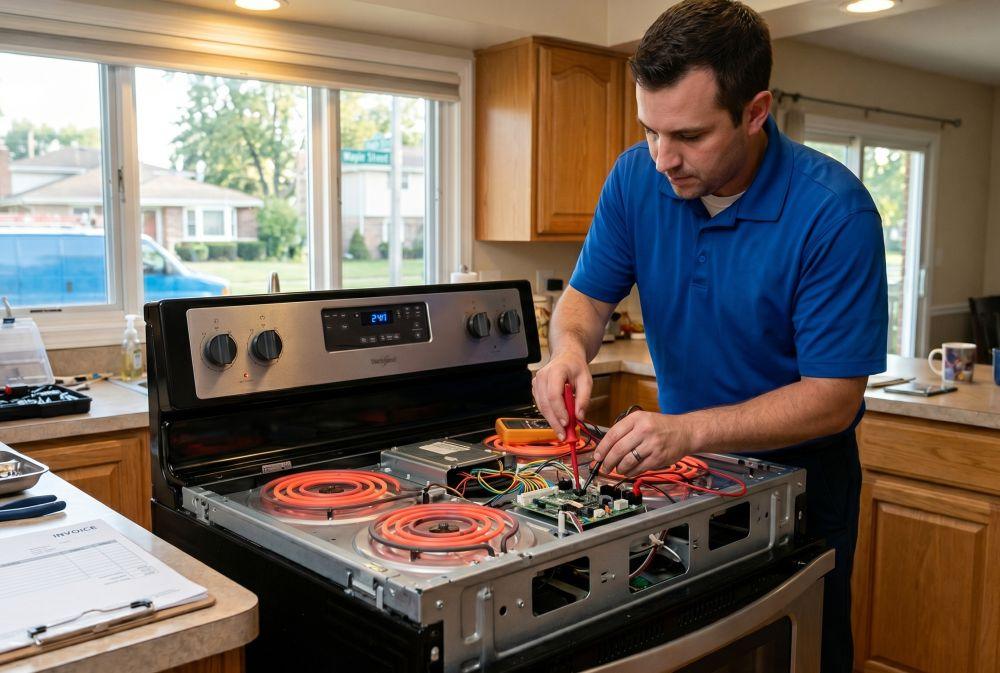
What it means when the breaker trips as soon as the burner is turned on
A tripping breaker is a hard fault, not a weak connection. It can result from a shorted element, a pinched wire in the cooktop assembly, or a miswired surface element switch. On GE and Whirlpool coil units, a coil that slips and touches the cooktop frame can short. On glass tops, a cracked radiant element can short internally when heated. If the breaker trips only when a specific burner is engaged, the fault is often in that burner’s circuit. If it trips no matter which burner is turned on, the problem may be in the shared wiring or the control board. In any event, a breaker that trips should not be forced reset multiple times. That invites damage and risk.
Why a burner cycles on and off too fast
Fast cycling on radiant elements is controlled by an internal limiter or by the surface element board. If a pan never reaches temperature on a medium setting, the limiter may be opening too early due to poor contact with the glass or a warped element carrier. Correcting this requires reseating the element, verifying proper insulation pad placement, or replacing the element if the limiter is defective. On induction, what looks like fast cycling may be the inverter reducing power due to poor pan match. A flat-bottom magnetic pan solves that in most cases, but if the behavior persists with a known good pan, the cooktop needs diagnosis.
Why careful testing prevents repeat failures
Replacing a burned element solves the symptom once, but if the terminal block or outlet is weak, the new part will run hot and may fail early. The same applies to infinite switches fed by poor supply voltage. Every successful repair includes a check of the upstream electrical path. In Des Plaines, that step carries more weight because of the age of many outlets and junction boxes behind ranges. It is the difference between getting through one meal and getting years of normal service.
When the repair intersects with city access and timing
Dispatching to a home off Mannheim Road near Rivers Casino Des Plaines takes a different route than a call near Oakton Community College. Technicians use I-294 and I-90 to reach the southeast, or the Northwest Highway corridor to cross town quickly. That routing matters for same-day calls when a burner quits midday. Proximity to 95 Bradrock Dr allows quick parts pickup if a range cord or terminal block is required to complete a safe repair in one visit.
Signs the issue is not in the burner at all
There are three common tells that the burner itself is fine. First, two surface elements fail at the same time, which points to a shared board, power feed, or leg loss. Second, the oven is also cold while the display and lights work. That suggests a missing 240 volt leg. Third, moving a known working coil to the suspect location does not restore heat on a coil top. That points to the receptacle or the switch for that location. These small tests speed the path to the true cause.
What owners in condos along South River Road should know
Condominium buildings near South River Road and in the Dempster-Lee corridor often house electric ranges on shared electrical infrastructure. Access to the range outlet may be tight, and the building may require scheduled service windows. The repair still follows the same electrical truths. If the outlet shows heat damage, replacement may involve coordination with building management. A licensed technician documents the condition and provides a parts and labor plan that aligns with association rules.
Two short lists that help with fast triage before booking
Single burner cold with others fine: suspect the heating element, the surface element switch or infinite switch, or the receptacle on coil units. Two burners cold on the same side or both rears: suspect a shared surface element board or a lost 120 volt leg in the 240 volt circuit. All burners and oven cold but lights on: suspect a missing 240 volt leg, a damaged terminal block, or a power cord issue. Burner stuck on high: suspect a failed infinite switch or a stuck relay on a surface element board. Sparking or melted plastic smell at the plug: replace the receptacle, range cord, and terminal block as a set.
Why a transparent diagnostic matters more than part swapping
In Des Plaines, the fastest repair is the one that solves the root cause the first time. That means a careful diagnostic with measured voltages and continuity tests, not a string of parts guessed at from symptoms. Without that process, owners often replace an element, then an infinite switch, only to learn the terminal block was burned and starving the circuit all along. A clear plan prevents that waste and restores both safety and function.
Why many Des Plaines homeowners misread the problem
It is natural to blame the visible part. A red glow that never appears seems like a dead element. In a city where so many outlets are older than the range itself, the odds favor the supply side. That is why the most shareable local takeaway is simple. Before assuming the burner is bad, verify both 120 volt legs at the outlet, inspect the cord and terminal block, and only then move inward to switches and elements. The right test saves money and stops the cycle of recurring failures.
Service positioning for those ready to book now
Residents in Des Plaines who need electric stove repair can schedule with a local team that works on this equipment every day. Unique Repair Services Inc. Operates at 95 Bradrock Dr, Des Plaines, IL 60018. The company is a licensed Illinois contractor and an insured appliance repair service with manufacturer-trained technicians and factory-authorized service across major brands including Whirlpool, GE, Frigidaire, Maytag, Kenmore, KitchenAid, LG, Samsung, and Bosch. The dispatch approach is built for the city’s grid, with rapid access to 60016, 60017, 60018, and 60019 via Northwest Highway, Oakton Street, Mannheim Road, and I-294. Same-day and next-day appointment availability is standard, with transparent diagnostic pricing and the diagnostic fee applied to the completed repair when approved. Parts and workmanship warranties apply based on job type and brand authorization.
Homeowners across Cumberland, Oakton Manor, Apollo, Parkwood Estates, Downtown Des Plaines, and the Lake Park area who are dealing with a cold burner, a stuck-on burner, a cracked glass top, or a dead cooktop can call +1-847-318-3363 or visit https://uniquerepair.com/ to request electric stove repair Des Plaines IL. For map and arrival reference, the Google Business Profile is available at https://www.google.com/maps?cid=4938574192076092876. Service also extends to Park Ridge, Mount Prospect, Niles, Glenview, Rosemont, Elk Grove Village, and Arlington Heights. For residents who prefer a direct service page, see the electric stove repair page at https://uniquerepair.com/service-areas/des-plaines/electric-stove-repair-services/.
Unique Repair Services, Inc.
95 Bradrock Dr
Des Plaines, IL 60018
Phone: (847) 318-3363
Email: [email protected]
Hours:
Monday to Thursday: 8AM–6PM
Friday: 8AM–5PM
Website: https://uniquerepair.com
Follow Us: Facebook