Why Commercial HVAC in Phoenix Requires a Different Standard Than Anywhere Else in Arizona
Why Commercial HVAC in Phoenix Requires a Different Standard Than Anywhere Else in Arizona
Commercial buildings in Phoenix ask more from their HVAC systems than almost any other market in Arizona. Rooftop packaged units sit in full sun on masonry roofs that read 150 degrees by late afternoon in July. Air intakes pull dust during monsoon haboobs that plaster condenser coils with caliche fines and choke airflow. Tenants work long hours through swing shifts near Sky Harbor and the I-10 and Loop 202 corridors, so downtime is not an option. That is why commercial HVAC repair and maintenance in Phoenix has to follow a different standard. It must be faster, more rigorous, more dust-aware, and tuned for the ASHRAE climate zone 2B hot-dry reality that drives both peak cooling loads and failure modes.
Day and Night Air Conditioning, Heating and Plumbing has served Phoenix since 1978 from the headquarters at 3669 E La Salle St in 85040. The team services everything from small retail suites in Arcadia and Biltmore to mid-rise office and warehouse spaces across North Phoenix and the South Mountain corridor. The technicians see where commercial HVAC repair succeeds in this climate and where it fails. The difference shows in how units are diagnosed, cleaned, sealed, and commissioned for the desert, not for a generic spec sheet written for a cooler state.
Why Phoenix Puts Commercial HVAC on the Edge
ASHRAE classifies Phoenix as hot-dry climate zone 2B. The 99 percent design cooling temperature across Maricopa County runs in the 110 to 117 degree range depending on neighborhood elevation. On a west-exposure rooftop, surface temperatures register 150 degrees or more at 3 PM. At the equipment cabinet, the ambient air at the condenser fan can sit at 130 to 140 degrees. Electrical and refrigeration parts do not forget those numbers. A run capacitor, which is the cylindrical electrical component that stores and releases an energy pulse to start and assist the compressor motor, runs hotter here and fails sooner. Contactors, which are the heavy-duty switches that pull in and deliver power to the compressor and fan motors, pit and weld faster at high current under high ambient heat.
From June through September, monsoon storms push dust across the Valley. Haboob events carry caliche fines that lodge deep inside the condenser coil, which is the outdoor radiator that rejects heat. Day and Night documents 15 to 25 percent capacity loss on fouled coils after a single dust event when a store manager on Camelback Road calls about rising indoor temperatures. That capacity does not come back until the coil is chemically cleaned and rinsed. For a rooftop unit, a 25 percent capacity loss at 4 PM in July is the difference between a pizza kitchen holding 78 degrees or climbing into the high 80s when the dinner rush starts.
Commercial systems also face specific airflow challenges. Many Phoenix properties built in the 1980s and 1990s have original ductwork that leaks or is undersized for today’s higher-static packaged units. Day and Night measures 20 to 30 percent supply loss on some older retail and office ducts that were never sealed. In mid-century buildings along the Encanto and Camelback East corridors, supply trunks run long, and ceiling plenum leakage sends cooled air into the attic. That is why commercial HVAC repair in Phoenix must address duct leakage, not just rooftop units.
Rooftop Packaged Units Behave Differently Above a Hot Deck
Most commercial buildings in Phoenix cool with rooftop packaged units, often called RTUs. An RTU combines the compressor, condenser coil, evaporator coil, blower, and controls in one cabinet on the roof. The entire refrigeration circuit and the blower sit in the sun and wind every day of the year. On a 115 degree day with a 150 degree roof surface, the compressor runs at elevated discharge pressure. The condenser fan works harder to move air across a coil already loaded with dust. The evaporator coil inside the same cabinet can begin to ice if the supply fan belt slips, the filter is blocked, or the refrigerant metering device goes off setpoint. An iced evaporator looks like a cooling problem in the space, but the root cause is often airflow starvation or a control fault upstream.
Economizers on Phoenix RTUs deserve special attention. An economizer is a damper assembly that draws in outside air for “free cooling” when outdoor conditions are favorable. In Phoenix, outside air is rarely cooler than indoor setpoint during the day in June, July, and August. Economizer linkage failure or a stuck damper can hold the outside air damper open and flood the system with 110 degree air. The technician must test the economizer operation, verify damper position at the controller, and confirm with a physical inspection. Day and Night commonly finds miscalibrated mixed-air sensors on economizers near Loop 101 and Loop 202 corridors that cause energy waste and poor comfort.
Why Commercial HVAC Repair in Phoenix Has to Follow a Dust-First Protocol
Every commercial HVAC repair visit in Phoenix should start with airflow and coil assessment. A capacitance test on a run capacitor with a meter will confirm if the value has dropped below tolerance, but that test should come only after the technician sees whether the condenser coil can even breathe. A coil that is plugged with caliche fines loads a compressor past its design. Adding refrigerant to a system with an airflow problem is a wrong fix that hides the dust issue and increases energy use.
Commercial kitchens along 7th Street, Indian School Road, and Downtown Phoenix add grease to the mix. Grease binds dust to coils and filters and requires a degreasing coil cleaner to restore the fin passages. The wrong chemical etches aluminum fins and shortens coil life. Day and Night uses manufacturer-approved cleaners and low-pressure rinsing to protect the fins while removing bonded fouling. The rinse matters as much as the chemical. On a roof without safe water access, technicians carry lift-approved rinse tanks and manage runoff to protect building surfaces and landscaping below.
The 2026 R-454B Refrigerant Transition Will Reshape Phoenix Commercial Service
The federal R-454B refrigerant transition under EPA SNAP Rule 24 takes effect January 1, 2026. New R-410A equipment cannot be manufactured after that date. R-454B is an A2L mildly flammable refrigerant with a global warming potential of 466, in contrast to R-410A’s 2,088. Phoenix commercial property owners should plan for how this change affects replacement timing and serviceability.
Here is what it means in practice. Existing R-410A rooftop units can still be serviced. Recovered R-410A will remain available for the installed base, but supply will tighten over several years as stocks are consumed. Leak repair on an older R-410A RTU in 2026 or 2027 still makes sense in some cases, but long-term refrigerant cost projections and remaining compressor life change the cost-benefit math. On new installations after 2026, contractors must handle R-454B with A2L-rated tools, R-454B-compatible leak detectors, and updated safety practices including indoor concentration thresholds if any part of the system sits within the occupied space.
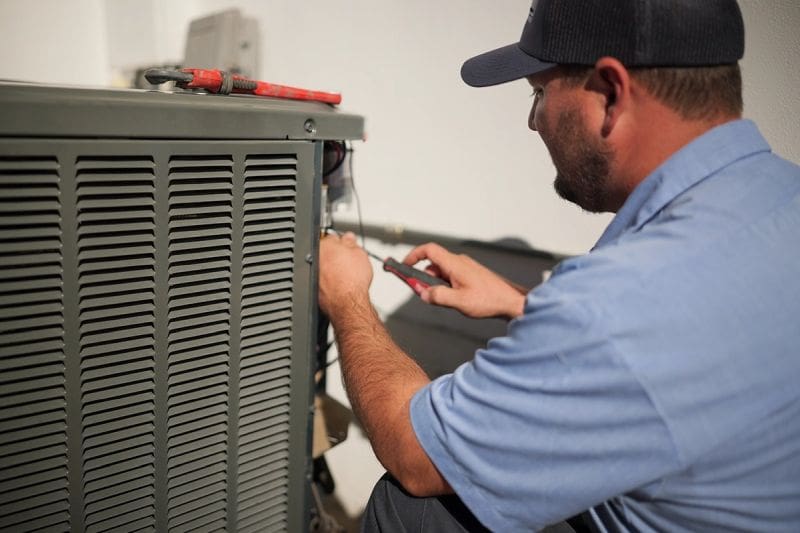
Day and Night technicians hold EPA Section 608 Universal certifications and have completed R-454B transition training for A2L refrigerants. That matters when a multi-tenant building on 24th Street plans a staged RTU replacement across roofs that share ventilation shafts and common plenum paths. Charge size, leak detection, and service procedures change. The team documents the plan and updates service tags so on-call crews at 9 PM on a Saturday know exactly what is on each roof.
SEER2 Minimums, Southwest Standards, and What They Mean on a Phoenix Roof
Federal SEER2 standards that took effect with the M1 test procedure changed how efficiency is rated. The Southwest region minimum for split systems under 45,000 BTU stands at 14.3 SEER2 with an 11.7 EER2 minimum. Packaged units share the 14.3 SEER2 threshold in 2026. For commercial RTUs, engineers also look at EER and part-load ratings, but the building still benefits from higher SEER2 designs because the new test method accounts for more realistic duct static pressures and external resistance, which is exactly what Phoenix systems face with long duct runs and return restrictions in older buildings.
Premium variable-speed systems in the 18+ SEER2 class with advanced compressor modulation can reduce peak demand and improve part-load efficiency during extended shoulder seasons, especially in April, May, September, and October. In Phoenix, a variable-speed compressor and electronically commutated blower motor can hold supply air in a tighter band during monsoon humidity spikes, which makes the indoor environment feel cooler at the same setpoint. That can matter in open-plan offices near Camelback Mountain and Piestewa Peak where glass exposure and occupant counts swing during the day.
Load Calculations: Manual N for Commercial and Why It Beats Rule of Thumb
Commercial load calculation is not guesswork on square footage. Manual N is the ACCA standard for commercial load calculations. It accounts for roof construction type, deck mass, insulation, window area and shading, orientation, internal loads from people and equipment, ventilation air, and Phoenix’s 110 to 117 degree design outdoor temperature. Rule-of-thumb tonnage estimates miss those variables and commonly oversize or undersize systems in Phoenix, especially in buildings with long west exposures and dark roofs.
For mixed-use properties in Arcadia, Biltmore, and Desert Ridge, Day and Night completes Manual N for commercial spaces and Manual J for attached residential components if any. The technicians also use Manual D commercial heating and cooling principles for duct verification and Manual S for equipment selection to match the calculated load, not a stock size on the truck. That discipline lowers runtime hours at peak, reduces short cycling, and extends compressor life. In the long run, it reduces calls for commercial HVAC repair because the equipment operates within its design envelope instead of fighting a misapplied selection.
Diagnostics That Withstand 115 Degrees and Monsoon Dust
Commercial HVAC repair in Phoenix must follow a method that survives high heat and airborne dust. Day and Night field practice starts with safety and isolation lockout at the disconnect, followed by visual inspection that looks for burned contactor faces, swollen capacitors, oil staining at coil u-bends that signals a refrigerant leak, belt condition and tension, filter loading, and economizer damper position. Temperature and pressure readings come next once airflow is confirmed. Superheat and subcooling data guide charge evaluation. A low superheat with a high subcooling may indicate a restricted metering device or overfeeding TXV, which is the thermostatic expansion valve that meters refrigerant into the evaporator coil. A high superheat with low subcooling may point to undercharge or low airflow.
Electrical testing includes capacitance measurements, contactor coil resistance, and voltage drop across power lugs that can loosen with thermal cycling. On multi-story rooftops off Central Avenue and 7th Street, vibration and thermal expansion can loosen terminations season after season, which is why torque checks during maintenance are so important. The technician also checks the blower motor amp draw versus nameplate and the supply fan belt alignment and tension. A slipping belt can mimic a refrigeration problem by starving the evaporator of air.
What a Phoenix Commercial Maintenance Visit Must Include
Commercial properties in Phoenix need maintenance that goes beyond a filter change. The urban heat island and dust load demand a deep routine.
Full condenser coil chemical cleaning and low-pressure rinse after monsoon dust events to recover the 15 to 25 percent capacity loss that fouled coils cause. Capacitance testing of run and start capacitors under load to catch heat-weakened components before failure in July and August. Economizer damper and sensor calibration with verification of actual damper position and mixed-air temperature. Refrigerant charge check by superheat and subcooling once airflow is proven, not before, with written values for trend tracking. Duct leakage scan at accessible connections and curb adapter seams, which commonly leak on older curb-to-unit transitions.
This protocol lowers emergency calls on Phoenix RTUs perched above Maryvale, Sunnyslope, and Paradise Valley Village where rooftop access is time-consuming and after-hours access comes with added logistics. It also keeps energy bills more predictable for tenants along the Camelback Corridor, where lease agreements pass through utility charges.
Why Indoor Air Quality in Phoenix Commercial Spaces Needs a Practical Approach
Humidification is rarely needed in Phoenix, but filtration and ventilation control are critical. MERV 8 filters catch larger particles and protect the coil. Many Phoenix offices move to MERV 11 or MERV 13 to capture finer dust and allergens, but the higher MERV rating increases resistance to airflow. That means the blower motor must be capable of handling the higher static pressure. If not, the higher MERV filter can starve airflow and cause iced evaporators during monsoon humidity. Day and Night sizes filter racks and verifies fan curves to support higher MERV filtration when a property manager near Phoenix Convention Center wants cleaner indoor air without trading off supply airflow.
Dust, Water, and Plumbing Interactions in Commercial Buildings
In Phoenix, HVAC and plumbing often touch. Condensate drains from RTUs or air handlers run into roof drains or interior stacks. Algae growth during monsoon season can clog condensate drain lines and trip pan float switches, which shuts down cooling during peak heat. Day and Night integrates plumbing know-how under Arizona ROC C-37 with HVAC service under ROC C-39. The team clears condensate with safe biocides and inspects roof drain routing so water does not overflow near traffic areas or loading docks during a storm.
Water quality affects hydronic systems and water-source heat pumps in mixed-use mid-rises near Roosevelt Row or along Central Avenue. Phoenix municipal water delivered through the Central Arizona Project measures 12 to 18 grains per gallon and 200 to 300 ppm calcium carbonate equivalent. Minerals precipitate on heat exchangers, restrict flow, and reduce heat transfer. A maintenance plan that includes scale control and periodic descaling keeps those systems on line. That same CAP hardness also shortens water heater anode rod life to 3 to 5 years compared to 6 to 8 years in moderate markets, which property managers must factor into budget cycles for common-area water heaters from brands like Bradford White and A.O. Smith.
Energy Programs, Incentives, and the Business Case
On the residential side, APS Cool Rewards offers up to $2,000 for qualifying heat pump installations, SRP’s HVAC Rebate Program offers up to $1,500 on qualifying high-efficiency AC installations, and the federal Inflation Reduction Act Section 25C Energy Efficient Home Improvement Credit allows up to $2,000 annually for qualifying heat pumps through 2032. For many Phoenix homeowners, that can stack to as much as $5,500 in combined offset on a 2026 high-efficiency installation. While commercial incentives follow different schedules and often run through utility business programs, these residential figures matter for small office owners who also manage homes in Arcadia, Ahwatukee, and Desert Ridge and want to align upgrade timing across properties.
For commercial buildings, Phoenix’s high daytime temperatures and long cooling seasons magnify the value of variable-speed compressors, high-efficiency motors, and properly tuned economizers. Demand charges on utility bills can represent a large share of monthly cost for buildings near I-17 and the US 60 corridor. Reducing peak load by 10 to 20 percent through equipment selection and sequence tuning can change monthly operating expenses in a way that outlives initial capital cost talk. Day and Night documents before and after kW demand at peak where building automation systems allow trend export, so owners see the change on paper, not as a vague promise.
Common Phoenix Commercial HVAC Repair Calls and What Usually Solves Them
The most frequent commercial HVAC repair calls in Phoenix share a pattern built by heat and dust. The fix starts with the right test and a realistic understanding of what fails under 115 degree design days.
Run capacitor failure on rooftop units after long afternoons above 130 degree ambient at the cabinet. The fix is a like-for-like capacitor replacement matched on microfarads and voltage rating, followed by a check of compressor and fan amp draws to confirm no overload condition caused the failure. Contactor failure with pitted or welded contacts. Replacement and a check for proper coil voltage and control circuit health, plus verification of short-cycle protection at the thermostat or controller. Condenser coil fouling from monsoon dust. Chemical clean and rinse to restore fin passages and capacity, followed by a test of head pressure at a stabilized condition. Refrigerant leak at evaporator coil u-bends or service valves. Locate with electronic leak detection rated for the refrigerant type, confirm with soap solution, repair where feasible, evacuate, weigh in charge to nameplate, and document superheat and subcooling. Economizer stuck open bringing in hot outside air. Inspect damper position, repair linkage, calibrate sensors, confirm controller logic, and test mixed-air temperature to spec.
In Maryvale and Sunnyslope units with long runtime histories, compressor failure can also occur after years of operation under high head pressure from dirty coils or chronic overcharge. In those cases, Day and Night helps owners weigh compressor replacement cost versus full unit replacement. With the 2026 R-454B transition, a failed R-410A compressor in 2026 or beyond may push the decision toward complete replacement, especially if the evaporator section and heat exchanger show age-related wear.
Why Ducts and Curbs Matter as Much as Compressors in Phoenix
Many Phoenix commercial buildings use curb adapters to set new RTUs on existing roof curbs. A poor adapter fit leaks supply air into the roof cavity or pulls return air from the roof instead of the space. That ruins capacity and comfort. Day and Night inspects curb adapters for seal integrity and air bypass. Smoke puffs at joints and static pressure readings on supply and return confirm whether the duct system is delivering air where it should. In older buildings along Encanto and Central Phoenix, it is common to find 35 to 40 percent total supply loss when original ductwork never received modern sealing. Correcting those losses prevents repeated commercial HVAC repair calls that blame the box on the roof instead of the air path below it.
Monsoon Storms, Power Surges, and After-Hours Realities
Phoenix monsoon storms arrive with wind, dust, lightning, and sudden power events. Commercial HVAC controls can be sensitive to voltage sags and surges. Surge protection at the unit and clean grounding at the service panel help reduce control board failures. Day and Night stocks common control boards, fan motors, capacitors, and contactors for same-day commercial HVAC repair across 85016, 85018, 85032, 85040, 85044, 85048, 85050, and related zip codes so a restaurant off 7th Street or a retail suite at Desert Ridge does not wait through a multi-day parts order in July.
After-hours service is not a luxury in this market. A server room near Phoenix Sky Harbor International Airport cannot ride through an overnight AC failure when outside air sits above 100 degrees after sunset. Day and Night runs true 24/7 emergency service with dispatch that understands building access, roof ladder logistics, and safety protocols on lit but hot rooftops. The team’s upfront flat-rate pricing model applies at all hours, so a Sunday 11 PM call does not create a surprise surcharge the next week.
Why This Article’s Data Gets Shared by Phoenix Managers
Three facts tend to surprise owners and managers and often get passed along in property newsletters across Maricopa County. First, a single haboob can cut rooftop unit capacity by 15 to 25 percent until the condenser coil is chemically cleaned and rinsed. Second, rooftop cabinet ambient air in Phoenix often sits at 130 to 140 degrees at 3 PM on west-exposure installations, which is why run capacitors fail so often every June and July. Third, the federal R-454B transition on January 1, 2026 ends new R-410A system manufacturing, which changes the math on whether to put money into a major R-410A repair in late 2025 versus plan a staged replacement early in 2026. Those are real, local numbers. They drive better decisions.
Serving Phoenix Commercial Properties Since 1978
Day and Night services commercial properties across Phoenix and Maricopa County with crews familiar with the roof conditions and building types in each area. Arcadia and Biltmore mid-century buildings around 85018 and 85016 need duct sealing and careful curb adapter work. Ahwatukee Foothills properties in 85044 and 85048 often have long roof runs and late-afternoon solar exposure off South Mountain Park and Preserve that amplify late-day loads. Desert Ridge in 85050 and 85054 runs newer packaged equipment that benefits from economizer tuning and higher SEER2 options. North Phoenix distribution spaces along I-17 handle high internal loads and need exact ventilation control to meet occupancy while keeping sensible heat in check. Maryvale in 85033 and Encanto near central arterials like McDowell Road and Thomas Road bring a mix of legacy RTUs and older ducts that leak at seams and boots.
Technicians know the practical entry points at each site, from service elevators in Midtown towers to ladder access behind parapets in the Camelback Corridor. They also know how to schedule work to avoid loading dock crunch times and tenant peak hours. That is what a Phoenix commercial HVAC repair partner must deliver: technical accuracy and operational awareness.
Equipment Brands and Parts Strategy That Fit Phoenix
Day and Night installs and services major brands seen across the Valley, including Trane, Carrier, Lennox, Goodman, Rheem, York, American Standard, and Mitsubishi Electric for ductless zones in offices and conference rooms. The brand selection for replacement leans on what supports the building’s duty cycle. For high-use restaurants and gyms where runtimes are extreme, Trane and Carrier RTUs with proven compressor and cabinet designs serve well. For smaller retail suites where budget and quick availability drive the project, Goodman and Rheem packaged units offer solid performance under the 14.3 SEER2 base minimum with options to step up when part-load performance matters.
Parts stocking changes during Phoenix summer. Day and Night shelves run capacitors, contactors, blower motors, condenser fan motors, and economizer actuators because those are the parts that keep commercial HVAC repair work moving same-day across Phoenix zip codes. The team also carries universal control boards where brand-specific boards are delayed, with careful documentation and wiring diagrams left inside the cabinet for future service reference.
Compliance, Credentials, and Why Licensure Matters on a Phoenix Roof
Commercial clients should expect clear credentials on any rooftop. Day and Night holds the Arizona ROC C-39 Air Conditioning and Refrigeration License for HVAC and the ROC C-37 Plumbing License for plumbing. The technicians carry EPA Section 608 Universal Refrigerant Handling Certification. They complete R-454B A2L refrigerant transition training to service and install post-2026 systems safely. They pass background checks and operate under a drug-free workplace policy. These are not paper credentials. They protect building owners on insurance, compliance, and warranty claims when something goes wrong on an occupied site at 2 PM or 2 AM.
Why Commercial and Residential Knowledge Together Help Phoenix Properties
Many Phoenix owners manage both homes and commercial suites. A single contractor who understands both sides shortens response times and reduces finger-pointing where systems connect. Condensate drains, water heaters for restrooms, and gas lines for kitchen tenants share chases with HVAC runs in many Phoenix buildings. Day and Night’s integrated HVAC and plumbing service approach prevents a call loop between two contractors while water drips through a ceiling tile in a retail bay off Indian School Road. The technician on site can reopen a clogged condensate line, replace a failed condensate pump, and verify trap seals without asking the manager to place a second work order with another vendor.
What Phoenix Owners Can Expect from a Commissioning and Handoff
After a commercial HVAC repair or replacement, commissioning sets the unit up for the desert. Day and Night records baseline temperature split, static pressure, superheat, and subcooling under stable conditions. The team calibrates thermostat or controller settings, including short-cycle protection and stage timings. Economizers are set to the correct minimum outside air for code ventilation without over-ventilating during peak heat. Filter sizes and recommended MERV ratings are documented with a schedule that fits dust load and tenant hours. If the building runs a smart thermostat or a building automation system, the technician verifies sensor mapping and trend collection so the owner can read kW demand trends across hot weeks.
Why Commercial HVAC Repair in Phoenix Is Its Own Specialty
Commercial HVAC repair in Phoenix is about diagnosing through dust, heat, and long rooftop runs. It is about knowing that a fouled condenser coil turns a good compressor into a hot, short-lived one within a single monsoon season if cleaning is skipped. It is about understanding that an economizer stuck open can add 110 degree air to a supply duct already under negative pressure due to a curb leak, and that the fix has three parts: damper, seal, and static. It is about planning for the R-454B transition and the SEER2 landscape without confusing residential and commercial standards, and still using Manual N and Manual D to right-size and right-duct because Phoenix punishes guesswork.
Ready Response Across Phoenix and Maricopa County
Day and Night supports commercial HVAC repair requests Valley-wide with true 24/7 coverage and same-day availability for urgent summer calls. The dispatch team knows the neighborhoods from Paradise Valley Village to South Mountain and the arterials that get technicians on site fast, whether that route runs along SR 51, I-17, I-10, Loop 101, or Loop 202. The difference shows when a store near Camelback Mountain calls at 4 PM with warm air, or a warehouse off US 60 reports a package unit down before a night shift loads out. The call goes to a team that knows Phoenix roofs and Phoenix summers.
Call for Commercial HVAC Repair That Matches Phoenix
For commercial HVAC repair that is built for Phoenix heat, dust, and rooftop realities, Day and Night Air Conditioning, Heating and Plumbing is ready 24/7. Since 1978, the team has served Phoenix and Maricopa County from 3669 E La Salle St, ROC C-39 and ROC C-37 licensed, with EPA Section 608 certified technicians trained on the R-454B transition. Upfront flat-rate pricing is presented in writing before any work begins. Same-day service is available for urgent calls. Free estimates are provided on new system installations, with APS Cool Rewards, SRP rebate, and federal Section 25C documentation support for qualifying projects. For immediate commercial HVAC repair service anywhere from Arcadia and Biltmore to Ahwatukee, Desert Ridge, Maryvale, and Encanto, call (602) 584-7758.
Day & Night Air Conditioning, Heating & Plumbing
AZ Licenses: ROC335883 | ROC335884
📍
Phoenix Headquarters 3669 E La Salle St,
Phoenix, AZ 85040
📞
24/7 Service Phone