- I. Numbers
- II. Numbers Table
- III. Ticker-code
- IV. Ticker-code Table
- V. Old Hootic
Numbers
Unlike most places, /who/ does not use the numerals 0-9. Instead, they use capital letters to substitute for them. Outside of academia, this is only done for official documents, and then only limited to documenting the date* and keeping tally of votes in an election or other government affair. In all other cases, the protocol is to fully write out any number in letters ("774" becomes "seven hundred seventy-four" in casual contexts).
There is no official stated reason as to why the otherwise-standard numerals are unused or why those specific letters are used, so the reason for Hoomans' lettered numeral system is unknown. Hoomans are taught 0-9 at a young age and many have a basic understanding of how that system works due to their prevalence internationally, but they never use them themselves. When asked, the typical response is "That's how it's always been and it hasn't failed us."
*For reference, Hoomans catalog dates as "age month/day/year".
Numbers Table
| Holo Standard Numeral | Hooman Numeral |
|---|---|
| -1 | -I |
| 0 | O |
| 1 | I |
| 2 | II |
| 3 | III |
| 4 | IV |
| 5 | V |
| 6 | VI |
| 7 | VII |
| 8 | VIII |
| 9 | IX |
| 10 | X |
| 50 | L |
| 100 | C |
| 500 | D |
| 900 | DCCCC |
| 1000 | M |
| 2000 | MM |
| 3000 | MMM |
| 4000 | IVM |
| 5000 | VM |
| 6000 | VIM |
| 7000 | VIIM |
| 8000 | VIIIM |
| 9000 | IXM |
| 10,000 | XM |
Ticker-code
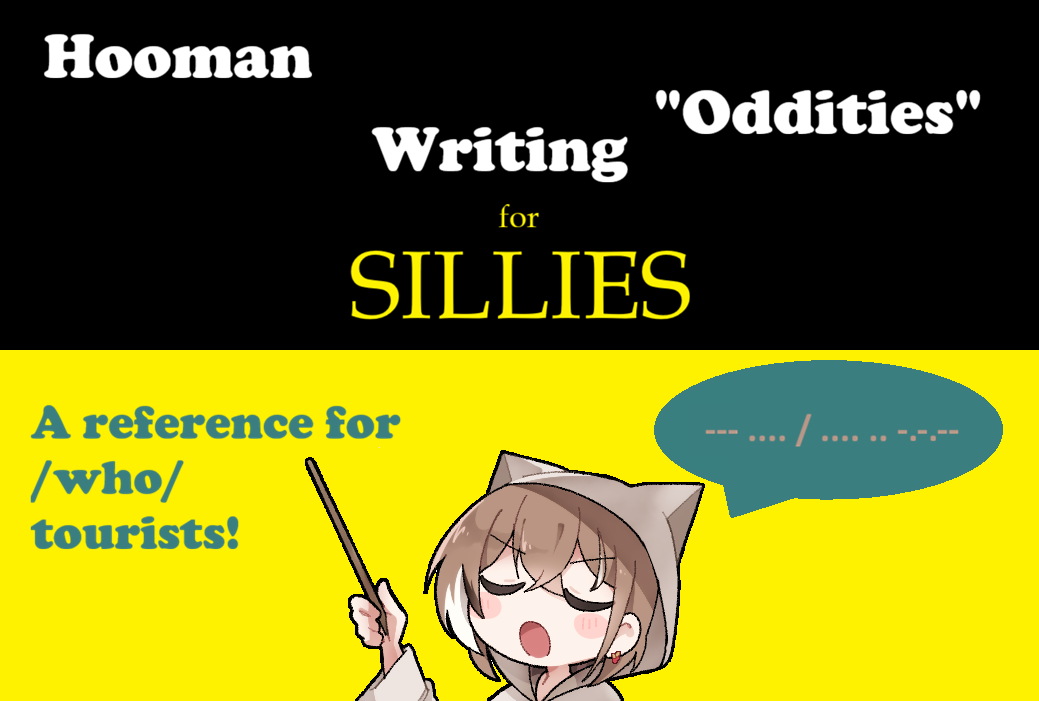
Invented during the long-past days of the Owl Republic, ticker-code (named after the ticking noises made on the first devices that created the messages) was a method of communication across suspended wires that allowed for near-instant transmission of information across miles. Though said wires are now defunct, ticker-code is still regularly taught to Hooties. Most Hoomans take effort to brush up on it from time to time if they don't regularly use it. This is done using what Hoomans call a ticker-box which prints ink onto a sheet of paper in the form of dashes and dots, depending on how long the Hooman using it holds down on a small lever typically found where one would place a right hand. Many ticker-box models do make a "clackety-clack" noise when the lever is pressed down, which allows for Hoomans to make what they call "silent messages", typically made either when practicing or when wanting to send a message covertly.
Of course, Hoomans don't limit themselves to just ticker-boxes if they want to compose messages in ticker-code. Hoots who are familiar with the code can easily write a message with it by hand, and this is often done for schematics and blueprints so as not to distract from the (often SOVLFVL) illustrations therein. "Silent messages" can easily be replicated by various kinetic methods, such as knocking on a hard surface of some kind.
One misconception is that numbers are given ticker-code designations. They do not. If a Hoomans have to write "888" in ticker code, they would have to choose between either transcribing the letter-written form (. .. --. .... - / .... ..- -. -.. .-. . -.. / . .. --. .... - -.-- -....- . .. --. .... -) or Hooman Numeration (-.. -.-. -.-. -.-. .-.. -..- -..- -..- ...- .. .. ..) of it.
Another thing about ticker-code that new learners may find a tad confusing is the implementation of slashes. For clarification, these are handwritten at appropriate points in the phrase to denote the spaces between words.
Ticker-code Table
| Character | Ticker-code |
|---|---|
| a | .- |
| b | -... |
| c | -.-. |
| d | -.. |
| e | . |
| f | ..-. |
| g | --. |
| h | .... |
| i | .. |
| j | .--- |
| k | -.- |
| l | .-.. |
| m | -- |
| n | -. |
| o | --- |
| p | .--. |
| q | --.- |
| r | .-. |
| s | ... |
| t | - |
| u | ..- |
| v | ...- |
| w | .-- |
| x | -..- |
| y | -.-- |
| z | --.. |
| . | .-.-.- |
| ? | ..--.. |
| ! | -.-.-- |
| + | .-.-. |
| - | -....- |
| = | -...- |
| / | -..-. |
| : | ---... |
| " | .-..-. |
| ' | .----. |
Old Hootic
Back in the day, Hoomans didn't use the Holo Standard script. The fact they still refuse to use the standard numerals is evidence of this.
In Holo Standard's place, Hoomans used a runic system now known as Old Hootic. All Hooman documents dating back to their first age (E.S.) used Old Hootic. Shortly after the foundation of the Republic, though, the Script Standardization Act was passed, which saw Holo Standard take the place of Old Hootic in all subsequent public documents, with some exceptions.
The most prevalent of these exceptions is one that continues to this day: religious texts. Originally, all religious texts used Old Hootic even after the passage of the SSA, though as the years went on the public religious documents were re-transcribed to what they are today. Modern writings from Archivists and Morbs are still initially written in Old Hootic, only being rewritten in Holo Standard once reviewed by peers and deemed acceptable to release to the public. This is done as a sort of safeguard against information leaks, as knowledge of Old Hootic is nowadays lost information among the Hooman populace, with the exceptions of aforementioned religious officials as well as historians.
One Old Hootic term instantly recognizable among Hoomanity, though, is -/ᚹᚺᛟ/-. Such a term is regularly placed at the top and bottom of every governmental document.