Liber Regionum Mundi

Continens Mauvae
Table of Contents
Chapter II: The Mirevalian Empire
Full Name: L'Imperi Mirevalenc
Capital: Mascaloma
Form of Rule: Hereditary Imperial Election
Faith: The Church of Splendour

Amidst the states and crowns of all the land, few shine as bright as the crown of Mirevale; from their seat of power in Mascaloma, they are the largest nation in the entirety of the continent of Mauva, with territories spanning as far as the Meio lands of Samica in the south and the deserts of Fasia in the west.
Their origins lay in the tribes of western Mauva; safe from the reaches of the Himmerian Giants and their rule over the eastern continent by way of the Ascarpian Mountains, the kingdoms born from these tribes fought over the dominance, and from one of these kingdoms, came Mirevale; born from the conquests of the Kings of Mascaloma, the then-converted warriors spread throughout the entire region and beyond, estabilishing the empire as it is today.
[TBA]
Chapter III: Els Estats principescos
Capitals: Válaza, Honderias, Illos, Madrala, Torvano
Form of Rule: Delegatory Viceroyalty
Faith: The Church of Splendour
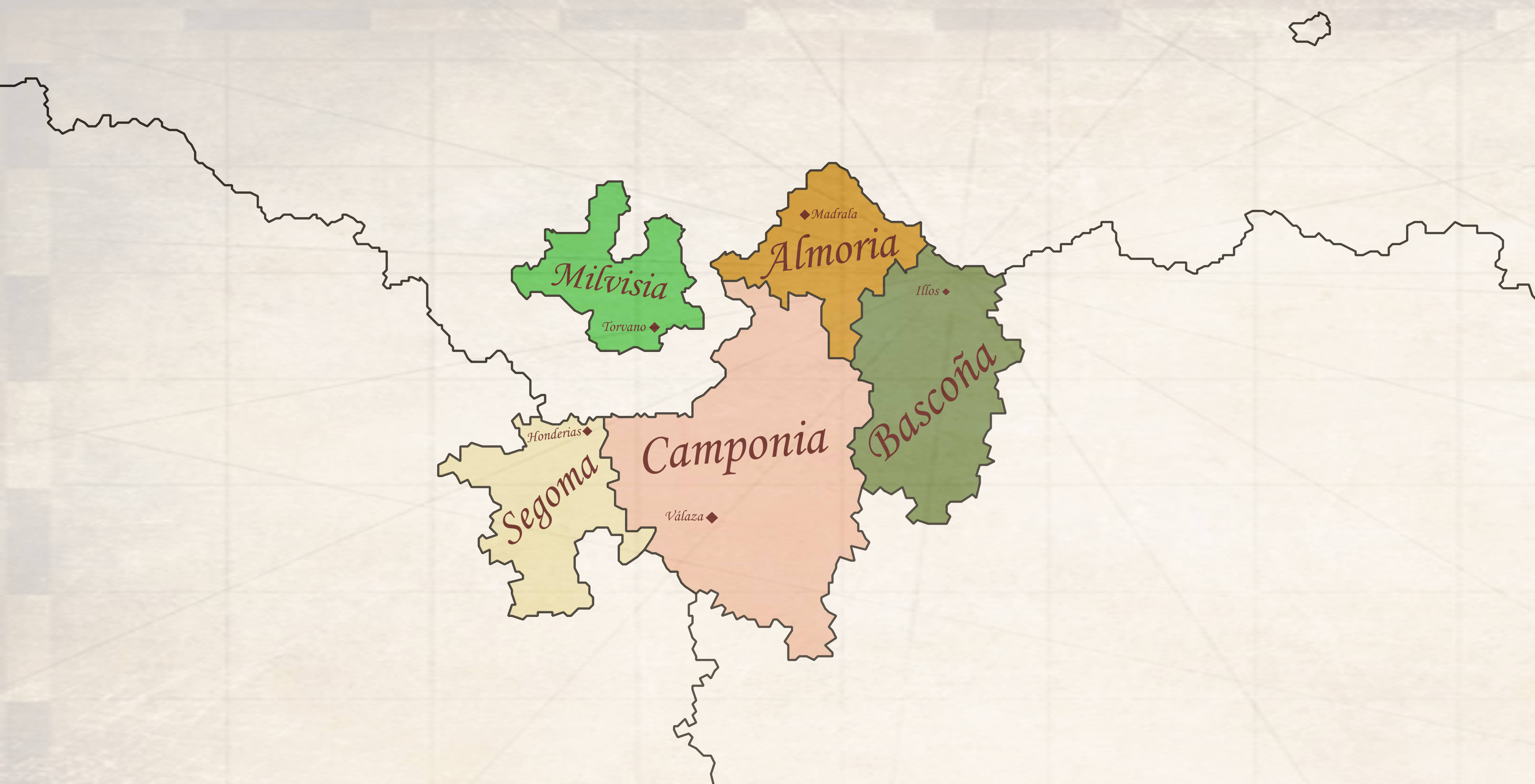
It is with accordance to the hereditary law of the land, borne of the practices of the kingdom of Mascaloma, that a holder of many properties and lands who has been graced with a multiplicity of adult sons may, out of a desire to test within them their capabilities for the management of such inheritance, temporarily appoint these sons the stewardship of separate properties; That their abilities in the management of servants and land may be proven through earthen deeds, and their worthiness towards the right of inheritance be made seen in their actions, rather than mere appearance and courting of fatherly favour.
Although such manners of inheritance have somewhat fallen out of favour from the noble class, who may find the practice somewhat complex and bothersome to carry out or even who do not have the necessary children to carry out such a method, this practice is kept well alive by that highest and most prestigious of inheritances within the land; the Imperial Throne of Mirevale. Although previous attempts at such inheritance were made, it was not until the Reform of 1382, undertaken by the then-emperor Teodor IV "The Stalwart" Brascarams following his hard-fought ascension to the throne, that three of five the Princely States of today had been formed, with the addition of Almoria and Bascoña to the system in 1430 by Emperor Teodor X
The functioning of an Princely State is as thus; with the election of a Prince to the Imperial Throne, he is given, alongside the vast array of rights and ownerships of his station, the royal right to assign his children to a princedom. None but those outside of the circle of Prince-Heirs of the Imperial House may become Princes; should there not be enough candidates for the title, stewardship of a state would fall to either the previous holding princes who had not been elected, or a council of the foremost nobles of the unclaimed realm.
Foremost amongst the states is Camponia*, with the capital of Válaza. Holding the greatest size, the greatest population, as well as the greatest wealth, it is undeniable the most powerful and desirable of princedoms. It has traditionally been given to the firstborn son of an Emperor, in recognition of their primogeniture, though some occasions where it has been given to another son have occurred. It is amongst all known for the fertility that it was named after; of their power as a breadbasket, whose bounty serves as the foremost source of food for the entire region. *
In following, is Segoma, with the capital of Honderias. Though of decent wealth, it is greatly dwarfed by its predecessor in all matters save that of trade, wherein their access to the great rivers of Lutan and Marjoisse, which flow well into the country, give them great importance by means of riverine access to the Empire.
Most distant of all amongst the princely states is Bascoña, with the capital of Illos. It is one of the most recent additions to the Empire, and the easternmost of their territories within Mauva itself. It is for this reason that this state holds the greatest military strength amongst all Princedoms, surpassing even that of Camponia, holding countless castles and fortresses in the borderlands near foreign crowns.
Most curious amongst these states, however, is that of the island of Milvisia, with the capital of Torvano. Although wealthier materially than both Bascoña and Almoria, it is the fourthmost in matters of power; although plentiful in fertile land, it is bound by the special privileges and rights of the Milvisiani, those natives of the land who had fought with such bitter strength against conquest that they were granted exceptional freedoms from standard law.
Chapter VI: The Straccian Peninsula

Chapter VI, Section II: The Republic of Nera
Full Name: Il Serenissima Repubblica di Nera
Capital: Montellegaria
Form of Rule: Sovereign Parliamentary Republic
Faith: The Church of Splendour

In the verdant hills and rolling plains of Straccia, Nera stands as one of its most notable states. It is the largest of all of them, yet at the same time neither the most populous, nor the wealthiest, nor the one with the most martial might—though it does greatly still in all such aspects. The reasoning behind such facts, as well as the very existance of it's modern state, can be traced back to its history...
The History of Nera proper begins, as with most Straccian states, with the Great Migration of the Uhren across the Meringian Sea. The Straccian Continent - until then only partially and sparsely populated by human tribes forced from the central plains by the expansion of the Himmerian Giants, proved no challenge for the newcomers to settle. It is said their first settlements - located around the tip of modern day Silenia - were able to quickly expand, turning the fledgleling settlements into a true kingdom. With the advent of their Amazonian Mares, these new Straccians quickly swept through the peninsula, pushing off even the Himmerians, and founding the Great Kingdom of Allegro.
It is here where the tale of Nera begins. Situated within the southwestern regions of Straccia, their territory, situated midst the Ipenali Alps and the hilly mountain chains that run across most of central Straccia, consists mostly of warm plains, with very few hills in comparison to most of the country. It's warm yet not exceedingly wet climate (with the except of its far southwestern regions) allowed it to become the perfect location for the growth of crops such as wheat and rice, turning it into the breadbasket of the country. Growth of the region followed, with cities such as Edroa and Epanima becoming amidst some of the largest and most powerful in the Kingdom. With the collapse of the Himmerians and the ascension of Allegro into the eminent power in Mauva during the 5th century, this influence only grew, turning them into centers of culture and trade. This Golden Age of Allegro was able to last for nearly three centuries.
In the eigth century, the Great Kingdom already showed ailing signs - a wave of continude cold temperatures damaged crops, while the bureaucracy continued to grow more and more corrupt and independent, their lineage of kings that were increasingly unable to meet the demands of their crown. It was not long until a foreign power took notice of such weakness; and the one to do it was the Sbravani Tsardom. The giants of central Himmeria, yet again united under a common liege, had already grown considerably since their founding in the 700s, with a domain that stretched all the way to the limits of the Maja River in modern day Mabria and Acanas. Filled with great ambition, they called upon their allies - the Himmerianized humans of Johannes, and launched a mighty invasion of the peninsula.
While this war, in the east, would lead to the death of the king and the subsequent collapse of Allegro into a vast number of squabbling warlords, the invasion carried out in the west by the Sbravani was a far more merciless one. The giants swept over the Bordo della Spiaggia, crushing the local armies in battle. What followed was a grand scouring, a total razing of the region of Nera. Entire cities were razed to the ground—Epanima was destroyed, never to return, and Edroas, faring only lightly better, was reduced to such extenct that it has still not fully recovered to this very day. Although the Sbravani would soon leave, their attention taken by the blazes of the Drovich Revolts, the damage was done.
As the peninsula devolved into fighting between the burgeoning city states, Nera remained desolate; yet not all parts of it had suffered this fate. The then small city of Montellegaria, which had been very luckily passed over by the armies of the Sbravani, soon began to grow exponentially, bolstering their population with the refugees of the region. By the turn of the millenium, Montellegaria had estabilished itself as a regional power. Led by their elected leaders, the Doges, Montellegaria came to dominate its region, subjugating smaller cities and villages and fending off invading armies from the states of Avonna, Senucco and Santula. In 1149, at last, they proclaimed themselves the Most Serene Republic of Nera, estabilishing the republican power that lasts to this day.
Chapter VIII, Section I: The Sbravani Tsardom
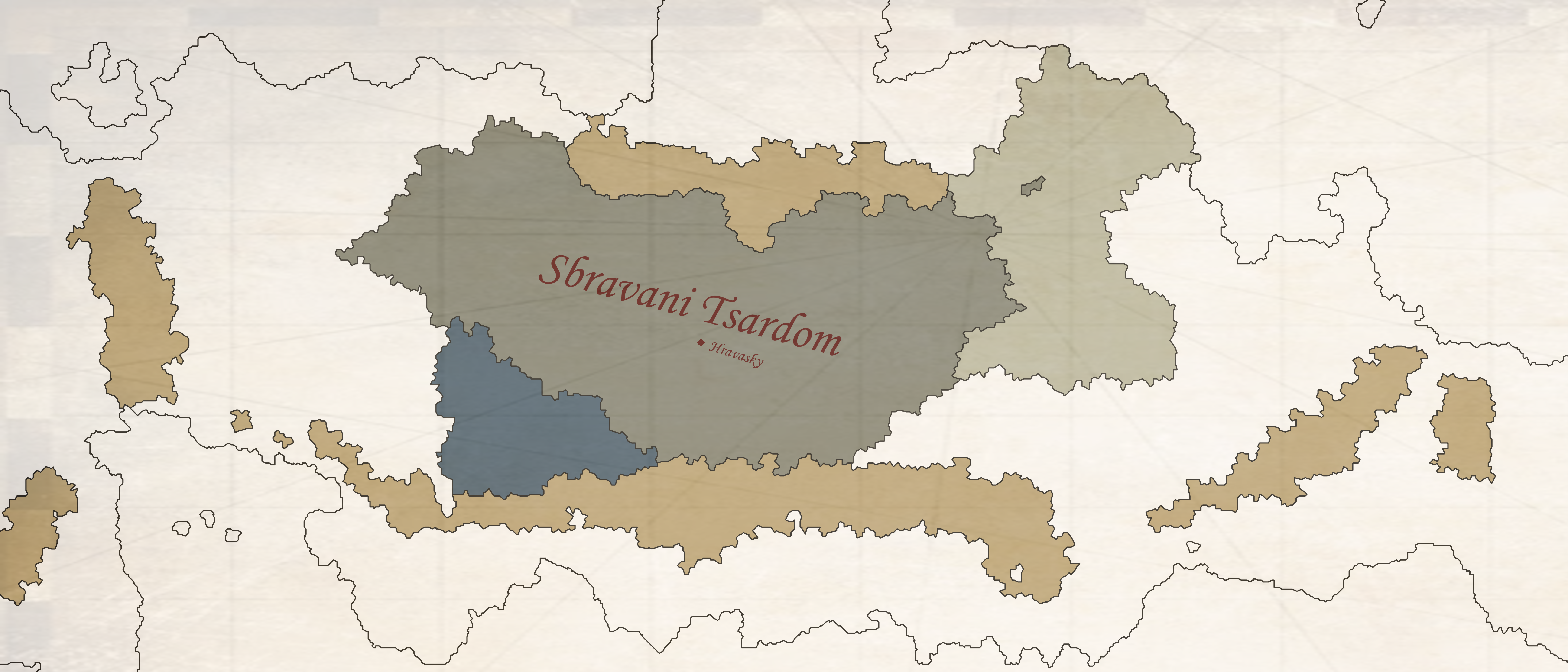
Full Name: Sbravanskoye Tsarstvo
Capital: Hravasky
Form of Rule: Absolute Monarchy
Faith: Himer Faiths
Within the heart of Mauva, there lies a great plain; entirely flat land, as far as the eye can see, desolate and bare. Little lives in that land, for what little does, does so greater than in any other land in the corners of the world. The Himmerian Plains are a vast steppe, whose few rivers borne from the vast mountains that border them in the north and south house plant life of enormous size. It is said that once, there had been animals whose stature was as great of the giants themselves, but, unable to quench the hunger of the maneaters, they were driven to extinction.
This event, our records say, is what first drove the Himmerians from out of their continental depths into the vast continent, a thousand years before the coming of the Splendorous Faith. For the millenia that followed, these giants, united under what they called their Eternal Kings, launched a campaign upon the unorganized and primitive human tribes of the continent, forging an empire which ranged from the very reaches of the Ascarpian Mountains, in the west, to the eastern coasts of the Valkes. Central Mauva was under their grip. The only ones to avoid this fate were the Vidrellians; ferocious hillmen who fought the giants with great abandon, fighting always to their last breath and with far greater numbers.
Throughout the ages, the Himmerian Yoke prevailed over the continent, humanity itself being kept as slaves and cattle for the Maneating Goliaths. The cruelty of their rule drove vast swathes of tribes not only towards the Mirevalian plains in the west, but north, towards the almost uninhabited forests of Straccia, and even further south, into the beastly wilds of Samica.
Yet even a reign such as theirs was not to last; their vast realm soon grew corrupt and decadent; unable to contain their cruelty towards their servants, they consumed themselves from within, waging slaughter upon their own with such ferocity that the very existence of their race came to be at risk. What little remnants remained were of no threat to the human race. They were, in almost their entirety, driven off the lands of the continent, their cities burnt and razed by those whom had served them. The Vidrellians, above all, took no little part in this matter, attacking them with such ferocity that it is said not a single stone of the ruins of old Himmeria remains in the eastern continent.
For the centuries that followed, the threat of the giant seemed as thought it had been eradicated, driven to the depths of the continent where they might have never again be seen. The Great Kingdom of Allegro, made from the descendants of the Uhrenics who had conquered Straccia around the time of the fall of the giants, rose to fill their position as the eminent power, exerting influence upon the countless human kingdoms that had been slowly forming through culture and trade.
Yet the threat of the giants was not to be forever slain; for they would soon make their return. It is not known what had occured to the giants within the depths of the plains; it is forbidden by their faith that a human should ever step foot within their heartlands, under the strict penalty of death through consumption. What we know is that amidst those that remained, one particular tribe of the giants rose amidst the rest: the Sbravani. Having united the giants once again, they forged an empire anew under their new 'Tsar', waging brutal wars of conquest against the nations of Mauva. It was these wars that triggered the downfall of Allegro, these wars that drove the Kings of Bagra to kneel in servitude to Mascaloma.
It had seemed to all that the days of Himmeria had returned, but to humanity's luck, this expansionism did not last...
Chapter VIII, Section II: Drovichs Confederacy
Full Name: Veče Drovičei
Capital: Raskow
Form of Rule: Noble Confederacy
Faith: Himer Faiths
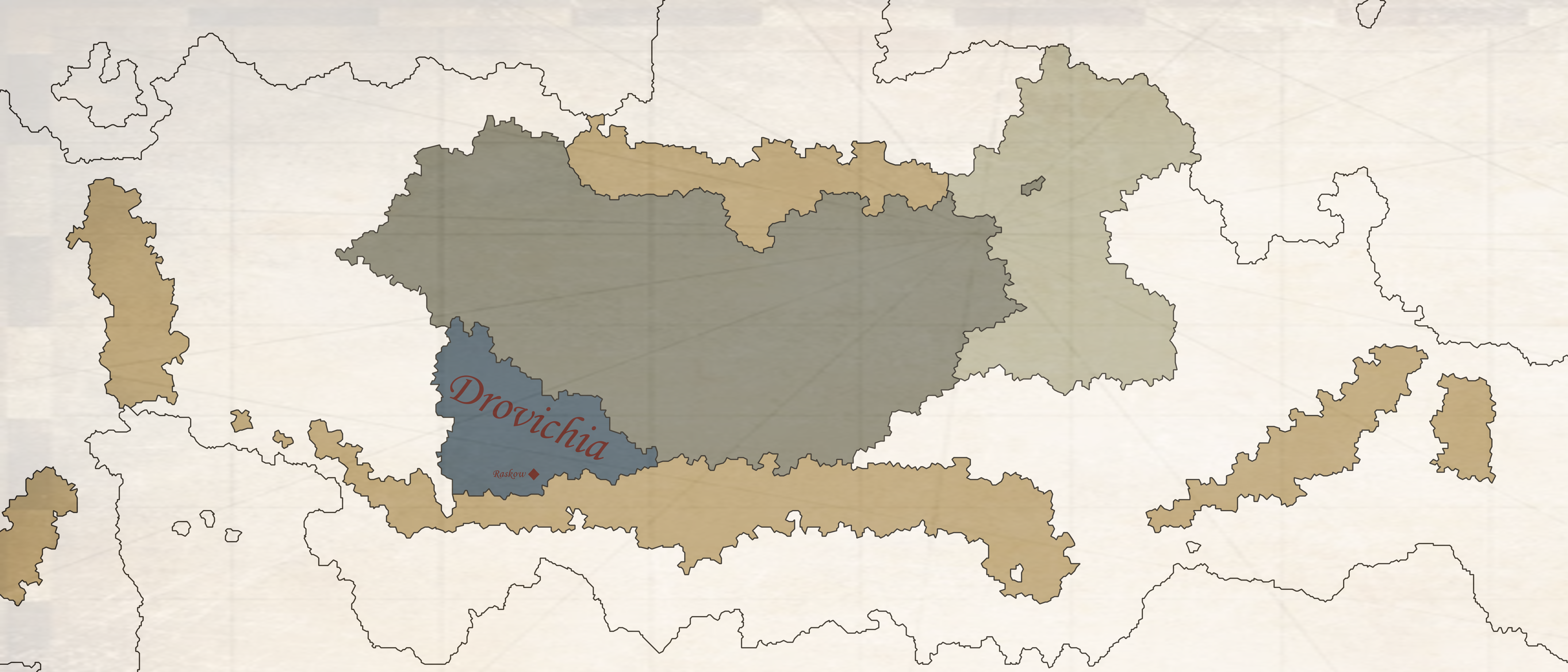
Most of what is known about the workings of the Sbravani come from but one single source; the Drovichs. Supposedly a warrior class that had risen to prominence after the fall of Himmeria, they had steadily grown in power over the centuries until the Sbravani unified the divided giants. It was not too long until the Tsars of Sbrava soon came after the one remaining element that preceded their power: the Drovich. Steadily, their powers were restricted decree by decree, until they could take it no longer: as the Tsar laid waste to Allegro, an event which would cause the disintegration of their kingdom, the Drovich rose up in revolt, estabilishing their Confederacy, an assembly which they came to name as Veche.
Though not succesful in overthrowing the Tsar as they had hoped, the Drovich were not defeated; fleeing to the southwestern corners of the plains, they soon found allies in the shape of the human kingdoms of Sudamedia and the Lily Coast, who themselves feared the rise of Old Himmeria. Devoid of allies save for the Halfgiants of Johan, the expansion of the Sbravani was curbed, and they arrived at the borders they hold to this very day.