Why Rooftop AC Units Struggle More During Phoenix Record Heat
Why Rooftop AC Units Struggle More During Phoenix Record Heat
Why Rooftop AC Units Struggle More During Phoenix Record Heat
Phoenix puts rooftop AC units under an extreme thermal load. Record heat pushes equipment past design limits. Failures arrive fast and compound. This article explains the physics, the parts that suffer, and the field fixes that hold up in the Valley of the Sun.
Rooftop units in Phoenix work in a harsher microclimate
On a 115°F afternoon, rooftop surfaces get far hotter than the air. Black membranes and dark pebbles can hit 150 to 170°F. Rooftop units sit inside that heat dome. The condenser coil breathes air that is 10 to 25°F hotter than street level. That head start raises condensing temperature, which drives up compressor discharge pressure. The compressor then pulls more amperage and runs longer. Oil film thins. Windings cook. Bearings dry. Each run cycle shaves useful life.
In Phoenix, this is daily reality from June to September. The North Mountain area gets sun from early morning. The Arcadia and Biltmore districts see reflective heat from stucco and glass. Paradise Valley Village has broad, exposed roofs. Ahwatukee Foothills roofs can trap heat against South Mountain at sunset. Across zip codes 85016, 85018, 85021, 85032, 85044, 85048, 85050, and 85085, rooftop units run hotter and longer than identical systems at ground level.
The physics that shorten RTU life in the Valley of the Sun
Every AC must reject indoor heat outdoors. A rooftop unit’s condenser coil does that job. In record heat, the coil rejects heat into air that is already superheated by the roof. The condensing temperature rises above 130°F. Head pressure goes past safe limits. The expansion valve (TXV) works harder to maintain superheat. The compressor pushes high mass flow at high ratio. That combination makes any weak part fail early.
Electrical parts do not like heat either. Start capacitors dry out faster above 140°F. Contactors pit and weld. Relay switches stick. UV and ozone age wire insulation. Vibration on a flat roof loosens crimp connectors. Small faults turn into no-cool calls on the first 118°F spike at 4 p.m.
Which components break first under Phoenix rooftop heat
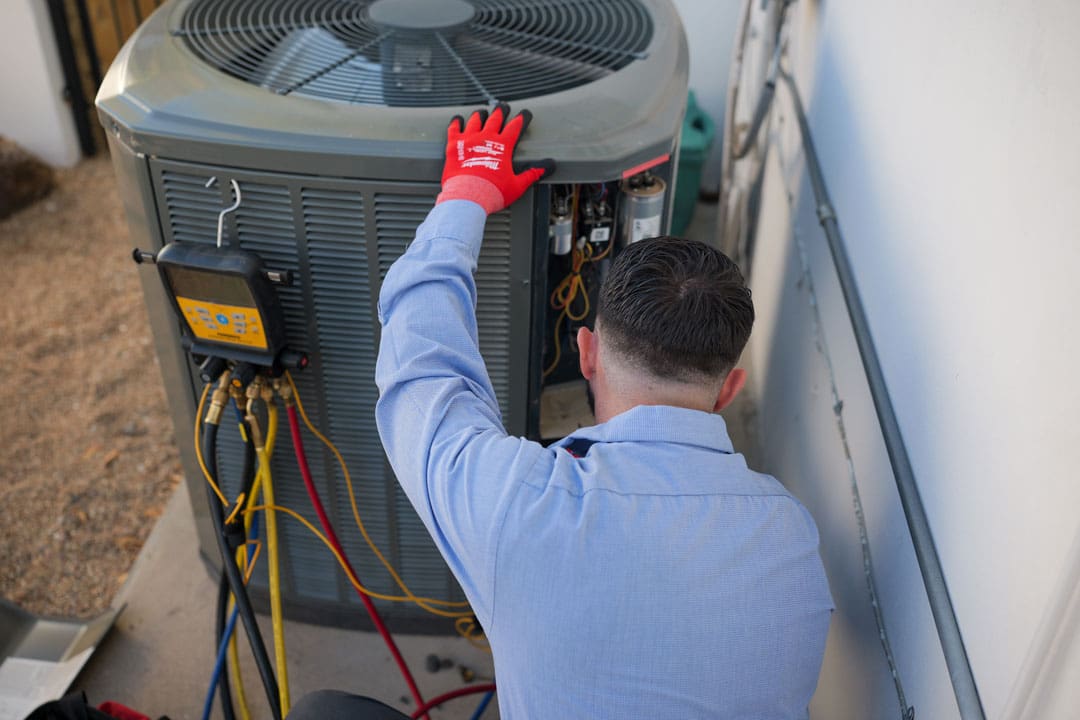
Technicians in Phoenix see a recurring pattern on rooftop units during heat alerts. First, condenser fan motors fail. Blades warp. Bearings seize. The motor overheats. Once airflow over the condenser coil drops, head pressure spikes. Then weak start capacitors blow. The compressor tries to start against high head and locks. Contactors burn as they chatter under load.
Refrigerant circuit stress follows. Elevated condensing temperatures push R-410A pressures near the relief zone. Micro leaks at service ports, Schrader cores, or braze joints open. Charge drifts low. Evaporator coils freeze at night. By late afternoon the unit blows warm air. Short cycling starts. The blower motor draws high amps due to static pressure and clogged MERV filters. The drain pan overflows as ice melts. The condensate safety switch trips and shuts the system down.
On package RTUs above Maryvale strip malls and Sunnyslope apartments, coil fin damage is common. Dust and monsoon grit cake the condenser coil. Oil and kitchen exhaust on mixed-use roofs glue that dust to fins. The result is a 15 to 30 percent drop in heat rejection right when Phoenix needs every BTU of capacity.
Why rooftop placement magnifies airflow problems
Rooftop units depend on clean, unobstructed airflow. Phoenix roofs are crowded. Solar arrays, parapets, and duct chases block intake. Hot discharge air recirculates back into the coil. We see this in Desert Ridge retail centers and across Glendale logistics roofs. A coil that breathes its own exhaust runs at a higher condensing temperature. That adds 5 to 15°F to the head pressure. The compressor runs louder. Vibration increases. Fasteners loosen. Copper refrigerant lines rub on sheet metal and develop pinhole leaks.
High static pressure and duct losses on older Phoenix buildings
Many Phoenix commercial roofs have legacy ductwork with thin insulation and poor sealing. Sun-baked ducts lose capacity before the air even reaches the register. Supply air at 55°F can pick up 5 to 10°F across a long rooftop run. The thermostat then calls longer. The blower motor runs at a higher tap to overcome static. This pushes current toward the motor full-load amps. On 2006 era rooftop units, that is a quick path to a squealing fan motor and a tripped breaker.
Split systems and heat pumps feel the heat too, but RTUs are hit hardest
Ground condensers sit near shaded yards in Arcadia and under carports in South Phoenix. They still run hot, but they breathe cooler air than the roof. Ductless mini-splits from Mitsubishi Electric and Daikin do even better in sunrooms because the outdoor units can sit in filtered shade. Rooftop package units carry all components in one hot shell. That is efficient for space use. It is not friendly to electronics and refrigerant circuits during a 117°F record stretch.
Common Phoenix rooftop failures Day & Night repairs during heat waves
Three service patterns recur during record heat. First is electrical failure. Faulty start capacitors and welded contactors stop the compressor. Second is airflow failure. Clogged condenser coils and failed fan motors cause high head and warm air. Third is refrigerant failure. Small R-410A leaks at copper lines or Schrader valves lead to low charge, frozen evaporators, and short cycling. These show up across Phoenix zip codes like 85032 and 85050 and in high-traffic corridors near Phoenix Sky Harbor International Airport and Chase Field.
Our technicians stock heavy-duty start capacitors and universal contactors on every truck. That reduces first-visit delays. Our NATE-certified team checks compressor amperage, measures superheat and subcool, and tests TXV function under load. We verify thermostat calibration and staging logic. We clear clogged condensate drain lines and replace safety switches as needed. We do this on central air conditioners, rooftop units, package units, ductless mini-splits, heat pumps, and split systems from Trane, Carrier, Lennox, Goodman, Rheem, York, Bryant, American Standard, Daikin, and Mitsubishi Electric.
Why Phoenix heat fries capacitors and contactors faster
Capacitors are chemical devices. Heat accelerates dielectric breakdown. At 150°F shell temperature, many start capacitors lose 20 percent of their rating within a season. Undercharged capacitors cannot deliver the necessary phase shift. The compressor stalls at start and draws locked-rotor amps. Contactors try to close on that surge. The arc pits the contacts. After several tries, the contacts weld. The unit stops responding to the thermostat, or it short cycles with every attempt.
On Phoenix rooftops near Camelback Mountain or Papago Park, metal enclosures get far hotter than the air. We often measure 160°F inside control compartments at 3 p.m. A contactor rated for 140°F ambient is beyond its design envelope. We replace these with high-temperature contactors and verify the enclosure has ventilation and proper gasket seals.
Refrigerant behavior in 115°F rooftop air
R-410A works at higher pressures than legacy R-22. That is not a problem in moderate climates. In Phoenix, with rooftop inlet air 125 to 140°F, liquid line pressures climb rapidly. Oil migration becomes unstable on start-stop cycles. Minor restrictions at the filter drier or TXV screen produce a large pressure drop. The evaporator starves. Superheat spikes. The compressor runs hot. If the charge is slightly low from a micro leak, the evaporator coil can still freeze overnight under lighter load, then blow warm in the afternoon. That pattern confuses owners. Our technicians confirm with clamp thermometers and line set pressure readings, then correct charge after leak repair.
Dust, monsoon debris, and coil fouling across Maricopa County
Phoenix has an arid desert climate. Dust storms hit the Valley quickly. Fine particulates clog condenser fins on RTUs in Glendale, Peoria, and Tempe. Restaurants near Footprint Center and Chase Field add grease aerosols that stick to coils. Coil fouling raises condensing temperature and amps. We see a 10 to 20 percent capacity drop on a coil that looks only slightly dull. Annual coil cleaning is not a luxury here. It is required to keep SEER performance close to nameplate.
How roof reflectivity and shading change your RTU’s survival odds
A bright white roof at a Biltmore office runs cooler than a dark asphalt roof in Maryvale. A simple shade screen on the west exposure of a rooftop unit can knock 10°F off the control panel temperature at 5 p.m. We also see improved performance when the discharge air can blow clear of parapets. If the unit exhausts into a corner, hot air recirculates. We re-angle fan guards and recommend wind baffles where tests show recirculation.
Why airflow inside the building matters to the rooftop unit
Air handlers and ducts inside the building set the load that the rooftop unit must clear. In older Phoenix homes in 85018 and 85021, return plenums can be undersized. MERV filters can be over-restrictive. The blower motor strains. Evaporator coils frost. That pushes liquid floodback at start. The compressor main bearing and reeds suffer. We balance airflow and static pressure, select the right MERV filters, and tune blower speeds to reduce these risks.
Owner and facility manager checks that help during a heat alert
Small actions keep a rooftop unit alive during a heat wave. These are safe for owners and facility managers and help stabilize operation until a technician arrives.
- Inspect and replace dirty return filters with the correct MERV rating.
- Clear debris and weeds from around rooftop condenser intakes.
- Set thermostats to a steady temperature to reduce short cycling.
- Open blocked supply registers to lower static pressure.
- Verify the condensate drain is flowing at the roof scupper or drain point.
These steps do not replace technical service. They buy time and can prevent a hard lockout during a 115°F afternoon in Paradise Valley or Desert Ridge.
How Day & Night stabilizes rooftop units in peak Phoenix heat
Day & Night Air Conditioning, Heating, & Plumbing is built for the Phoenix climate. The company serves homeowners and property managers across Phoenix, Scottsdale, Tempe, Mesa, Chandler, Glendale, Peoria, Gilbert, and Paradise Valley. Dispatch is 24/7. The team handles emergency air conditioning repair near me calls from condos near the Heard Museum to warehouses off I‑17 near North Mountain.
Service begins with deep diagnostics. Technicians measure compressor inrush current, running amps, and discharge line temperature. They test start capacitors under load. They examine contactor faces for heat pitting. They verify TXV operation and adjust superheat targets for rooftop conditions. They log static pressure, check blower motor health, and confirm thermostat staging. They scan condenser and evaporator coils for hotspots with thermal imaging during record heat. They document subcool readings to verify charge. They repair or replace burned out compressors only after root causes are corrected, which prevents repeat failure.
Trucks roll with heavy-duty start capacitors, universal contactors, relay switches, fan motors, MERV filters, copper refrigerant line repair kits, and condensate safety switches. That parts depth speeds first-visit restoration. The goal is central air conditioning restoration under real Phoenix load, not a band-aid that fails at 6 p.m.
Specific rooftop design upgrades that work in Phoenix
Upgrades can move a rooftop unit from fragile to stable. High-efficiency condenser fan blades reduce amp draw at peak head pressure. ECM fan motors tolerate heat better than PSC motors. Coil coatings protect against salt and dust adhesion, which helps near Papago Park and the airport corridor. Oversized condenser coils or add-on condenser fan cycling kits trim head pressure during dusk heat soak. A sun shield over the control compartment drops component temperatures. Where the roof layout allows, moving the unit out of corner recirculation zones cuts discharge re-entrainment.
For North Phoenix sunrooms and casitas, ductless mini-splits from Mitsubishi Electric or Daikin deliver strong comfort with lower rooftop exposure. For large homes in Arcadia or Biltmore, high-efficiency Trane or Carrier heat pumps with variable speed compressors handle load swings better during monsoon humidity spikes. Commercial RTUs in Maryvale benefit from demand ventilation controls, which prevent over-ventilation during 118°F peaks.
Maintenance cadence for rooftop units under Phoenix load
Once per year is not enough in Phoenix. Rooftop units need a spring start-up and a mid-summer check. In the spring, coils should be cleaned, contactors inspected, and refrigerant charge verified under moderate load. In July or August, a mid-season visit should re-clean coils, retest capacitors, check blower and condenser fan amps, and confirm condensate flow. Buildings near Camelback Mountain see more dust. They benefit from quarterly coil rinses. Retail sites near Chase Field and Footprint Center should schedule grease-specific coil cleaners due to kitchen exhaust in the air stream.
Day & Night offers HVAC maintenance structured for Maricopa County. It addresses the rooftop loads that Phoenix imposes. The result is fewer emergency calls and lower total energy bills on utility peaks.
Energy and comfort losses you can feel during a heat dome
Clients describe a set of symptoms that point to rooftop stress. First, the air feels lukewarm in the late afternoon. Second, the system runs long without reaching setpoint. Third, the thermostat shows wide swings. Fourth, the energy bill jumps 20 to 40 percent versus May. Fifth, water drips from the overflow instead of the primary condensate line. Each symptom links to a technical cause on the roof, or in the ducts, or both.
What “AC repair Phoenix” means during a record-setting week
Calls spike citywide when Phoenix hits a streak of 115 to 118°F days. Our dispatch centers prioritize no-cool cases and homes with health risks. We route trucks across 85001, 85018, 85032, 85044, 85048, and 85050 using real-time heat and outage maps. The goal is fast central air conditioning restoration. Same-day service is standard. Night calls are common. The phrase emergency air conditioning repair near me is not marketing here. It is the daily use case from South Mountain to Sunnyslope.
Clear signals your rooftop unit is overheating
Several small signs point to rooftop distress. If you catch them early, repairs stay minor and costs stay controlled.
- Short cycling in late afternoon with warm supply air.
- Ice on the copper refrigerant lines at dawn.
- Squealing or grinding from the condenser fan motor.
- Breaker trips when the compressor tries to start.
- Water from secondary or rooftop overflow drains.
If you notice these in Arcadia, Desert Ridge, or Paradise Valley Village, book service before the next heat spike. Failures cascade quickly in Phoenix heat.
Brands and equipment Day & Night services across Phoenix
Technicians are factory-trained to service Trane, Carrier, Lennox, Goodman, Rheem, York, Bryant, American Standard, Daikin, and Mitsubishi Electric. They support central air conditioners, rooftop units, package units, heat pumps, ductless mini-splits, and split systems. Using OEM parts preserves SEER ratings and keeps manufacturer warranties intact when required by policy. This matters for high-efficiency heat pumps in Desert Ridge and for Carrier rooftop package units over Biltmore office suites.
Commercial RTU realities from Maryvale to Mesa
Commercial rooftops see heavy cycling and wider ventilation swings. Mixed-use buildings near downtown Phoenix draw outside air through dusty intakes. Hypermarkets in Mesa and Chandler run long hours. Distribution centers in Glendale and Peoria have high internal loads. These rooftop units suffer burned contactors, failed blower belts where used, clogged TXV screens, and high head trips. Day & Night’s commercial HVAC repair process includes duct leakage tests, economizer logic checks, damper calibration, and airflow balancing. The goal is stable capacity during on-peak utility windows and after-hours warehouse shifts.
Why plumbing matters during rooftop AC maintenance
Phoenix roofs lack shade and run hot. That raises condensate production on humid monsoon nights. Clogged condensate drain lines trigger float switches and false no-cool calls. Day & Night’s plumbing technicians clear condensate blockages, replace cracked drain pans, and route lines to proper scuppers or drains. Cross-discipline service helps avoid repeat trips during peak weeks.
Local proof points that matter to Phoenix homeowners and managers
Day & Night holds an A+ rating with the BBB and maintains Licensed, Bonded, and Insured status under ROC #133378. NATE-certified technicians arrive in professional uniforms and carry the parts needed for first-visit repairs. Fixed-price guarantees remove guesswork. Same-day service is normal across Phoenix and its neighboring cities. These signals matter when temperatures hit 116°F and every hour counts.
Field anecdote: Arcadia rooftop unit rescued before failure
An Arcadia homeowner in 85018 reported warm air from 3 to 7 p.m. The rooftop package unit was five years old. On arrival, head pressure sat 60 psi high. The condenser coil looked clean from the curb. Up close, fins were matted with dust and lint. The start capacitor had drifted 18 percent below rating. Contactors showed mild pitting. We performed a deep coil clean, replaced the capacitor with a heavy-duty unit, and dressed the contactor faces. We corrected charge to restore subcool to spec. Supply air dropped from 66°F to 54°F under the same load. The unit held 74°F indoors through a 116°F afternoon. That visit prevented a hard failure on the next spike.
Facility case: Maryvale retail strip with repeat warm-air complaints
A property manager reported three RTUs with warm air between 4 and 6 p.m. We measured recirculation at two units positioned in a parapet corner. Discharge air looped back into the condenser. Head pressure rose fast as the sun hit the west wall. We rotated fan guards, added wind baffles, and cleaned coils with a foaming agent. We installed sun shields over control compartments. Contactors and capacitors were replaced with high-temperature parts. Complaints stopped even as Phoenix hit a 117°F day the next week.
What to expect during an emergency service call
Dispatch confirms address and access. A NATE-certified technician arrives with rooftop safety gear. Diagnostics focus on compressor and fan motor health first. Electrical tests include start and run capacitor value checks and contactor continuity. Refrigerant tests include superheat and subcool. Airflow tests include coil delta-T and static pressure. If the unit is blowing warm air, we check for frozen evaporator coils and clogged condensate drains. If short cycling is present, we test thermostat placement and staging. We provide a fixed-price repair quote on the spot. Most parts are on the truck. If a burned out compressor is confirmed, we stabilize the system, review options, and schedule compressor replacement with crane coordination as needed.
Why rooftop AC units struggle more during Phoenix record heat
The summary is simple. Rooftop units in Phoenix breathe hotter air, sit on hotter surfaces, and run under longer, heavier loads. Components age faster. Electrical parts fail sooner. Refrigerant circuits operate near limits. Airflow is harder to maintain. Dust and grease foul coils. Ducts lose cold before it reaches the space. Each risk amplifies the others. That is why AC repair Phoenix is a critical service during record heat, and why emergency air conditioning repair near me is more than a search term for Valley residents. It is the safety net that keeps homes and businesses livable.
Service coverage with tight local response
Day & Night covers Phoenix, AZ, with rapid dispatch across 85001, 85016, 85018, 85021, 85032, 85044, 85048, 85050, and 85085. Technicians know Arcadia’s older ductwork, Biltmore’s rooftop layouts, Desert Ridge’s planned communities, and North Mountain’s sun exposure. Crews serve properties near Phoenix Sky Harbor International Airport, Camelback Mountain, Papago Park, the Heard Museum, the Arizona State Capitol, Footprint Center, and Chase Field. Neighboring service areas include Scottsdale, Tempe, Mesa, Chandler, Glendale, Peoria, Gilbert, and Paradise Valley. That neighborhood knowledge shortens fix times and raises first-visit success.
Parts, tools, and methods that solve Phoenix rooftop pain points
Our approach is matched to the climate. We stock high-temperature contactors, heavy-duty start capacitors, OEM blower motors, condenser fan motors, MERV filter ranges, filter driers, and TXV kits. We carry nitrogen for pressure testing, digital manifolds for accurate subcool, and coil cleaning systems suited for rooftop grease and dust. We protect condensate drains with cleanouts and sensors. We log operating data under peak load to verify performance. We fix the root cause and confirm system stability before we leave.
The cost of waiting during a Phoenix heat streak
Delay raises costs. A weak start capacitor can be a simple same-day fix. Wait a week, and the compressor may fail after repeated hard starts. A dusty coil that adds 20 psi to head pressure can be cleaned in an hour. Wait, and the condenser fan motor fails or a high-pressure trip damages terminals. An ice-blocked evaporator coil can be resolved with airflow corrections. Wait, and liquid floodback can harm the compressor. In Phoenix, small problems turn into major repairs within days during record heat.
Why homeowners and managers choose Day & Night during record heat
Clients choose Day & Night because the company is built around Phoenix’s demands. The team is NATE-certified, BBB A+ rated, and Licensed, Bonded, and Insured under ROC #133378. Crews arrive in professional uniforms and respect property. Pricing is fixed and explained up front. The company supports residential cooling solutions and commercial HVAC repair with equal depth. The trucks carry the parts that solve rooftop failures on the first visit whenever possible.
Ready for reliable rooftop AC help that holds up to 115°F plus?
Do not wait for a lockout at 6 p.m. When the roof is still 150°F. Book AC repair Phoenix with Day & Night Air Conditioning, Heating, & Plumbing. Ask for 24/7 emergency air conditioning repair near me if the system is down. Mention the $50 off AC repair coupon. Request same-day service if you live in Arcadia, Biltmore, Desert Ridge, Maryvale, North Mountain, Paradise Valley Village, South Mountain, Sunnyslope, or Ahwatukee Foothills. The team services all major brands including Trane, Carrier, Lennox, Goodman, Rheem, York, Bryant, American Standard, Daikin, and Mitsubishi Electric.
Clear conversion steps:
- Call or schedule online for immediate dispatch. 2) Share your zip code and symptoms such as AC blowing warm air, short cycling, or frozen evaporator coils. 3) Approve a fixed-price repair from a NATE-certified technician. 4) Restore cool, stable air before the next heat spike. Day & Night is ready to help across Maricopa County and the Valley of the Sun, day and night.
Day & Night Air Conditioning, Heating, & Plumbing — 24/7 AC Repair Phoenix, AZ. ROC #133378. NATE-Certified. BBB A+ Rated. Serving Phoenix, Scottsdale, Tempe, Mesa, Chandler, Glendale, Peoria, Gilbert, and Paradise Valley.
Day & Night Air Conditioning, Heating & Plumbing
3669 E La Salle St,
Phoenix, AZ 85040
AZ Licenses: ROC335883 | ROC335884
Google Maps | Facebook | Instagram | LinkedIn