The Hidden Cost of Ignoring Strange Noises from Your AC Unit
The Hidden Cost of Ignoring Strange Noises from Your AC Unit
The Hidden Cost of Ignoring Strange Noises from Your AC Unit
In Phoenix, AZ, air conditioning is a life-safety system. Summer highs pass 110°F across the Valley of the Sun, and homes from Arcadia to Ahwatukee depend on steady cooling. When an AC starts to squeal, buzz, click, hiss, or bang, the sound tells a story. Each tone maps to a component under stress. Ignoring that signal can turn a small part swap into a compressor failure and a multi-thousand-dollar outage. The difference often comes down to hours, not weeks.
Day & Night Air Conditioning, Heating, & Plumbing sees this pattern every July and August. A quick fix on a start capacitor could have saved a rooftop package unit on a shop near Camelback Mountain. A hissing leak caught early could have protected a heat pump in Desert Ridge. The team serves residential and commercial properties across Maricopa County with rapid diagnostics and factory-authorized repairs. The focus here is simple: explain what those noises mean, why they cost far more if ignored, and how fast action protects comfort, equipment life, and power bills.
Why strange AC noises in Phoenix carry a high price tag
Desert heat pushes every part of a cooling system to its limit. The compressor runs long cycles. Condenser coils face dust. Airflow drops as filters clog with desert particulates. When a part begins to fail under this load, it voices the problem. A squeal from a blower motor bearing, a buzz from a struggling contactor, or a click without a start from a weak capacitor all carry real cost risk. In Phoenix heat, minor faults ramp to major damage fast.
Consider a start capacitor that cannot deliver the kick a compressor needs. Each failed start overheats the windings. That heat degrades insulation and pulls high amperage. In a week of 115°F afternoons, those failed starts can burn out a compressor. Replacing a capacitor runs a fraction of a compressor swap. The cost gap is large, and the downtime risk is larger, especially for businesses that rely on rooftop units (RTUs) to keep staff safe and customers comfortable near the Footprint Center or Chase Field.
What the common AC noises usually mean
Sound is not a guess in HVAC. It is diagnostic data. Here is how trained technicians in Phoenix interpret the most frequent noises in central air conditioners, heat pumps, rooftop package units, ductless mini-splits, and split systems.
- Squealing or screeching: Often a blower motor bearing, a belt issue on older air handlers, or a condenser fan motor under high friction. In many cases, lubrication fails, or the motor draws excessive amperage.
- Buzzing or humming: Common with weak start capacitors, pitted contactors, failing relay switches, or loose transformer mounting. A compressor that hums but does not start is a red flag.
- Clicking with no start: Frequently a control board or contactor issue, weak capacitor, or thermostat signal fault. Repeated clicking stresses the compressor and contact points.
- Hissing or bubbling: Indicative of a refrigerant leak, often R-410A, near the evaporator coil, condenser coil, or a flare connection on copper refrigerant lines. Low charge leads to frozen evaporator coils and warm air.
- Banging or clanking: Suggests a loose blower wheel, a misaligned condenser fan blade, or a failing compressor crankshaft. This sound points to urgent mechanical risk.
A single noise can have multiple sources, which is why trained diagnostics matter. For example, a squeal may be a motor bearing, but it can also be a blower wheel scraping an out-of-round housing due to heat warping. In Phoenix attics, heat speeds up material fatigue. The right test set with clamp meters, megohm meters, and gauges keeps guesses out of the process.
How ignoring noises raises bills and causes secondary damage
Every noisy symptom has a cost path. Some costs are direct, like a motor or capacitor. Others show up as collateral damage: higher energy use, water leaks, or even code violations in commercial sites near Phoenix Sky Harbor International Airport.
Energy consumption goes up first. A compressor that struggles to start can pull 2 to 3 times its normal inrush current. A blower motor with bad bearings runs hot and wastes watts. Across a Phoenix cooling season, that waste can add hundreds of dollars to utility bills for a single home in 85050 or 85032. For a small shop with two RTUs in Paradise Valley Village, the waste scales fast.
Water damage follows airflow and refrigerant faults. Low airflow over the evaporator coil creates deep freeze. Ice on copper refrigerant lines can extend outside the air handler. When it melts, condensate can overwhelm the drain pan. If the condensate drain line is already clogged, water overflows. Ceilings stain, drywall sags, and mold risk rises in Maryvale or Sunnyslope homes with older ductwork. A $200 drain clearing turns into a $2,000 ceiling repair if left alone.
Compressor damage is the big ticket. A burned-out compressor in a split system or rooftop unit can cost more than half the price of a full system change-out. In Phoenix, a compressor replacement during peak season also means longer lead times and gaps in cooling during 110°F afternoons. For families in South Mountain or businesses near the Arizona State Capitol, that downtime is not an option.
Warranty loss sits in the background. Many brands, including Trane, Carrier, Lennox, Goodman, Rheem, York, Bryant, American Standard, Daikin, and Mitsubishi Electric, expect prompt service when a fault appears. Continued operation with known noises can void coverage. Using non-OEM parts can impact SEER performance and the manufacturer’s warranty requirements. Certified service protects both efficiency and coverage.
Why Phoenix heat accelerates failures that start with sound
The Valley’s arid climate strains central air conditioners, heat pumps, ductless mini-splits, and rooftop package units. Ambient air at 115°F reduces the condenser’s ability to reject heat. Head pressures spike. Oil thins. Electrical components sit in hot metal housings and bake. Contactors arc more. Insulation on windings degrades faster. Any small imbalance becomes a loud one. A squeal in March becomes a failure in July. Dust from Papago Park winds drives coil fouling and makes condenser fan motors work harder. That is why filtered inlets, high-MERV filters matched to blower capacity, and timely coil cleaning are not optional.
Residential systems in Arcadia, Biltmore, and Ahwatukee Foothills also face attic temperatures that top 140°F. An air handler in that space feels like a kiln. Electronic boards and relay switches degrade faster. Wiring insulation can get brittle. Rooftop units on strip malls in Glendale, Peoria, or Tempe sit in direct sun all day. The stress shows up first in the sounds those systems make when a part is near the end.
From noise to diagnosis: how a NATE-certified tech reads the signs
Day & Night deploys a structured workflow that turns sounds into data. A tech listens on arrival, notes the tone, and logs the operating environment. The thermostat is checked for correct staging and calibration. The air filter is inspected. The blower door is opened for a look at the air handler. The evaporator coil frost pattern is confirmed if present. Pressure readings go on the gauges for R-410A systems, while superheat and subcooling numbers point to refrigerant charge and expansion valve health.
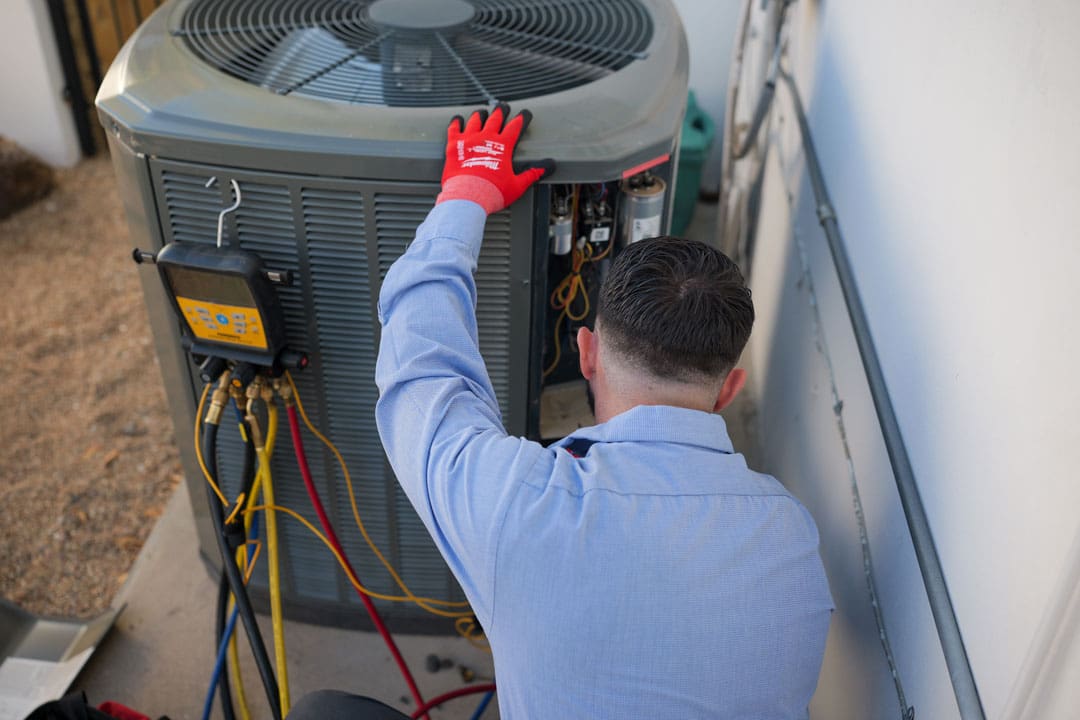
Electrical readings come next. A clamp meter records starting and running amperage on the compressor, the condenser fan motor, and the blower motor. If a hum with no start is heard, the start capacitor is tested on microfarads and replaced if out of tolerance. Pitted contactors get swapped. The trucks carry heavy-duty start capacitors and universal contactors for first-visit fixes. If the noise links to a blower motor bearing, shaft play is checked and end bell temperature is measured. If bearings are gone, the motor is replaced with a matched RPM and HP unit to maintain airflow.
Hissing noises trigger a leak check. Soap tests and electronic sniffers locate the point. Many Phoenix homes with copper refrigerant lines routed through hot attics see leaks at flare connections or rubbed spots near hangers. Small leaks reduce charge. Low charge creates coil freeze. The result is warm air from the supply vents, short cycling, and icing on the suction line. Leaving that leak unaddressed burns kilowatts and shortens compressor life. Correct repair involves fixing the leak, pulling a deep vacuum, weighing in the correct R-410A charge, and verifying performance.
How much waiting really costs: practical numbers from Phoenix calls
Numbers help set priorities. Each home and building differs, yet patterns in Phoenix are clear.
A weak start capacitor that hums and clicks can be a same-day repair. Left alone it may cause a locked rotor and burn the compressor. That is a swing from a modest part and labor bill to a major investment. A clogged condensate drain line can trigger safety switches that shut off cooling during a heat spike. Clearing and treating the line is simple. Ignore it and risk ceiling damage or air handler corrosion, which raises costs.
Commercial rooftop units near downtown and Scottsdale face a larger impact. A noisy condenser fan motor on a busy Saturday near the Heard Museum or Chase Field can push head pressures sky high. That strains compressors. Replacing one fan motor is a fixed, predictable cost. Replacing a compressor on an RTU while the business is down leads to lost revenue and emergency crane schedules. The hidden cost often exceeds the repair itself.
Why “emergency air conditioning repair near me” matters in the Valley
In Phoenix, an AC failure is not an inconvenience. It is a hazard. Infants, older adults, and pets cannot tolerate hours without cooling during peak heat. Many medications have storage limits. Electronics in home offices near Biltmore or Desert Ridge overheat. Same-day response protects health and property. That is why residents search for emergency air conditioning repair near me, and why Day & Night runs 24/7 emergency dispatch across zip codes 85001, 85016, 85018, 85021, 85032, 85044, 85048, 85050, and 85085. The fleet coverage reaches Scottsdale, Tempe, Mesa, Chandler, Glendale, Peoria, Gilbert, and Paradise Valley as well.
Fast arrival is not enough. Stocked trucks matter. Carrying start capacitors, contactors, blower motors, MERV filters, relay switches, and universal fan motors lets a technician restore cooling on the first visit. Factory-authorized access to Trane, Carrier, Lennox, Goodman, Rheem, York, Bryant, American Standard, Daikin, and Mitsubishi Electric parts protects SEER ratings and warranties. In Phoenix heat, first-visit resolution reduces exposure and stress.
Real examples from Phoenix neighborhoods
Arcadia. A central air conditioner in a 1960s ranch started to squeal at the indoor unit. The homeowner noticed a slight rise in energy bills. The squeal grew over two weeks. A NATE-certified tech found a blower motor bearing near failure and a partially collapsed return duct liner. The motor drew high amps and screamed under load. Replacing the motor and restoring the return path solved the sound and cut runtime. Waiting longer would have overheated the motor and risked board damage.
Desert Ridge. A heat pump emitted a faint hiss near the air handler. Supply air felt warmer. The tech found a small R-410A leak at a flare connection. The evaporator coil was icing, and the suction line had frost. The fix was straightforward: repair the flare, pull a deep vacuum, weigh in the charge, and check superheat. The system stabilized. Leaving the leak would have led to short cycling, high bills, and possible compressor overheating.
Paradise Valley Village. A rooftop package unit on a boutique shop started to buzz and click. The compressor did not start. The store manager called for AC repair Phoenix at 6 pm. The tech arrived with a stocked truck. Testing showed a weak start capacitor and a pitted contactor. Both parts were replaced on the roof. The unit started and cooled the space within an hour. Without the parts on hand, the call would have rolled to morning, risking product damage and a hot opening shift.
Appliance types and how noise points to specific failures
Central air conditioners in Phoenix homes often use split systems with an outdoor condenser and an indoor air handler. Squeals and rattles indoors usually relate to the blower motor, blower wheel, or duct resonance. Outdoor buzz indicates electrical stress at the contactor or compressor. Heat pumps add reversing valves that can click or whoosh as they shift stages. Ductless mini-splits use inverter-driven compressors and ECM fans that run quietly. Any new grinding or ice crackle in a mini-split needs quick attention, as small refrigerant charges leave little margin. Rooftop units on commercial sites have large condenser fan arrays. A single out-of-balance blade can make a roof sound like a drum. That is a warning to service the fan before bearing damage spreads metal through the coil.
Package units on Phoenix roofs also face thermal cycling. Metal expands and contracts all day. Screws walk out. Panels rattle and produce a loud hum that managers hear inside. While some of that is cosmetic, loose panels can let in dust and rain, which shortens board life. Securing panels and replacing gaskets during maintenance keeps sound down and protects components.
The role of each core component when noises start
HVAC compressor. The compressor is the heart of the system. A hum with high amp draw but no start points to a weak start capacitor or bad start winding. Knocking inside the compressor suggests internal mechanical failure. That is urgent.
Condenser coil. A whistling or high-pitched tone outdoors sometimes indicates airflow obstruction. Cottonwood fluff and desert dust can clog fins. High head pressure follows. Fans work harder and growl. Cleaning restores normal tone and pressure.
Blower motor. Squeals, rattles, and scraping noises inside often point to failing bearings, a loose blower wheel set screw, or a bent wheel. Left alone, vibration can crack the housing or damage the control board.
Expansion valve (TXV). A misbehaving TXV can chatter as it hunts. The system may hiss and produce uneven cooling. Superheat and subcooling readings confirm the diagnosis.
Air handler and ductwork. Loose ducts boom and pop with static pressure swings. Filter bypass whistles as air races through gaps. High MERV filters raise static pressure. The blower speeds up and gets louder. Matching filter and fan settings is key.
Contactors and relay switches. Repeated clicking without start points to pitted contacts, weak coils, or control voltage issues. Buzzing from the contactor is common with low voltage or failing coils.
MERV filters. Clogged filters create a telltale rush and a higher pitch at the return. That high pitch often pairs with icing at the evaporator coil and sweaty supply vents on humid monsoon days.
Evaporator coil. Ice crackles and pops during thaw. That is a symptom of low airflow or low refrigerant. A frozen coil starves the home and strains the compressor.
Copper refrigerant lines. Rubbing sounds in walls can be refrigerant lines touching framing. As the system cycles, lines expand and move. Foam isolators stop the rub and the noise.
Maintenance, tuning, and the “sound baseline” for Phoenix homes
Quiet systems save money. During HVAC maintenance, a tech listens and documents a sound baseline. That gives a reference for future visits. Bearings get quieter with correct lubrication on applicable motors. Dirty condenser coils growl; clean coils hum softly. A healthy blower has a steady, low pitch. A shift in that tone during a future visit flags a pending issue. In Phoenix, a baseline helps catch early signs between punishing heat waves.
Maintenance also addresses Phoenix-specific stress. Condenser coil cleaning is done more often. Condensate drain lines are flushed and treated because Monsoon humidity drives more water through pans. Thermostat settings are checked for sensible staging to avoid short cycling. Return air paths are measured for static pressure to keep filters within the blower’s capacity. Drain safety switches are tested to prevent ceiling damage in homes across 85018 and 85044. These steps keep systems quiet and efficient.
Brands, parts, and how proper service protects performance
Different manufacturers use different control strategies and parts. Trane and American Standard share components but differ in model controls. Carrier and Bryant share many boards and contactors. Lennox has distinct motor controls. Goodman and Rheem have common, readily available contactors and capacitors. York packs components tightly in some condensers, which makes access more precise. Daikin and Mitsubishi Electric run inverter-driven compressors in many ductless and variable-speed systems, where incorrect diagnostics can create new faults. Using genuine OEM parts where required maintains the SEER rating and the manufacturer’s warranty.
Day & Night provides factory-authorized service across all major brands. For North Phoenix sunrooms or casitas where duct runs are impractical, Mitsubishi ductless mini-splits offer excellent control with quiet operation. A squeak from an indoor cassette or an outdoor inverter that starts to rattle deserves fast service because these systems run near-silent when healthy. Noise stands out for a reason.
Service coverage across Phoenix with location-specific response
Coverage spans Phoenix and the wider Maricopa County corridor, including Arcadia, Biltmore, Ahwatukee Foothills, Desert Ridge, North Mountain, Paradise Valley Village, Maryvale, South Mountain, and Sunnyslope. Calls near Camelback Mountain, Papago Park, Chase Field, the Heard Museum, and the Arizona State Capitol get routed to the closest truck. Rapid dispatch reaches North Phoenix zip codes 85032, 85050, and 85085, as well as 85001, 85016, 85018, 85021, 85044, and 85048. Neighboring cities receive the same attention: Scottsdale, Tempe, Mesa, Chandler, Glendale, Peoria, Gilbert, and Paradise Valley. This density shortens drive time and gets cooling back online sooner.
When a repair is wise and when replacement is smarter
Noise can be the first sign that a system is near end of life. A cracked compressor shell, repeated capacitor failures, and frequent contactor replacements point to broader wear. Units that use older refrigerants or have low SEER ratings can consume far more energy than current options. In Phoenix, where run hours are high, efficiency differences pay back faster. A trained tech explains repair costs and life expectancy. If the compressor is shorted and the coil is corroded, a change-out may make sense. If a blower motor bearing squeals on a system with a strong compressor and a clean coil, a repair is the right call.
If the AC starts to sound wrong, do this first
Quick action prevents damage. Homeowners and facility managers can take a few safe steps before a tech arrives. These steps can protect the compressor, reduce overflow risk, and preserve evidence of the fault.
- Set the thermostat to off for cooling if banging or grinding is present, then switch the fan to on to thaw a frozen coil.
- Check the air filter and replace it if dirty. A clogged filter causes whistling and ice.
- Look for water at the air handler or ceiling return. If water is present, keep the system off and call for service.
- Note the sound type and timing. Does it occur at start-up, during steady run, or at shutdown?
- Search AC repair Phoenix or contact Day & Night for 24/7 emergency air conditioning repair near me to dispatch a NATE-certified tech.
Technical depth that prevents repeat breakdowns
Fixing noise is not the end. The solution has to address root cause. Day & Night technicians check blower motor amperage, verify compressor current against nameplate ratings, and measure voltage drop across contactors. They inspect the expansion valve for hunting behavior and confirm charge with superheat and subcooling. Airflow is verified at supply vents to make sure a new motor is moving the correct CFM. Coils are cleaned to reduce head pressure. Drain lines are cleared and treated. The goal is central air conditioning restoration with durable performance, not a bandage.
Residential and commercial readiness for the next heat wave
Homes across Phoenix need steady cooling during June, July, and August. So do offices, clinics, and retail spaces from downtown to Paradise Valley. A scheduled HVAC maintenance visit after a noisy repair is smart. It confirms settings, verifies refrigerant levels under peak load, and resets the sound baseline. Commercial sites with rooftop units benefit from vibration analysis and fan balancing. A quiet roof usually signals healthy bearings and correct airflow.
For properties near PHX where jet blast and dust attack coils, added coil guards and short maintenance intervals keep units cleaner and quieter. For historic homes in Arcadia and Biltmore, duct assessments reduce whistling and popping by correcting static pressure and sealing returns. Good airflow reduces noise and energy waste.
Credentials, coverage, and why Phoenix chooses Day & Night
Trust starts with proof. Day & Night is licensed, bonded, and insured, holding ROC #133378. The company maintains a BBB A+ rating and staffs NATE-certified technicians. Same-day service is standard. 24/7 emergency AC repair keeps families and businesses safe during heat spikes. Professional, uniformed experts arrive in stocked trucks with heavy-duty start capacitors, universal contactors, MERV filters, and common blower motors. Fixed-price guarantees remove guesswork and support clear decisions. Decades of service in Phoenix inform every call, whether a home near Sunnyslope or a shop off Central Avenue needs help.
A focused diagnostic snapshot: Why Phoenix ACs blow warm air
Refrigerant leaks lower R-410A charge and freeze the evaporator coil. Ice blocks heat transfer and the system blows warm air. Electrical failures are common in the Phoenix sun. Start capacitors and contactors overheat and fail. The compressor never engages. Clogged condensate drain lines trigger float switches that shut off cooling. Humidity during Monsoon season can amplify this problem. Each cause is common, each is fixable, and each grows more costly if ignored.
Precision component repair for long-term performance
Long-term reliability comes from correct measurements. Technicians measure blower motor amperage, compare compressor draw to manufacturer specs, and check the expansion valve behavior. They validate temperature splits, confirm airflow across the coil, and look for signs of short cycling. The result is a quiet system that holds setpoint without strain. It is the difference between a one-week reprieve and a full season of steady comfort in Phoenix neighborhoods from Maryvale to South Mountain.
AC repair Phoenix: how local knowledge cuts downtime
Local climate and building stock matter. Many Phoenix homes use rooftop package units or split systems with air handlers in hot attics. Commercial buildings near downtown and the Footprint Center rely on RTUs with economizers and complex control boards. Knowing which failures trend in which areas speeds diagnosis. Contactors near Camelback Mountain often pit faster due to dust. Drain lines clog more often in older Arcadia homes with legacy trap designs. Day & Night aligns parts, tools, and training to these patterns. That is how service remains quick, quiet, and correct.
Schedule fast help now
Hearing a squeal, buzz, click, hiss, or bang from your AC in Phoenix, AZ? Do not wait. A small part today can prevent a major failure tomorrow. Day & Night Air Conditioning, Heating, & Plumbing provides 24/7 emergency air conditioning repair near you across Phoenix and the entire Maricopa County urban corridor.
Why residents and businesses choose Day & Night:
NATE-Certified Technicians. Licensed, Bonded, and Insured, ROC #133378. BBB A+ Rating. Same-Day Service. 24/7 Emergency AC Repair. Fixed-Price Guarantee. Professional Uniformed Experts. Service for Trane, Carrier, Lennox, Goodman, Rheem, York, Bryant, American Standard, Daikin, and Mitsubishi Electric.
Coverage includes Phoenix zip codes 85001, 85016, 85018, 85021, 85032, 85044, 85048, 85050, and 85085, plus Scottsdale, Tempe, Mesa, Chandler, Glendale, Peoria, Gilbert, and Paradise Valley.
Coupon: mention this article and claim $50 off AC repair. Limited-time local offer.
Call Day & Night Air Conditioning, Heating, & Plumbing now. Dispatch is standing by 24/7 for AC repair Phoenix. Protect the compressor. Lower the bill. Keep the home or business safe in the Valley heat.
Day & Night Air Conditioning, Heating, & Plumbing
Phoenix, AZ — Serving the Valley of the Sun
Licensed, Bonded, and Insured — ROC #133378
24/7 Emergency Line: (602) 954-3041
Web: dayandnightair.com
Day & Night Air Conditioning, Heating & Plumbing
3669 E La Salle St,
Phoenix, AZ 85040
AZ Licenses: ROC335883 | ROC335884
Google Maps | Facebook | Instagram | LinkedIn