Fuwawa Abyssgard AI Voice 
I first started messing around with AI voice cloning around early 2025. I tried different platforms and settled on weights.gg since it allowed you to make some decent quality stuff for little to no cost. I made some models, made some audio clips, but ultimately fell out of it fairly quickly because I wasn't that impressed with the results nor really had the motivation to.
Fast-forward about a year later and my curiosity had returned. I wanted to take another stab at voice cloning. However, to my surprise weights had shutdown and joined the ranks of OpenAI. I browsed different alternative platforms and began to feel frustrated with constant presence of account sign-ups and subscription requirements. How are you supposed to know if something is any good before having to pay for it? Many sites claim to offer free trials, but their most"advanced" features are hard-paywalled. I've already felt burned and annoyed in the past by paid services that ended up producing lack-luster results. So instead, I decided to do it myself.
I explored local voice cloning tools and discoverd Applio. A fantastic piece of software that simplifies the training process, yet is quite powerful and includes just about everything you need to create and use your own models. Their documentation was also really insightful into how to train better models.
One of the downsides with Applio, however and most any machine-learning at the moment, is the dependency on NVIDIA GPU's to get any significant performance. Lacking such a thing myself, I then looked into cloud-compute options. You may be thinking, if you are going to pay for cloud-computing, you might as well pay for a subscription to the one-of-many dedicated voice-cloning services. I did ask myself this, and still opted for cloud-compute becuase it is the best bang for your buck. I just pay for what I need and have lots of flexibilty. I'm not constrained by max creations or minutes or tokens what have you per month. I'm not throwing unused allocation away or paying for more than I need. I knew a subscription wasn't for me becuase I get curious on a whim and probably wasn't going to stick around.
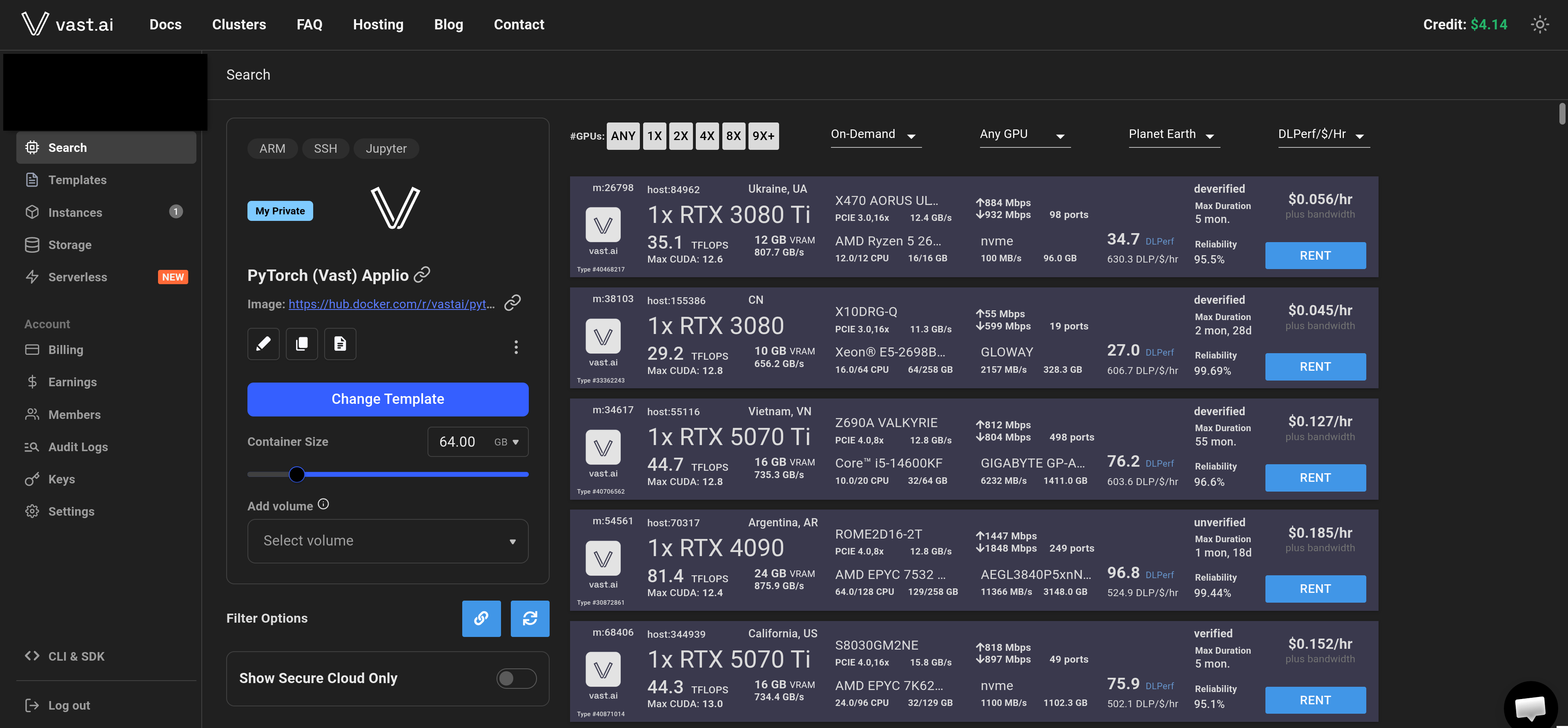
So which provider did I go with? Vast.ai
It's an interesting but simple business model. People with expensive powerful GPUs rent them out to others who want to use one temporarily. The renting is not physical, instead a server is generated on the host machine you decide to rent. Pricing is transparent and you are charged mostly for time. Once your machine is active, every second counts and you start being billed. I was very ignorant at first and most of my spent funds went towards learning. If you are like me and figuring it out for the first time, rent a cheap machine to practice on then you can switch to a beefier machine once you have your workflow down and know exactly what you need. Once I knew what I was doing, I was able to train the model I am sharing with you today for less than $1 USD.
If it wasn't given away by the big title, the voice model I decided to train was based on Fuwawa Abyssgard of Hololive. She has a unique and soft voice and I am a fan of FUWAMOCO. There are already some pretty decent Mococo voice models, but the lack of publicly available models for Fuwawa that I thought were of good quality is a big part of what led me down this rabbit hole in the first place. I likely would not have bothered making my own model If I found a pre-made one I was satisfied with.
I call this model v6
"v6" because of 3 public models I compared against, and 2 prior versions I made before I had a better grasp on how to make a high-quality model.
More data does not equal better. Longer training and more epochs does not equal better. What matters most is the quality of the data you put in. And there is an eventual plateauing in the model's machine learning progress. In the beginning, there is a lot to learn and it will make a lot of mistakes. But as it gets better and better and there is less to learn, it will still do its damnedest to try and keep learning as long as you let it. Not only does training progress begin to slow with diminishing returns, but your model may over-train and begin steering in the wrong direction as it keeps trying to make progress.
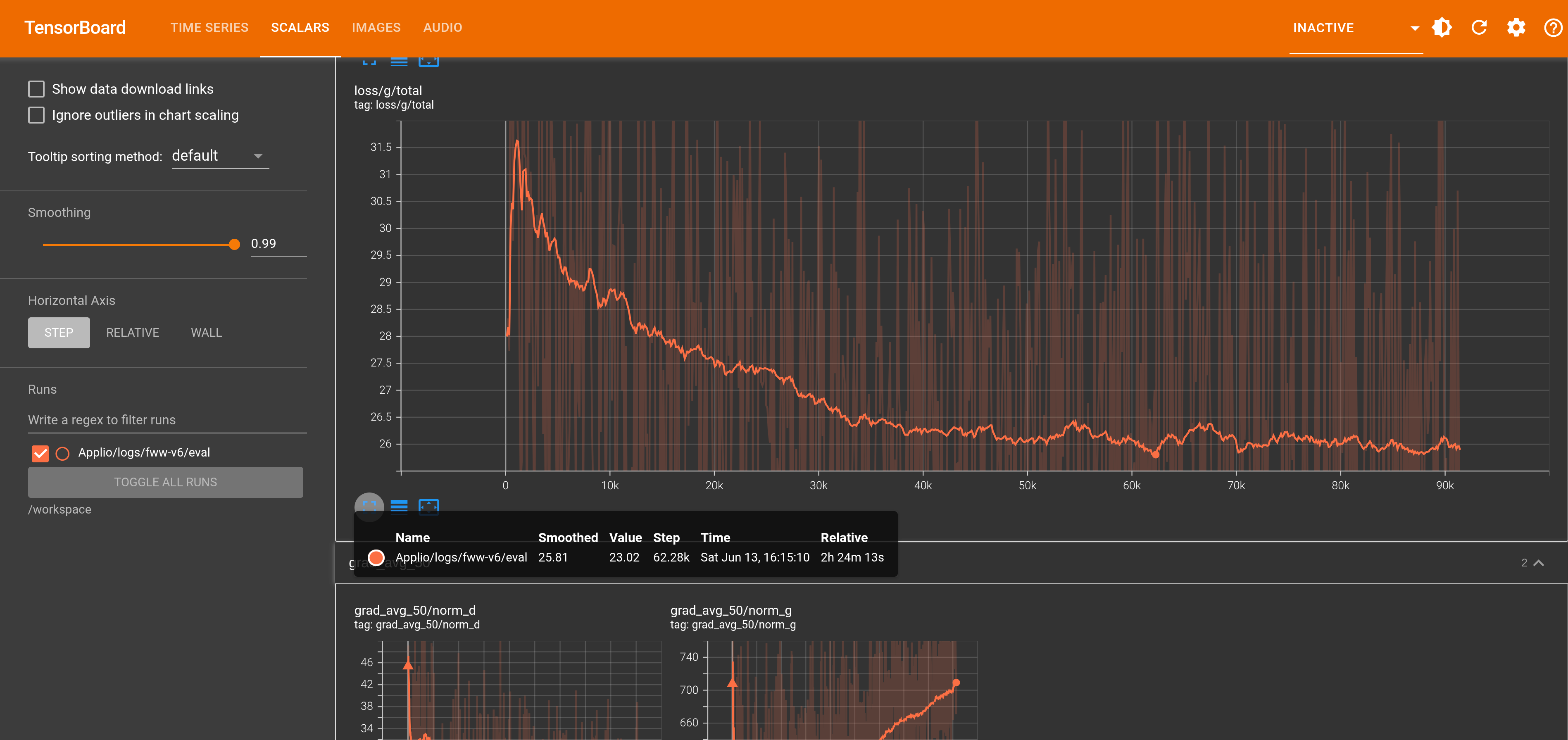
For example, in the following graph you can see the model's g/total over time, which is a good metric for tracking training progress. Around 62k steps is when this model bottomed-out and letting it train for nearly twice as long would not have produced better results.
v4 was my first attempt where I was getting the hang of things and how to use Applio+Vast.
v5 was only slightly improved over v4. The only thing I changed between those training runs was the length of the training and the batch size used on the dataset. The quality of this one was already pretty good compared to the other public models, but sounded a little too nasally and had more spectral artifacting (that robotic hiss sound) than I would have liked to hear.
v6 is where I went back to the drawing board with everything I had learned.
I stemmed clean vocals from the dataset samples and removed low-level noise. I removed laughs and loud breaths and other chaotic sounds. As much as it pained me to cut out Fuwawa's delightful laughter, sounds such as these are chaotic in pitch and difficult to train on. It will only confuse your model as it tries to make sense of something that is nothing like speech. I also saved the dataset in .wav this time so the model had lossless audio quality to work with. I included a dynamic variety of speech to try and capture their range of emotions. I then trained the model as long as needed until training slowed and the optimal stopping point presented itself.
I believe I have created the best voice model of Fuwawa you can find publicly available, but you can be the judge for yourself.
Download
Listen to Samples
You can listen to some audio samples as this link: https://pastefy.app/aJrOfJ6H
Click "Show Preview" in top right of the code panel. It's a basic HTML table with audio embedders for quick side-by-side comparisions.
Test 1 - "The quick brown fox jumps over the lazy dog."
English pangram that contains all 26 letters and is a compact way to test articulation.
Test 2 - “Seven sleek swans swam swiftly southward.”
A more targeted test that stresses sibilants and high-frequency energy, some of the hardest sounds for RVC models and often produces electric hissing. Even the best models struggle to fully eliminate artifacting without over-compressing and sounding flat. Model C is an example of this. It has little to no artifacting, but has a more muted sound profile that has lost a lot of the dynamics.
Test 3 - "I guess you are my little pogchamp..." -Source
A meme test that shows a more real-world example with human speech inference and imperfect audio quality vs. tests 1 and 2 which were generated with EdgeTTS.
Model Sources
Below is a list of the public models I compared against in my training.
-light