How to Calculate Freight Class: Complete Step-by-Step Guide (2026)
Freight class is one of the most important factors in determining shipping costs for LTL (Less-Than-Truckload) freight. Whether you are a small business owner, logistics manager, or eCommerce seller, understanding how to calculate freight class accurately can help you reduce costs, avoid penalties, and streamline your shipping operations.
In this guide, you will learn how to calculate freight class step by step, understand the key factors involved, and discover how to simplify the process using a reliable online tool like Freight Class Calculator.
What Is Freight Class?
Freight class is a standardized system used in the shipping industry to categorize different types of cargo. It is defined under the National Motor Freight Classification (NMFC) system and ranges from Class 50 to Class 500.
Lower freight classes generally represent dense, durable, and easy-to-ship items, while higher freight classes are assigned to lightweight, fragile, or bulky goods that require special handling. This classification directly impacts shipping rates, making it essential to determine it correctly.
Why Freight Class Matters in Shipping
Freight class plays a critical role in determining shipping costs and logistics efficiency. Carriers use freight class to calculate pricing, allocate space, and assess risk. If your freight class is incorrect, you may face additional charges, shipment delays, or reclassification fees.
For businesses that ship regularly, even small errors in freight classification can lead to significant financial losses over time. This is why using accurate methods or tools to calculate freight class is essential for cost optimization and smooth operations.
The 4 Key Factors Used to Calculate Freight Class
Freight class is determined based on four primary factors. Understanding these factors is crucial for accurate classification.
Density
Density is the most important factor in freight classification. It is calculated by dividing the weight of the shipment by its volume. Higher density shipments usually fall into lower freight classes and cost less to ship.
Stowability
Stowability refers to how easily the freight can be stored alongside other shipments. Items with irregular shapes or hazardous materials may be harder to stow and could result in a higher freight class.
Handling
Handling considers how easy or difficult it is to move the shipment. Fragile, oversized, or heavy items may require special handling, which can increase the freight class.
Liability
Liability refers to the risk associated with the shipment, including the likelihood of damage, theft, or spoilage. High-value or delicate goods often have higher freight classes.
Among these four factors, density is the most commonly used for calculating freight class, especially in modern shipping practices.
Step-by-Step Guide to Calculate Freight Class Manually
Understanding the manual process helps you grasp how freight classification works. Below is a step-by-step method.
Step 1: Measure the Dimensions
Start by measuring the length, width, and height of your shipment. Make sure to include all packaging materials and pallets. Accurate measurements are essential for correct calculations.
Step 2: Calculate the Volume
Multiply the length, width, and height to get the total volume of the shipment. If your measurements are in inches, convert the volume into cubic feet by dividing by 1728.
Step 3: Weigh the Shipment
Determine the total weight of the shipment in pounds. This should include the weight of the product, packaging, and pallet.
Step 4: Calculate Density
Use the formula:
Density = Weight ÷ Volume
For example, if your shipment weighs 500 pounds and occupies 50 cubic feet, the density is 10 pounds per cubic foot.
Step 5: Determine Freight Class
Once you have the density, match it with the NMFC density scale to find the correct freight class. Lower densities result in higher freight classes and higher shipping costs.
Freight Class Density Chart
Below is a simplified density chart used to determine freight class:
| Density (lbs/ft³) | Freight Class |
|---|---|
| 50+ | Class 50 |
| 35–50 | Class 55 |
| 30–35 | Class 60 |
| 22.5–30 | Class 65 |
| 15–22.5 | Class 70 |
| 12–15 | Class 85 |
| 10.5–12 | Class 92.5 |
| 9–10.5 | Class 100 |
| 8–9 | Class 110 |
| 7–8 | Class 125 |
| 6–7 | Class 150 |
| 5–6 | Class 175 |
| 4–5 | Class 200 |
| 3–4 | Class 250 |
| 2–3 | Class 300 |
| 1–2 | Class 400 |
| Less than 1 | Class 500 |
This chart helps convert density values into freight classes used by carriers.
Challenges of Manual Freight Class Calculation
Although manual calculation is possible, it comes with several limitations. The process can be time-consuming, especially for businesses handling multiple shipments daily. There is also a high risk of human error when measuring dimensions or applying formulas incorrectly.
Additionally, interpreting density charts can be confusing for beginners. These challenges make manual calculation inefficient for most modern logistics operations.
The Best Way to Calculate Freight Class Instantly
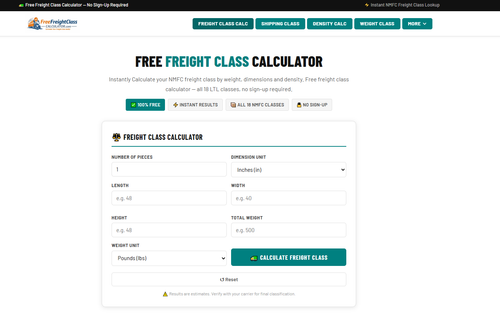
To simplify the process, many businesses use online tools. One of the most efficient options available is:
This tool eliminates the need for manual calculations and provides instant, accurate results based on your input.
How to Use Free Freight Class Calculator
Using the Free Freight Class Calculator is straightforward and saves significant time.
First, enter the shipment dimensions, including length, width, and height. Next, input the total weight of the shipment. Once the details are entered, click the calculate button.
The tool will instantly compute the density and assign the correct freight class based on NMFC standards. This eliminates guesswork and ensures accuracy.
Benefits of Using Free Freight Class Calculator
Using an online calculator offers several advantages over manual methods.
It provides instant results, allowing you to make quick decisions. The calculations are highly accurate, reducing the risk of costly reclassification fees. The interface is simple and user-friendly, making it accessible even for beginners.
Another major benefit is that no signup is required. You can use the tool anytime without creating an account. It also works seamlessly across all devices, including mobile and desktop.
Real Example of Freight Class Calculation
Consider a shipment with the following details:
Dimensions: 48 x 40 x 48 inches
Weight: 400 pounds
Manually calculating density and class can take time. However, by entering these values into the calculator, you can instantly determine the freight class, which may fall between Class 125 and Class 150 depending on density.
This demonstrates how the tool simplifies complex calculations.
Common Mistakes to Avoid
Many shippers make mistakes that lead to incorrect freight classification.
One common mistake is inaccurate measurement of dimensions. Always include packaging and pallets. Another issue is incorrect weight entry, which can significantly affect density.
Some users also ignore density calculations and rely on estimates, which can lead to errors. Using a reliable calculator helps eliminate these mistakes.
Tips to Reduce Freight Class and Shipping Costs
Lowering your freight class can significantly reduce shipping costs.
Start by increasing shipment density. Use compact packaging and eliminate empty space. Optimize dimensions to avoid oversized packages. Standard pallets can improve stowability and efficiency.
Always verify your freight class before shipping to avoid additional charges.
When Should You Use a Freight Class Calculator?
A freight class calculator should be used whenever you are preparing an LTL shipment. It is especially useful when comparing shipping rates, planning logistics, or ensuring compliance with carrier requirements.
Businesses that ship frequently can benefit greatly from using a calculator to streamline operations and reduce costs.
Manual Calculation vs Online Calculator
Manual calculation provides a deeper understanding of the process but is not practical for daily use. It is time-consuming and prone to errors.
Online calculators, on the other hand, are fast, accurate, and easy to use. They are ideal for both beginners and professionals who need quick results.
Final Thoughts
Calculating freight class is a critical step in the shipping process. While the manual method helps you understand the fundamentals, it is not the most efficient approach for modern logistics.
Using a reliable tool like Free Freight Class Calculator simplifies the process and ensures accurate results. It helps businesses save time, reduce costs, and avoid costly mistakes.
If you are looking for a fast and accurate way to calculate freight class, this tool provides everything you need in one place.
Conclusion
Freight class calculation does not have to be complicated. By understanding the key factors and using the right tools, you can improve your shipping efficiency and reduce costs.
Whether you are a small business owner or a logistics professional, using an online freight class calculator is the smartest way to ensure accuracy and efficiency in your shipping process.