Spartanburg SC Pool Builder: From Concept Through Construction, Done Right
A pool looks simple from the patio. Smooth water, clean tile, maybe a stone spa sending a quiet ripple across the surface. Underneath that relaxing picture is a tightly choreographed system of soil engineering, hydraulics, electrical, waterproofing, and finish work. The difference between a backyard pool that performs for decades and one that becomes a maintenance headache shows up in choices made long before excavation. That is why the process matters as much as the final pour, especially across the Upstate where soils, slopes, and weather can turn a straightforward plan into a complex build if you do not anticipate the details.
I have designed, priced, and overseen pools across Spartanburg, Greenville, Lake Keowee, Anderson, and the valleys around Asheville. Each community brings its own quirks. Spartanburg clay can hold water that swells after heavy rain. Greenville’s infill neighborhoods sometimes hide utility surprises. Lake Keowee’s steep lots beg for vanishing edges, which raises the stakes on structure and hydraulics. Asheville’s microclimates push winterization and freeze protection to the front of the conversation. The goal is the same in each place: a custom pool that fits the site, the way you live, and the budget you set, delivered with a clear, consistent process by a pool contractor who owns the outcome.
Start with how you will actually use the pool
Most homeowners come in with a look in mind, usually a clean rectangle or a freeform lagoon in their saved photos. Good starting point, not the finish line. The best custom pool builders spend the first few meetings digging into use cases, because shape and finish do not matter if the pool misses the way your family swims.
A family that wants lap swimming, cannonballs, and volleyball nights needs long, straight water with a uniform depth in the center and benches that do not interrupt play. A couple who envisions quiet evenings with a glass of wine will value an integrated spa, warm LED lighting, and a silent equipment pad more than a wide shallow zone. For homeowners in Spartanburg neighborhoods with smaller backyards, sun shelf size and seating often matter more than length. In lake homes near Keowee, an infinity edge becomes a view feature as much as a swimming feature.
The conversation should turn into an annotated sketch before anyone quotes a price. Draw the swim lanes, mark a tanning ledge for two loungers, size the spa to the actual headcount that will use it, place benches and steps where they do not conflict with play. Add practical dimensions and elevations so you are designing for your yard, not a catalog.
Budget with full life-cycle costs in view
Sticker price is only one line on the ledger. Ask any experienced pool contractor and you will hear the same advice: plan for build cost, operating cost, and ownership resilience. A low bid that hides essential items will cost you later.
Salt systems, variable-speed pumps, cartridge or oversized DE filters, automation, and LED lighting raise the upfront number but lower monthly burn. In the Upstate, energy rates and long swimming seasons reward automation and efficient hydraulics. On a typical 12 by 28 foot pool, a variable-speed pump can cut electrical use by half or more compared with single-speed, especially when paired with 2.5 inch suction and return lines that reduce head loss. Robotic cleaners cost more than suction cleaners, but they free you from running the main pump just to vacuum.
Materials drive both looks and long-term care. Plaster is affordable and classic, yet it will need resurfacing sooner than pebble or quartz finishes, particularly if chemistry drifts. Porcelain or natural stone coping can handle the South Carolina sun, but dense, sealed stone holds up better near saltwater systems. I often tell clients: prioritize shell and structure, then hydraulics, then finishes. You can always upgrade tile down the road. You cannot fix a thin bond beam or undersized plumbing without tearing into your investment.
Site conditions across the Upstate change the rules
Soil and slope set the stage, and every county in our region plays a different tune. A swimming pool contractor who builds from Spartanburg to Asheville knows not to treat any backyard as flat and friendly just because it looks that way.
Spartanburg clay is notorious for retaining moisture and expanding. That means over-excavation and proper backfill with compacted gravel, plus drainage behind walls and under the deck. French drains and under-deck piping route water away from the shell. On several Spartanburg projects, we also added a drain mat against the outside of raised walls to relieve hydrostatic pressure. If the builder skips those steps, you can see deck heave and coping movement within a couple of years.
Greenville’s older neighborhoods sometimes hide large oak roots and stubbed utilities in awkward places. Expect hand digging near the house, compact machinery in tight alleys, and extra time to protect foundations and fences. If you are talking with a pool builder Greenville SC homeowners recommend, ask about their plan for access protection and utility coordination, not just the pool design.
Lake Keowee elevates structure. Many lake lots roll quickly toward the water, which pushes designs toward raised beams, retaining walls, and vanishing edges. Those edges are stunning, but they require more steel, thicker beam sections, surge basins sized to the largest splash event you will realistically have, and precise spillway finishing so the sheet of water stays clean and quiet. Miss a calculation and you will hear a waterfall roar where you wanted a whisper.
Asheville’s terrain and winter nights add freeze depth and drainage demands. Equipment pads need wind protection and clear service access. Where snow or leaf load hits the cover, the deck slope must carry water away from the shell and the house. A pool builder Asheville NC homeowners trust will talk through pad layout, wind orientation, and winter service, not just summer fun.
The preconstruction checklist a good builder will insist on
Information beats optimism. Before any excavation, align on specifics in writing. The best custom pool builders in our region follow a disciplined list that reads something like this:
Verified property survey with setbacks, easements, and utilities marked, plus written HOA or architectural review approval if required. Soil notes from a geotechnical review or at minimum a compaction and bearing plan for the site, plus a drainage plan around the shell and deck. Engineered structural drawings that match site grades, especially for any raised wall, spa, vanishing edge, or attached retaining wall. Equipment schedule with exact models, pipe sizes, valve types, and control system, including automation and light transformers. Finish schedule covering interior surface, tile series, grout type, coping material, deck material and thickness, and expansion joint details.
That is the first and only list in this article, and for good reason. If these documents exist and match what you think you bought, you have already avoided most expensive change orders.
Excavation and the reality beneath the lawn
Excavation is the moment of truth. The lawn looked smooth, the sketches clean. The bucket hits soil and you find out if the yard has pockets of fill, old brick, or waterlogged clay. Experienced pool builders plan for surprises. They stage extra stone for backfill, keep a pump on hand if they hit groundwater, and have the engineer on call for field changes.
Depth and shape matter. If you want an 8 foot deep end for a diving board, the shell grows, the engineering tightens, and the yard needs more room for slopes. Many Spartanburg and Greenville backyards fit better with a sport bottom that runs from roughly 3 feet 6 inches at the shallow, to 5 feet in the middle, to 4 feet in the deep. You gain usable space, lower concrete volume, and safer play. For lap swimmers, a 40 foot run feels generous, but I have built satisfying lap lanes at 34 and even 30 feet by constraining steps and benches to a single side and keeping a clear line.
Access logistics matter as much as the hole. On tight lots near downtown Spartanburg or Greenville’s Augusta Road area, the pool contractor will schedule smaller machinery, more trips for spoils, and plywood or composite mats to protect neighbors’ driveways. That adds time and cost, yet it saves relationships and damage claims.
Steel, plumbing, and the skeleton you will never see again
Once the hole is shaped, the crew ties steel. This is where craftsmanship hides. A properly built rebar cage has consistent spacing, double steel at stress points like corners and beam edges, and clean ties that lift steel to the right elevation off the soil. Bond beam thickness, step reinforcement, and spa wall density matter. I often ask homeowners to walk the site at this stage. You will not fully understand the steel layout, but you will recognize care. Clean work now translates to fewer cracks and a sturdier shell for the life of the pool.
Plumbing and electrical rough-in weave through that skeleton. Bigger pipe is not a luxury, it is efficiency you cannot add later. For most standard pools, 2.5 inch suction and 2 inch returns with swept fittings keep friction losses low. Add dedicated lines for skimmers and main drains with Jandy-style valves at the pad so you can isolate each pull. If you are including a spa, insist on a true looped jet line with balanced tees, not a daisy chain. Lighting conduits need proper depth and sealed junctions away from splash zones. Bonding wire must touch steel, equipment, rails, and often water features. A swimming pool contractor who treats bonding as paperwork, not a performance requirement, is one to avoid.
Shotcrete or gunite and why technique beats terminology
People argue over shotcrete versus gunite. Both are pneumatically applied concrete, one with premixed wet material, the other mixed dry at the nozzle with water added. Both can produce excellent shells or poor ones depending on crew skill, rebound management, and cure. Focus less on the label and more on how the crew works.
Watch for consistent nozzle distance, firm compaction, and minimal rebound left in the shell. Rebound material that bounces off should be hauled out, not troweled back in. Corners and penetrations need extra attention. The beam should be full density without honeycombing, and the crew should keep a clean edge where the coping will bond. After the shoot, a controlled cure matters. Light moisture on the shell for several days, especially in summer, reduces shrink cracking and improves strength. Rushing to tile and coping without a reasonable cure timeline is asking for movement you will see later.
Coping, tile, and the interface that tells on a builder
The joint between water and deck tells the truth. Good coping sets with even overhang, consistent joints, and full thinset coverage, not dabs at the corners. Expansion joints at the perimeter separate deck from beam so seasonal movement does not shear tile. Tile should sit level and straight along the waterline. If you are choosing glass tile in a spa, ask for a premium thinset and grout that can handle thermal cycling. In saltwater systems, select tile and stone rated for salt exposure, and seal stone copings and spillways twice during build and again after the first season.
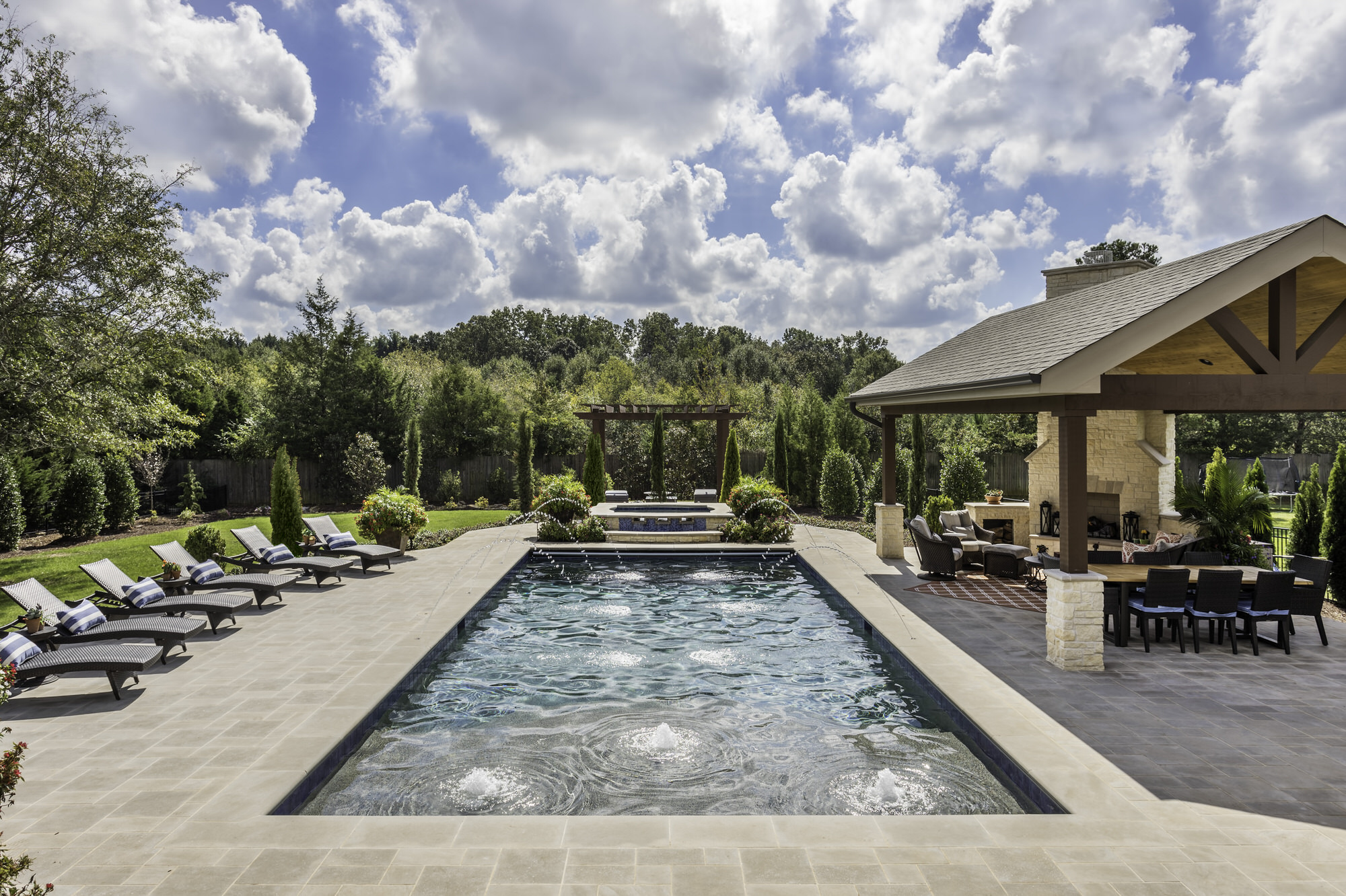
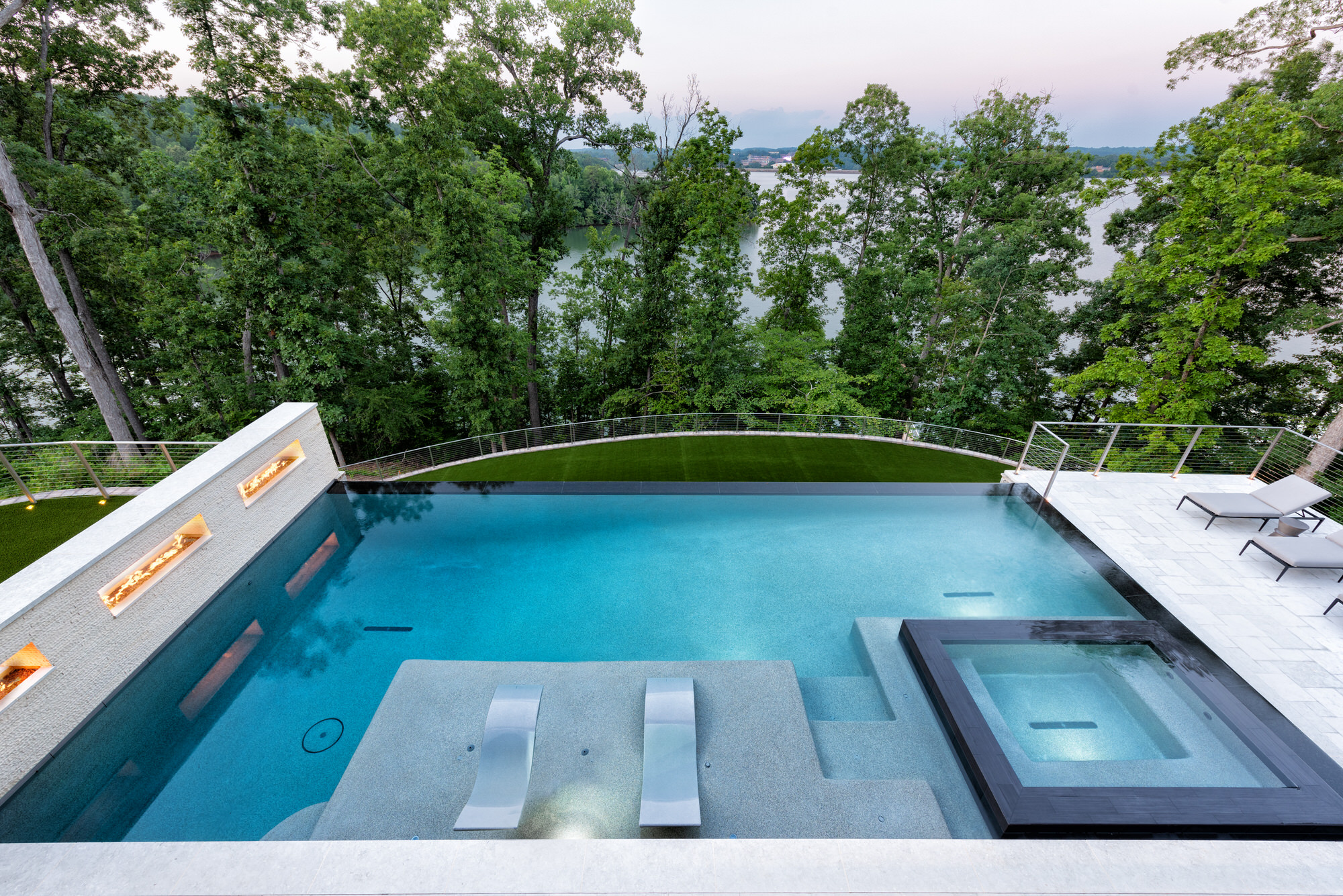
For looks and maintenance, 6 by 6 porcelain waterline tile remains a workhorse. Glass mosaics add sparkle, but they show every misalignment. On infinity edges near Lake Keowee, longer format tile on the weir creates a clean sheet. That sheet depends as much on the final trowel pass as on the tile, so confirm the builder has vanishing edges in their portfolio, not just on their website menu.
Decking choices that match how you live
Deck surface affects temperature, slip, and long-term care. Broom-finished concrete is affordable and safe when sealed properly. Stamped concrete can mimic stone effectively if the crew controls color and release powder. Pavers allow repair without visible patchwork, useful in Spartanburg yards that move a bit with seasonal moisture. Travertine or dense limestone feels cool underfoot and elevates the look, though it needs sealing and careful detailing around salt systems. Composite or hardwood decks pair well with modern rectangles, especially on sloped sites where a framed deck can bridge grades without heavy walls.
Think ergonomics. Benches should sit near social zones. A grill island wants room for circulation, not jammed against the pool edge. If you plan a pergola, lay out footings now so you do not cut the deck later. On compact Greenville lots, I often angle the pool a few degrees off the house to create wider usable zones and better view lines. Those small choices pay dividends every weekend.
Equipment pads that hum quietly and make sense to service
Too many builds treat the equipment pad as an afterthought. Then you live with a whine near the bedroom and a maze of pipes nobody wants to touch. A well-planned pad sits on a solid, level slab, with pumps on rubber isolators and unions on every component so maintenance does not require a hacksaw. Valves labeled with engraved tags beat Sharpie that fades in one summer. Power should be sized for expansion, with a subpanel that leaves extra breakers for a future heat pump or lights.
Automation earns its keep. Modern systems let you schedule pump speeds, lights, spa heat, and features from a phone. In our climate, I favor a variable-speed pump, a separate booster only if an older pressure-side cleaner is unavoidable, a salt chlorine generator sized at least 1.5 times your pool volume, and a heater type that matches your usage. Gas or propane heaters heat quickly for spas and shoulder-season dips. Heat pumps excel for steady pool temperature from spring through fall, though they slow down on the coldest mornings in Asheville. Some homeowners choose both: gas for the spa and a heat pump for the pool.
Inspections, startup, and water chemistry that preserves finishes
County inspections vary. Spartanburg and Greenville typically check bonding, setbacks, barriers, and sometimes structural reinforcement before shotcrete. Do not skip private quality checks just because the county signed off. Your builder should pressure test plumbing to 20 to 30 psi for 24 hours and document it. Before plaster, run through a punch list with your superintendent: coping alignment, tile work, expansion joints, and deck drainage verified with a hose.
Startup is its own craft. A proper plaster or pebble start balances pH and alkalinity from day one and runs the pump continuously for the first 24 to 48 hours. Brushing daily for the first week keeps dust from mottling the surface. Salt should not go in until the finish cures, usually 28 days for plaster, sometimes less for quartz or pebble if the manufacturer allows. I recommend a startup log on paper, signed daily for the first two weeks. It protects your finish warranty and holds everyone accountable.
Chemistry is not mysticism. In our region, I aim for free chlorine between 2 and 5 ppm, pH between 7.4 and 7.6, alkalinity around 80 to 100 ppm, calcium hardness appropriate to the finish, often 250 to 400 ppm, and a slightly negative to neutral saturation index to protect the surface without etching. Automation helps, but you still need a reliable test kit and a schedule. One service visit a month cannot rescue a neglected pool in July.
Timelines and what can move them
A well-managed custom pool installation in Spartanburg typically runs 10 to 16 weeks from dig to swim, longer if heavy walls, vanishing edges, or elaborate hardscapes join the scope. Permitting can take a couple of weeks. Excavation takes days, steel and plumbing another week, shotcrete a day, then cure time, then tile and coping, then deck, then equipment and electrical, then interior. Weather delays add margin. On lake projects near Keowee, expect extra time for retaining structures and inspections. In Asheville, winter can pause plaster work until temperatures stabilize.
Delays are not always bad. I would rather push plaster a week than set it on a borderline day that risks a blotchy cure. The key is communication. A reputable pool builder Spartanburg SC homeowners trust will share a timeline with milestones, update it weekly, and explain shifts with specifics, not vagueness.
Choosing the right partner across the Upstate
Labels do not build pools, crews do. Whether you are meeting pool builders in Greenville, a custom pool builder in Anderson, or interviewing a pool builder Lake Keowee SC residents recommend, ask questions that reveal process and pride.
Show me three projects like mine built within the last two years, and let me talk to those homeowners. Who will be on my site most days, and who makes the call when conditions change? What is your standard plumbing size and valve setup, and can you walk me through a typical equipment pad? How do you handle drainage and backfill on clay soils, and what goes into your raised wall engineering? What does your startup process include, and who maintains the chemistry in the first month?
Notice the verbs in their answers. Builders who do this right talk about compacting, bonding, isolating, balancing, verifying. They bring photos of rough stages, not just glamour shots. They do not push every client to the same template. That is what separates true custom pool builders from installers who bolt features onto a standard kit.
Real-world examples from around the region
A Spartanburg project on the east side sat on a gentle slope with heavy clay. The owners wanted a 12 by 25 rectangle with a full-length bench and a raised spa. We over-excavated 12 inches, brought in compacted stone, ran a drain line at the base of the beam, and used a thicker bond beam on the spa wall. The pad sat behind a low privacy wall to cut noise near a bedroom. Two years later, the deck joints remain tight and the spa spill is still a calm curtain.
In Greenville’s North Main area, access limited equipment size, and the yard pinched near the house. We angled a 10 by 22 plunge pool, added a four-foot sun shelf, and built a cedar screen to hide equipment. Automation runs a variable-speed pump at low speed most of the day, lights glow warm in the evening, and neighbors barely know it is there.
On Lake Keowee, a vanishing edge drove the design. The lot fell eight feet across the pool length. We engineered a raised beam and a 12 foot long weir, sized the catch basin to hold splash plus surge from six swimmers, and set the spill lip dead level. The homeowner wanted quiet, so we used a larger line to the edge custom pool builder and tuned flow by amp draw until the sheet ran clean and soft. The edge reads like glass from the patio, and the lake view takes over.
An Asheville build needed to face winter. We set the equipment in a sheltered nook, installed a heat pump with a bypass for efficient circulation, and programmed freeze protection to run at off-peak hours. The deck slopes gently to drains that carry runoff below the frost line. The clients swim from April through October, then use the spa through winter without worrying about ice forming around the pad.
What maintenance really looks like after the handoff
A well-built pool is not hands-off, but it does not own your weekends either. Smart design lowers the maintenance footprint. Skimmers placed to catch prevailing winds do more than any bottle of clarifier. Adequate return eyeballs push debris toward skimmers, not into corners. A robot does a better job on fine dust than a pressure cleaner, and it does not rely on the main pump.
Set a simple rhythm. Test water weekly during swim season, adjust as needed. Empty skimmers and the pump basket. Backwash only when pressure rises if you have a sand or DE filter, or hose down cartridges when flow drops. Check your salt cell for scale every month or two. Keep the deck joints sealed and the coping sealed annually if you selected natural stone. None of that requires a chemistry degree, but it does require a short appointment with your pool.
Final thoughts from the builder’s side of the fence
The most satisfying projects share a pattern. Homeowners bring a clear picture of how they will use the pool, stay open to site-specific advice, and choose a builder who sweats the parts no one sees. The builder plans, documents, and communicates, then treats rough stages with the same care they give to tile selection. The result feels effortless in summer because the hard work happened in winter meetings and springtime trenches.
Whether you call a pool builder Spartanburg SC neighbors recommend, check references for pool builders in Greenville, talk to a custom pool builder in Anderson, or line up a swimming pool contractor for a Lake Keowee or Asheville property, measure them by their process. A good one will walk you from concept through construction with calm competence, place each dollar where it does the most good, and hand you water that looks simple because the engineering behind it is anything but. That is how you do it right, from the first sketch to the first dive.