Dance It Out: Creative Movement Therapy for Anxiety
Anxiety lives in the body. It tightens the jaw, shortens the breath, and narrows vision until every sound feels like a siren. Many clients arrive telling me they have tried to “think” their way out of it and ended up more exhausted. When talk alone keeps skimming the surface, we invite the body into the conversation. That is the heart of creative movement therapy. It uses breath, rhythm, posture, and gesture to help the nervous system complete loops it has been stuck inside for years.
I have practiced across hospital programs, private studios, and community centers. I have watched people who could not sit still for five minutes learn to settle their pulse through a simple sway. I have watched tears finally come in a way that felt safe, contained by a steady beat and a therapist’s attuned pacing. Movement therapy is not a performance class. It is the practical and sometimes tender process of returning agency to a body that has been bracing for too long.
Why movement meets anxiety where it lives
Anxiety is not only a set of thoughts. It involves the autonomic nervous system, especially the sympathetic branch that prepares for action. When muscles, breath, and tempo change, the nervous system follows. This is one reason somatic therapy, including dance and movement-based approaches, can be so effective. It gives us direct access to arousal patterns through posture, pacing, and muscle tone.
Think of it this way. The body is always talking in language the mind often ignores. Shoulders hike up, breath rises into the chest, the center of gravity shifts forward like a runner at the start line. If the only intervention is verbal, the system may understand the idea of safety but not feel it. Gentle rotation of the spine, wide-field gazing, and exhaling longer than you inhale all send cues of safety to brainstem circuits that do not respond to logic. Over time, those signals change how quickly you escalate and how easily you return to baseline.
Movement also builds tolerance for sensation. Many anxious clients are not actually afraid of events, they are afraid of the sensations those events might trigger. The heart racing, the warm flush, the tingling in fingers. In a controlled session, we intentionally raise arousal a little through larger motions, then come back down through grounding or slower rhythms. This graded exposure desensitizes the system to its own signals. That is somatic therapy in action, not as a trend but as a skill.
What a session actually looks like
People often picture choreography or dance combinations. Real sessions look quieter and more personal. We begin with orientation. Where are your feet? What is the weight distribution? How does your jaw sit? We let the body answer first, then add words if they help frame the experience.
Next comes pacing. I watch breath rate, micro-movements, and gaze. If you are already wound up, we do not start with big jumps. We might begin with side-to-side weight shifts, a slow spiral of the spine, or a simple reach-and-release paired with a longer exhale. If you are flat or over-inhibited, we add https://griffinjiha693.lowescouponn.com/movement-therapy-and-mindfulness-a-powerful-pair energy through rhythm, percussive footwork, or call-and-response claps that build engagement without overwhelming.
Mirroring is common. I match the tempo and shape of your movement, then shift a notch toward regulation, inviting your system to come along. Think of it as meeting you at your edge, then widening the window just enough. There is space for words, but words are optional. Some clients talk most of the session; others find speech returns later, once their bodies feel less guarded.
Session length and intensity vary. In outpatient work, 50 minutes is standard. I usually include several arcs: warm-in, explore, integrate, rest. That last piece matters. The nervous system consolidates change when it feels safe and at ease. We close with stillness or very slow rocking, then a brief debrief. What felt possible? What felt too much? What do you want to take into the week?
A short vignette from practice
A woman in her thirties came to me after years of chronic worry and a job that rewarded vigilance. She had already tried cognitive therapy, which helped her challenge thoughts but did not touch the insomnia, jaw pain, or the way her hands trembled during meetings. In our third session, we found a simple duet. She stood with feet hip-width, knees soft. I stood five feet away and mirrored her micro-movements. When her shoulders drifted up, I let mine float up and then slowly down. When she sighed without noticing, I responded with a longer exhale that had sound. We added a soft, repetitive piano piece that set a stable tempo.
Her body began to follow that tempo. Hands unclenched, then clenched again, then unclenched. She said only a few words, mostly noticing. After about eighteen minutes, she sat. A tear fell, then another, and then she laughed in a small, surprised way. “I didn’t know I could feel this without falling apart.” We used that moment as a reference point in later sessions. She named it her “safe drop.” Over eight weeks, we built routines she could do at her desk in two minutes. The tremor did not vanish, but it lost its grip. That is a realistic outcome.
Techniques that reduce anxiety and why they work
Grounding through the feet organizes the system from the bottom up. Soft knees, clear contact with the floor, and small heel-to-toe shifts give the brain constant proprioceptive input. That feedback is stabilizing, especially when paired with longer exhales. If breath work alone has felt abstract, adding structure with movement makes it concrete. Imagine a four-count inhalation as you rise on the balls of your feet, then a six-count exhalation as you lower and let your shoulders drape. The body gets a clean message: up and on, down and safe.
Rhythm entrainment is another anchor. The nervous system locks on to external patterns. A steady 60 to 80 beats per minute supports downshift. Drums, metronomes, or even a clock can do the job. When clients are scattered, I sometimes use hand-to-thigh taps, alternating left and right. Cross-lateral patterns integrate both hemispheres and often quiet mental chatter. It looks deceptively simple. The effect is real.
Symbolic movement brings meaning in without forcing a story. A client who worries about dropping a ball at work may practice an intentional catch-and-place with a soft object. The gesture rewrites the script from “I will drop it” to “I can receive and set down.” Over time, the body practices success until it becomes familiar. Talk therapy can explore where the fear came from earlier in life. Movement therapy rehearses a new ending.
Co-regulation sits at the center. Humans calm in company. Therapists trained in movement therapy use their own breath, posture, and micro-adjustments as tools. Sometimes the most therapeutic act is a shared sway to a lullaby-like rhythm, with the therapist gradually slowing the tempo until both sets of shoulders settle. It is humble, and it is effective.
Safety, consent, and pacing for trauma therapy
Anxiety often coexists with trauma. In that case, the watchwords are consent, titration, and choice. If a client has a history of panic or dissociation, we work in short windows, 60 to 90 seconds at a time, followed by rest. We avoid eyes-closed work early on, since sudden internal imagery can flood the system. Instead, we anchor attention externally, tracking shapes and colors in the room or the feeling of feet on the ground.
Touch is not a given. Many people think dance therapy includes partnered holds. In trauma therapy, touch is used sparingly, if at all, and only with explicit, revocable consent. Boundary-making is often therapeutic in itself. For example, we might practice a clear step forward with a palm-out gesture to rehearse saying no, then a step back with both hands on the ribs to feel containment. The nervous system learns to mark space and choose proximity. That is attachment therapy in body language, building comfort with closeness and with distance.
Triggers can sneak in. Fast, high-intensity beats might feel like a club for one client and like danger for another. Lying on the floor may be a relaxation posture for some and unsafe for others. Good clinicians offer options. Chair-based grounding, standing rest with a hand on a wall, music-free sessions when sound becomes too much. If trauma memories surface, we slow down, orient to the room, and return to present cues. The point is not to relive what happened, but to restore choice in the body here and now.
When grief is the engine beneath the anxiety
Anxiety sometimes spikes not from looming threat but from unprocessed loss. People arrive reporting constant edginess, only to describe a year that included a death, a divorce, or a move. In grief counseling, I often see patterns of holding up, bracing, and keeping moving so as not to feel the drop. The body reads that bracing as ongoing alarm.
Movement offers a way to honor loss without drowning. Gentle rocking can soothe the ache. Slow, repetitive gestures create ritual when words feel thin. I have used candle-like hand spirals in silence, one minute at a time, then a bow to a photo or a cherished object. Some clients choose to dance to a song connected to the person who died, but we set timing and containment in advance. When tears come inside a steady rhythm, the system often tolerates them better. Anxiety then eases, not because the grief disappears, but because the body trusts it can feel without breaking.
What the research says, with realistic expectations
The evidence base for dance and movement therapy is growing. Systematic reviews describe small to moderate reductions in anxiety symptoms, especially in group-based programs and among people with medical comorbidities. Several small randomized or controlled studies have shown improvements in self-reported anxiety and physiological markers such as heart rate variability. The body of research is still modest compared with cognitive behavioral therapy, and effect sizes vary. In practice, I see the strongest change when movement therapy complements other approaches: skills from CBT for thought patterns, medication when indicated, and movement for regulation and integration.
For trauma-related anxiety, observational and pilot trials suggest benefits in grounding, dissociation reduction, and body awareness. Again, studies are heterogeneous in protocol and quality. That does not negate their value, but it does argue for precision in claims. If you are looking for the gold-standard study that proves one method cures anxiety, you will not find it here. If you are looking for a well-tolerated, skill-building path that teaches your body how to settle, there is meaningful support.
A simple home practice you can try
The goal at home is not to replicate a full session. It is to install a few reliable switches that nudge your body toward ease. Start with a two-minute practice done twice a day, ideally before anxiety ramps up.
Plant your feet hip-width, soften your knees, and scan the room slowly with your eyes to name three colors you see. Inhale for a count of four as you rise to your toes, exhale for a count of six as you lower and let shoulders melt. Tap left thigh, right thigh, left thigh, right thigh at a steady, comfortable tempo for one minute. Keep breath easy. Place one hand on your ribs and one on your belly. Whisper a word that feels resourceful, like “steady,” on the exhale three times. End with a gentle sway, eight slow arcs side to side, letting the jaw hang slightly.
Notice what changed, even if only one notch. If you feel dizzy, nauseated, or more anxious, shorten the set and slow it down. If you dissociate easily, keep your eyes open and your hand on a stable surface.
How movement therapy integrates with other care
Many clients are already in psychotherapy or on medication. Movement therapy does not compete; it complements. In sessions, we often translate insights from talk therapy into embodied practice. If you have learned to identify catastrophizing, we might practice interrupting it with a physical reset: feet down, exhale longer, look to the horizon. If your psychiatrist is adjusting a medication that changes energy levels, we calibrate movement dosage so you do not overshoot and crash.
Clients working on attachment therapy themes, such as fear of abandonment or discomfort with closeness, often find that dyadic movement conversations reveal more than words alone. We practice proximity, distance, turn-taking, and repair. If you step away and I wait, then invite without pressure, your body collects evidence that contact can be negotiated. Over time, the nervous system develops trust in relationships as co-regulating rather than threatening.
Edge cases, adaptations, and the art of pacing
No single approach fits everyone. People with chronic pain may flare with certain motions. We use micro-movements, isometrics, and breath-led imagery to reduce strain. A client with hypermobility might feel better stabilizing close to midline than stretching to extremes. Clients on the autism spectrum sometimes prefer clear structure and predictable beats, while others need silence to avoid sensory overload. Cultural context matters: some gestures have specific meanings in certain communities. Good therapists ask and adapt.
Dissociation requires special care. If you tend to float away, we keep movements small and interoception brief, paired with constant orientation to the room. I might ask you to keep a cool stone in your hand or to say out loud one object you can see while we move. If tears arrive and you go numb, we pause. People sometimes apologize for this. There is no apology needed. The body’s brakes worked hard to protect you. We thank them and widen tolerance a few seconds at a time.
Group vs individual work also changes the equation. Groups provide powerful co-regulation and belonging. They can also feel exposing at first. In groups, I set clear structures with choice baked in. Stand, sit, or simply watch, all valid modes. Individual sessions let us dive deep into personal pacing and symbol. Many clients use a blend, with group for community and individual for surgical precision.
What progress looks like over weeks, not just minutes
Early gains usually appear in micro-moments. Someone realizes they recovered from a startle in twenty seconds rather than twenty minutes. Sleep deepens by a half hour. The jaw does not ache every morning. After four to six sessions, patterns become more automatic. The exhale lengthens without prompting. The body catches itself tensing and softens on the way up. Over eight to twelve sessions, people report more range: they can raise their energy to give a talk and then bring it back down, rather than riding an all-day spike.

Relapses happen. A rough week at work, a sick child, a news alert, and the nervous system jumps. The difference is you now have levers to pull. Movement therapy teaches you what to do with your body in those first thirty seconds, before the spiral takes over. That is not a small thing. Over months, the baseline shifts.
Choosing a qualified movement therapist
Credentials vary by country. In the United States, look for clinicians credentialed through the American Dance Therapy Association. An R-DMT denotes a registered dance/movement therapist. A BC-DMT denotes board certification with advanced training and supervision. Many licensed mental health professionals integrate movement therapy with other modalities. Ask about trauma training, comfort with anxiety and panic, and how consent and choice operate in sessions.
A practical tip: schedule a consultation and notice how your body feels when you meet. Do you feel rushed or tracked? Is the therapist willing to slow down, to negotiate pace and touch, to adapt music or silence to your needs? Anxiety heals in relationships that respect your timing. If something feels off, keep looking. Fit matters.
Setting up your space and your soundtrack
You do not need a studio. A six-by-six-foot patch of floor works. Clear tripping hazards, wear shoes if you prefer, and keep water nearby. Lighting should let your eyes rest. If you enjoy music, build two or three short playlists at different tempos. One calming, 60 to 70 beats per minute. One neutral-medium, 80 to 100. One energizing, 100 to 120 for days when you feel flat. Include one track that feels personally meaningful. Keep volume moderate so your body does not interpret it as threat.
Try to practice at the same times each day. The body loves rhythm. Pair your practice with a routine you already have, like making coffee or finishing email. That scaffolding increases follow-through far more than willpower does.
A compact pre-meeting reset
When clients ask for a quick, portable sequence to use before a stressful call, I offer a straightforward protocol.
Look out a window or at a far wall and trace a gentle figure eight with your eyes for ten seconds, then blink slowly three times. Press your feet into the floor on a four-count inhale, release pressure on a six-count exhale, twice. Tap across your chest from left to right with fingertips for twenty seconds, then sweep hands down your arms to your hands once, then shake them out softly.
It takes under a minute, it does not look strange in an office, and it lowers arousal just enough to keep your voice steady. If your heart is racing hard, add two slow exhales with pursed lips, as if cooling soup.
Where movement sits in the field of mental health
Movement therapy has sometimes been sidelined as expressive arts rather than core care. That is changing as more clinicians recognize the role of the body in anxiety and trauma. It pairs naturally with evidence-based approaches and strengthens their effects by giving the nervous system what it needs most: new experiences of safety and agency. In hospitals, it reduces agitation. In schools, it improves regulation and attentional control. In private practice, it offers people who are tired of talking a different door.
The work is humble. It is not about perfect form. It is about the slow reclaiming of your own rhythms. Anxiety narrows life to a small strip of safe ground. Movement widens it, one breath-led reach at a time. If you decide to try it, go gently, choose a therapist who listens to your body as much as your words, and give your nervous system weeks, not days, to learn. The payoff is real: a steadier pulse, clearer choices, and a body that feels like a home rather than a siren.
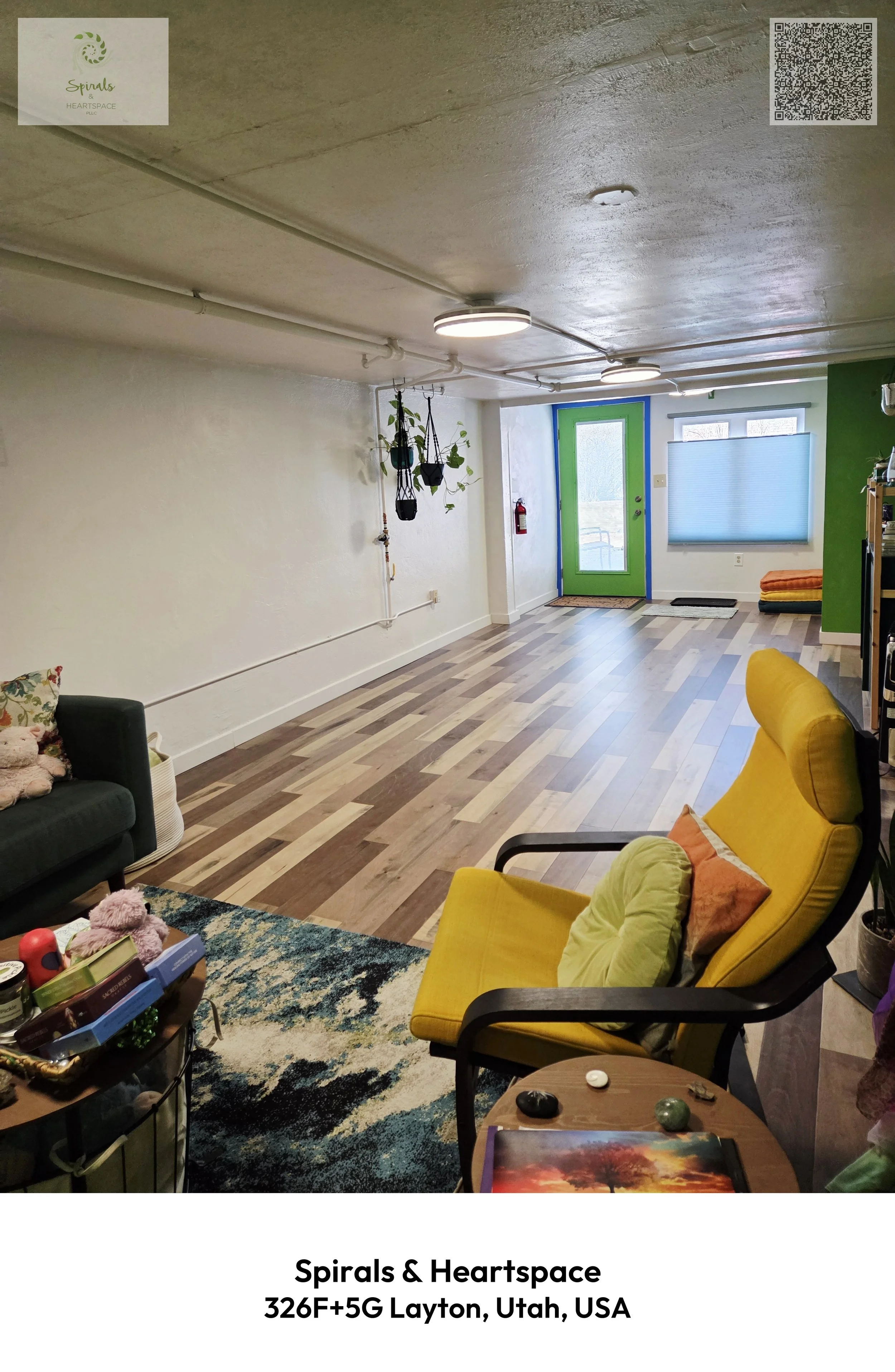
Name: Spirals & Heartspace
Address: 534 W Gentile St, Layton, UT 84041, United States
Phone: 385-301-5252
Website: https://spiralsandheartspacehealing.com/
Hours:
Monday: 9:30 AM - 7:00 PM
Tuesday: 9:30 AM - 7:00 PM
Wednesday: 9:30 AM - 7:00 PM
Thursday: 9:30 AM - 7:00 PM
Friday: 9:30 AM - 7:00 PM
Saturday: Closed
Sunday: Closed
Open-location code (plus code): 326F+5G Layton, Utah, USA
Map/listing URL: https://maps.app.goo.gl/M1jmgkhNyaMPCCJ8A
Embed iframe:
"@context": "https://schema.org", "@type": "ProfessionalService", "name": "Spirals & Heartspace", "url": "https://spiralsandheartspacehealing.com/", "address": "@type": "PostalAddress", "addressLocality": "Layton", "addressRegion": "UT", "addressCountry": "US"
🤖 Explore this content with AI:
💬 ChatGPT 🔍 Perplexity 🤖 Claude 🔮 Google AI Mode 🐦 Grok
Spirals & Heartspace is a Layton therapy practice offering somatic, trauma-informed support for adults who feel stuck in survival mode.
The practice focuses on trauma therapy, somatic therapy, grief counseling, movement therapy, and attachment therapy for clients looking for deeper healing work.
Based in Layton, Utah, Spirals & Heartspace offers therapy for adults in the local area and notes that both in-person and online sessions are available.
Clients who feel exhausted, disconnected, or trapped in long-standing patterns can explore a body-based approach that goes beyond traditional talk therapy alone.
The practice also offers coaching, consultation, and authentic movement for people seeking personal growth or professional support in related healing work.
For people searching for a psychotherapist in Layton, Spirals & Heartspace provides a local Utah base with services centered on trauma recovery, nervous system awareness, and attachment healing.
The official website identifies Layton and the surrounding Davis County area as the local service region for in-person care.
A public map listing is also available as a reference point for business lookup connected to the Layton area.
Spirals & Heartspace emphasizes a warm, embodied, creative approach designed to help clients reconnect with truth, clarity, and a more grounded sense of self.
Popular Questions About Spirals & Heartspace
What does Spirals & Heartspace help with?
Spirals & Heartspace offers support for trauma, grief, attachment wounds, emotional overwhelm, and body-based healing through somatic and movement-oriented therapy.
Is Spirals & Heartspace located in Layton?
Yes. The official website has a dedicated Layton, Utah location page and describes the practice as serving Layton and surrounding communities.
What therapy services are offered?
The website highlights trauma therapy, somatic therapy, grief counseling, movement therapy, and attachment therapy. It also lists coaching, consultation, and authentic movement.
Does Spirals & Heartspace offer online sessions?
Yes. The Layton location page states that both in-person and online sessions are available.
Who leads Spirals & Heartspace?
The official site identifies Ande Welling as the therapist, coach, movement facilitator, and guide behind the practice.
Who is a good fit for this practice?
The site is geared toward adults who feel exhausted from old survival patterns, complicated family dynamics, grief, self-abandonment, or unresolved trauma and want a deeper, body-aware approach.
How do I contact Spirals & Heartspace?
You can visit https://spiralsandheartspacehealing.com/ and use the contact form to inquire about therapy, coaching, consultation, authentic movement, or speaking.
Phone: 385-301-5252
Landmarks Near Layton, UT
Layton – The practice explicitly identifies Layton as its local base, making the city itself the clearest location reference.
Davis County – The Layton page says the practice serves individuals throughout Layton and Davis County, so this is an important regional service-area landmark.
Wasatch Mountains – The location page directly references Layton as sitting against the Wasatch Mountains, making this a natural local landmark for orientation.
Northern Utah – The site describes Layton within northern Utah, which is useful for people comparing nearby therapy options across the region.
Surrounding Layton communities – The official location page says the practice serves Layton and surrounding communities, which supports broader local relevance without overclaiming exact neighborhoods.
If you are looking for a psychotherapist in Layton, Spirals & Heartspace offers a local Utah therapy practice with in-person and online options for adults seeking trauma-informed support.