Technical Resilience In Building Security
Implementing a modern security framework requires a strategic focus on both the physical barriers and the invisible digital architecture that manages them. A successful design ensures that a facility can withstand external threats while remaining functional and safe for the authorised individuals who work within its walls. Modern property management has moved beyond simple lock-and-key mechanisms towards intelligent, integrated solutions that offer real-time data and remote oversight. By considering the unique risks associated with a specific site, designers can deploy a network that is both a formidable deterrent and a facilitator of efficient movement. The strength of this network depends on its ability to remain operational under all circumstances, requiring a comprehensive approach to hardware durability and electrical stability.
Key Takeaways:
- Evaluate the risk level of each zone to determine hardware strength.
- Implement encrypted signals to protect against digital credential theft.
- Prioritise system uptime through dedicated electrical backup solutions.
- Coordinate security lockdowns with automated fire safety overrides.
- Establish a regular maintenance cycle for all electronic locking parts.
Architectural Integrity And Zone Control
The first step in fortifying a commercial or residential property is a thorough assessment of the building's physical layout and its natural points of entry. Security consultants typically divide a premises into distinct zones, ranging from public-facing reception areas to highly restricted data centres or executive suites. By establishing clear perimeters, the system can regulate the flow of traffic, ensuring that visitors are contained within authorised areas while staff move freely. This spatial logic is essential for reducing the risk of internal theft or unauthorised access, as it requires a valid verification at every significant transition point within the facility.
Beyond the internal partitions, the exterior shell of the building must be reinforced with hardware that can withstand physical tampering. This includes the use of high-security door closers, reinforced frames, and sensors that detect when a door has been left ajar or forced open. Every external door acts as a critical node in the wider security network, and its failure can compromise the safety of the entire building. By matching the physical strength of the hardware to the specific threat level of the environment, designers create a balanced defence that protects assets without creating unnecessary obstacles for daily operations.
Electrical Stability And Continuity
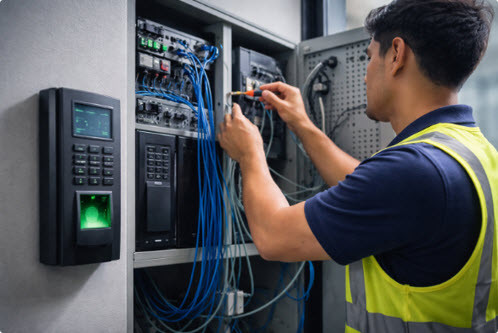
A sophisticated security network is only as reliable as the electrical current that powers its controllers, readers, and locks. In a professional installation, it is standard practice to ensure that the security infrastructure is isolated from general building power fluctuations. To maintain full operational capability during a local grid failure or a deliberate attempt to cut the power, engineers integrate uninterruptible power supplies into the central control panels. These units provide the necessary bridge to keep the system running until primary power is restored or a secondary generator takes over, ensuring that the facility’s perimeter remains locked and monitored at all times.
Proper power management also involves the careful calculation of the total electrical load for every connected device on a circuit. Overloading a power supply can lead to heat buildup and premature component failure, which in turn causes intermittent security gaps. Designers often use a distributed power architecture, where multiple smaller units serve specific clusters of doors, reducing the risk that a single electrical fault will disable the security for the entire building. Regular testing of the battery health within these backup units is a vital maintenance task, as it ensures the system will perform exactly as expected during an actual power emergency.
Credential Integrity And Signal Protection
The transition from physical keys to digital credentials has introduced the need for high-level data protection to prevent identity theft. Modern security systems rely on smart cards and mobile tokens that utilise secure handshaking protocols to verify a user's identity. Unlike older proximity cards, which transmit their ID number in plain text, these modern credentials use rotating encryption keys that change with every use. This makes it impossible for a malicious actor to intercept a signal and use it to clone a staff member's badge, providing a much higher degree of certainty for the organisation.
Mobile access technology takes this security a step further by utilising the biometric or passcode protections already built into a user's smartphone. By requiring the user to unlock their phone before the access signal is sent, the system effectively implements multi-factor authentication for every door. This significantly reduces the risks associated with lost or stolen physical cards, as a digital token cannot be used by anyone other than the authorised device owner. For the administrator, the ability to manage these digital keys through a central cloud platform provides a level of agility that physical cards cannot match, allowing for instant issuance and revocation.
Harmonising Safety And Security Protocols
A fundamental requirement for any electronic locking system is its absolute compliance with local fire and life safety regulations. Security measures must never become an obstacle during an emergency evacuation, which is why all electronic locks on exit routes must be hard-wired to the building's fire alarm system. Upon activation of the alarm, the system must automatically cut power to these locks, allowing every occupant to exit the building without needing to present a credential. This fail-safe operation is a non-negotiable part of a professional installation, ensuring that human life is always the primary consideration in any design.
To provide an additional layer of safety, manual override devices like green break-glass units must be installed alongside all electronically secured exits. These devices allow an individual to manually interrupt the power to a lock if the automated system fails or if they encounter a localised emergency. It is essential that these units are clearly visible and that their location remains consistent throughout the facility so that they can be found quickly in a smoke-filled or high-stress environment. Regular inspections of these manual overrides and the fire alarm interface are mandatory to ensure that the building remains a safe place for its occupants.
Digital Infrastructure And Cybersecurity
As security systems increasingly converge with standard IT networks, they must be protected against cyber threats with the same rigour as a corporate database. It is essential that the security infrastructure is partitioned on its own virtual local area network (VLAN) to prevent unauthorised access from other devices in the building. This network segregation ensures that a malware infection on an office computer cannot migrate to the door controllers and disable the building’s locks. A well-protected network also guarantees that the security data packets have the priority they need to ensure readers respond instantly to every user request.
Cybersecurity for building systems also involves the diligent management of hardware, including changing factory-default passwords and disabling unused network ports on the controllers. Encryption should be applied to all data in transit across the building's wiring to prevent man-in-the-middle attacks where an intruder attempts to inject unauthorised commands into the system. Regularly applying firmware updates from the manufacturer is another essential task, as these patches often contain critical fixes for newly discovered security vulnerabilities. By treating the security network as a critical part of the IT infrastructure, facility managers can protect the building from both physical and digital intruders.
Administrative Management And Auditing
The software platform serves as the central brain of the facility, providing a unified interface for managing users, schedules, and alerts. A robust management system allows administrators to define complex access rules, such as multi-person authentication for high-security areas or temporary permissions for visitors and contractors. Real-time monitoring features enable security staff to see exactly who is moving through the building at any given moment, providing immediate situational awareness. This proactive approach allows for the quick identification of unusual patterns, such as repeated access denials at a specific door, which might indicate a potential security threat.
A comprehensive reporting engine is an invaluable tool for both security auditing and operational management. Being able to generate detailed logs of every entry and exit allows for thorough investigations following an incident and provides the data needed for regulatory compliance. These logs can also be used to optimise building operations, such as identifying underutilised spaces or adjusting cleaning and maintenance schedules based on actual occupancy levels. By turning access data into actionable insights, organisations can improve the efficiency of their facility management while maintaining a high standard of security that adapts to the changing needs of the business.
Read another Article: Guide to Reliable Power for Commercial Security Systems