French Drains vs. Weeping Tiles in London, Ontario: Key Differences Explained
Homeowners in London, Ontario see water from every angle. Spring thaws push groundwater toward foundations. Summer storms drop heavy bursts of rain that pond in low yards. In older neighbourhoods near the Thames River, high water tables can linger for weeks after a wet spell. With those realities, the two terms people hear most are French drain and weeping tile. They both involve perforated pipe and gravel, and both move water away from where it causes trouble, but they are not interchangeable. Understanding the difference helps you pick the right fix the first time, avoid wasted spend, and keep your basement dry.
I work with properties across the city, from mid-century bungalows in Old East to newer builds in Fox Field and single-floor homes in Byron. The soil shifts, the elevations change, and the solutions need to match. What follows is a practical look at how the two systems work, where each belongs, how they are built in our climate, and how to maintain them. Along the way, I will flag common pitfalls I see in backyard drainage in London, Ontario, and what good drainage contractors in London, Ontario will do differently.
Two names, two jobs
A French drain is a surface or near-surface drain that intercepts and conveys shallow groundwater or storm runoff across a yard, driveway, or along a slope. It is a trench with a perforated pipe, surrounded by washed stone, wrapped in fabric, and sloped to daylight or a safe discharge point such as a dry well. Its job is to collect water moving through the upper soil profile before it causes soggy lawns, heaved patios, or garage flooding. Think of it as a yard drainage tool.
Weeping tile, also called foundation drain or perimeter drain, is a buried system that sits beside or below the footing of a foundation. In London you will almost always find 100 millimetre perforated pipe encircling the house, bedded in clear stone, and connected to a sump pit with a pump. Its job is to relieve hydrostatic pressure against the foundation and give groundwater an easy path down to the pipe, rather than through the wall. This system is part of the building envelope and, for new construction, is governed by the Ontario Building Code.
Both use similar materials. Both are invisible once installed. The crucial difference is purpose and placement: a French drain manages landscape water above footing depth, while a weeping tile manages subsurface water at footing depth.
Why London’s conditions matter
Local context shapes design. London sits on glacial tills and clay loams that drain slowly. Many lots have a thin topsoil over dense subsoil that becomes nearly impermeable when saturated. The frost line typically reaches 1.2 metres or deeper, so shallow pipes without protection can heave or clog as freeze and thaw cycles churn the soil. The average annual precipitation sits near 1,000 millimetres, with intense summer rain events that can drop 40 to 60 millimetres in an evening. Homes near tributaries of the Thames often deal with perched groundwater after wet springs.
City grading standards also play a role. Post-2000 subdivisions often have engineered lot grading that intends to carry surface water to rear yard catch basins. If the grading has settled around a foundation or if a neighbour added fill without tying into the pattern, ponding follows. Older areas rely more on natural drainage and sometimes on legacy connections that no longer meet code, such as foundation drains tied to sanitary sewers. Most municipalities in Ontario, including London, prohibit foundation drain connections to sanitary systems to prevent basement backups during storms. That is why sump pumps are now common, and why discharge routing matters.
These facts guide choices. A shallow French drain can solve chronic sogginess between two houses with tight side yards. It will not solve an active weeping tile failure. Conversely, replacing weeping tile might rescue a flooding basement but will not fix a backyard that sits lower than three neighbours.
Anatomy of a French drain
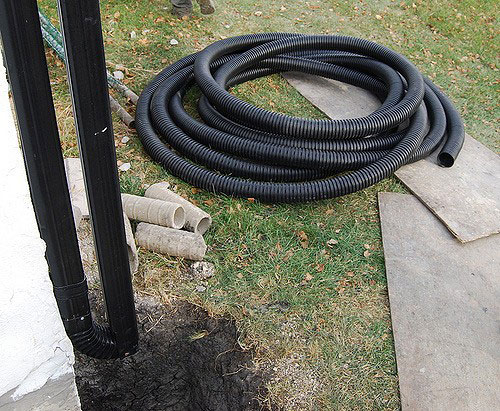
At its simplest, a French drain is a trench several hundred millimetres wide, lined with nonwoven geotextile, filled with washed 19 millimetre clear stone, and containing a perforated pipe with a slope of roughly 1 percent. In many yards a 300 to 400 millimetre depth is enough to intercept lateral water moving through the upper soil. In heavy clay pockets you may need to go deeper or widen the trench to expose more surface area. The pipe can be corrugated HDPE with a sock, or smooth-wall PVC with slotted or drilled perforations. Each has pros and cons. Corrugated bends easily to follow curves and is cost effective, but it can be more prone to silt settlement if not wrapped. Smooth-wall has better flow and is easier to flush clean, but it requires glued fittings and more careful layout.
The discharge is as important as the collection. A French drain that ends in the middle of the yard is a bathtub. The best outcomes come from daylighting the pipe at a downslope embankment, tying into a properly sized dry well with overflow, or connecting to a yard basin that sends water to a municipal storm system where permitted. In London, you cannot pipe yard drains into the sanitary sewer. On tight urban lots, an engineered dry well with 0.5 to 1.5 cubic metres of storage often matches soil infiltration capacity and the available footprint. Inspection risers at key points allow you to jet the line if a section silts in.
The stone matters. We specify washed 3/4 inch clear stone because the voids between stones create storage and flow paths, and washing removes fines that would otherwise plug the system. Skipping the fabric wrap invites clogging as surrounding fines migrate into the stone. The geotextile should be a robust nonwoven fabric rated for subsurface drainage, not landscaping weed cloth. It should fully envelope the stone so the soil never directly contacts the aggregate.
Anatomy of a weeping tile system
A foundation drain lives deeper. The trench sits at, or just below, the bottom of the footing. In many London homes that is 1.6 to 2.4 metres below grade, depending on basement depth. The pipe size is again commonly 100 millimetres. The Ontario Building Code requires a continuous foundation drainage layer with pipe and free-draining stone, with a path to a sump or gravity outlet. On a retrofit, we carefully excavate around the foundation, repair cracks, apply waterproofing membrane, and install a dimpled drainage board to create a consistent path for water to travel down the wall. Then we place the pipe on a compacted base of clear stone, slope it gently to the sump connection, and cover it with a minimum of 150 millimetres of the same stone. A layer of filter fabric goes on top before backfill, which helps keep fines out of the stone bed.
A proper sump system is part of the package. That includes a basin sized for the inflow rate, a reliable pump with a vertical float, check valve, and a discharge that runs to grade away from the foundation, often at least 1.8 to 3 metres from the wall. In neighbourhoods where winter pump discharge can freeze across sidewalks, we add a freeze protection bypass and locate outlets carefully to avoid nuisance icing. Many homeowners install a battery backup pump. In power outages during a storm, that battery buys time and often prevents the most expensive kind of water damage.
Interior weeping tile is a separate option for foundations that cannot be excavated easily, such as row houses or where driveway or deck structures pin the exterior. The system cuts a channel in the slab along the interior footing line, lays perforated pipe in stone, and routes to the sump. It relieves pressure under the slab and against the lower wall, but it does not protect the wall from freeze-thaw or external saturation. It is a practical choice in some cases, and a compromise in others.
Where each system belongs
I like to picture water as a patient, and the property as a body. A French drain is physiotherapy. It improves movement across the surface, reduces swelling where tissues are tight, and keeps the system from locking up. A weeping tile is surgery. It touches the core, changes how loads transfer, and demands more recovery time.
You choose a French drain in side yards where water sheets off a neighbour’s roof into your lawn, in flat backyards where clay holds puddles for days, at the toe of a slope where a garden stays saturated, or along a driveway that funnels water to the garage. These drains also pair well with regrading, swales, and downspout extensions. A correctly placed French drain can reduce the volume reaching the foundation and lighten the load on the weeping tile.
You choose weeping tile work when you see persistent damp spots on basement walls, efflorescence, musty odour even after dehumidification, or active seepage at the cove joint where the floor meets the wall. If the sump runs constantly after rain and never quite catches up, you may have partial blockages. If there is no sump at all in a modern house, the system might be improperly tied to a sanitary line from decades ago, which is now risky and often illegal. In older areas of London, I still find legacy clay tile pipes around foundations that have crushed or filled with iron ochre. Replacing those systems brings immediate relief.
A side-by-side snapshot
To keep the high-level differences straight, it helps to see them in one place.
French drain: Shallow trench in yard or along hardscape, manages surface and near-surface water, discharges to daylight or a storm-safe point, improves backyard drainage in London, Ontario without touching the foundation. Weeping tile: Deep perimeter drain at footing depth, manages groundwater at the foundation, connects to a sump or gravity storm outlet, protects structure and basement. Materials overlap: Both use 100 millimetre perforated pipe, washed 3/4 inch clear stone, and filter fabric, but depths, slopes, and discharge rules differ. Triggers: Choose French drains for soggy lawns, ponding, and nuisance flow paths. Choose weeping tiles for wall dampness, cove seepage, and hydrostatic pressure. Disruption and cost: French drains disturb turf and beds, often finished in a day or two. Weeping tile work involves excavation, foundation prep, and sump systems, often a week or more.
Building for London’s freeze-thaw
If a French drain sits too shallow, frost can compress the stone and migrate fines into the trench. We set the top of stone at least 200 millimetres below sod to protect it during spring thaw, then cap with a free-draining soil profile so surface water can reach the trench. In areas with vehicle loads, we upsize to a 150 millimetre stone layer with a geogrid cap below the topsoil or gravel. Slopes matter too. A minimum 1 percent pipe slope will carry water along, but the larger driver in French drains is hydraulic head through the stone. Where slopes are tight, we add inspection ports to allow flushing.
For weeping tile, proper insulation and protection of the exterior wall help in two ways. First, a dimple board creates a gap so water can drain vertically instead of freezing against the membrane. Second, backfill with clean stone up to at least 300 millimetres above the pipe reduces the fines that can settle in and clog flow paths. In cold snaps, sump discharge lines that run above grade can freeze. We use short above-grade runs, a larger diameter pipe, and a dedicated freeze relief that lets pumped water spill near the foundation temporarily rather than back up into the pump line. That is not elegant, but it saves basements when January locks up the main outlet.
Costs, with realistic ranges
Prices vary with access, landscaping, depth, and soil. In London, a straightforward French drain along a side yard, say 15 to 25 metres long, often lands in the 2,500 to 6,000 CAD range. Add complexity like multiple branches, catch basins, or a dry well, and 6,000 to 10,000 CAD is common. Decorative finishes over the trench line, like new sod or interlock, add to the tally.
Exterior weeping tile replacement is a different scale. A full perimeter on a typical 100 square metre footprint home can run from 18,000 to 35,000 CAD, sometimes more if access is tight, decks must be removed and rebuilt, or deep excavations require shoring. Interior weeping tile systems range from 8,000 to 18,000 CAD depending on length and sump upgrades. Battery backup pumps run from 1,200 to 3,000 CAD installed, worth every dollar in storm-related power failures.
These ranges reflect average conditions. I have seen small targeted repairs under a porch come in under 10,000 CAD and large, complex projects at two or three times the upper numbers where heritage constraints or extreme depths apply.
Common mistakes I see, and how to avoid them
One spring in Old South I walked a property that had just installed a French drain along a fence line. The owner still had standing water after rain. The solution looked textbook at a glance, but the discharge ran uphill to a capped pipe at a retaining wall. The system was perfect at holding water. We added a sump-style dry well with overflow to a lower swale and the yard drained within hours of a storm. Good design is more than a trench and pipe.
Another pattern: downspouts directed into a French drain that sits too close to the foundation. Roof runoff is fast and concentrated. Dumping it into a shallow trench two feet from the wall can overload the soil that sits above the footing and drive moisture inward. We move downspouts to rigid pipes that run to a safe discharge away from the foundation, and keep French drains at a distance where they intercept lateral flow, not feed it.
I still encounter older weeping tiles tied into sanitary laterals. During cloudbursts, those lines back up and pressurize the foundation drains, which then push water under the slab. A modern sump with an air-gapped connection avoids cross contamination and keeps flow one way. As a rule, if you are planning work around the foundation, call the City of London to confirm current requirements for storm and foundation drainage connections. Codes shift, and they matter.
Finally, maintenance gets ignored. French drains with no access points cannot be flushed. Sumps without check valves cycle water back and forth, shortening pump life. Basins full of sediment reduce capacity right when you need it. A little attention once or twice a year saves big headaches.
How grading and softscapes fit in
No pipe can fix a grade that sends water at a house. On many lots, subtle regrading solves half the problem before we install a metre of pipe. We aim for a 2 to 5 percent fall away from the foundation for at least 2 metres. In tight side yards, that is not always possible, so a shallow swale supplemented by a French drain catches what gravity will not handle alone.
Landscaping choices matter too. Raised garden beds built against foundation walls trap water and bury weep holes at brick veneer. Mulch piled above the sill line wicks moisture into framing. Dense clay soils compacted during construction crust over and shed water like a patio. Aeration and organic amendments in the upper 150 millimetres of soil improve infiltration and reduce peak flow toward drains. When we install French drains, we often pair them with soil improvement and a planting plan that tolerates wet feet near collection points.
Picking the right contractor, and what to ask
London has many capable drainage contractors. The best ones diagnose first and dig later. They bring levels, look for water lines on walls, trace downspout paths, and probe soil. They talk about discharge, not just collection. They show you materials before they go in the ground, including the grade of geotextile and the size of stone. They will also speak plainly about the limits of a given approach.
Here is a short checklist I share with clients who are deciding between bids.
Ask how water will leave the property, not just how the system collects it. Daylight, dry well, or storm tie-in each have constraints. Request a sketch with pipe sizes, slopes, depths, and discharge locations. A simple plan avoids misunderstandings. Clarify fabric and stone specifications. Washed 3/4 inch clear stone and a nonwoven filter fabric should be standard. For weeping tile, confirm membrane type, dimple board, sump details, and how landscaping will be restored. Discuss winter performance, including sump discharge freeze protection and maintenance access points.
When you hear vague answers about “gravel and pipe” without the details, be cautious. The difference between a system that lasts 20 years and one that fails in two is usually in those small technical choices.
Maintenance routines that pay off
French drains are relatively low maintenance if built well, but they benefit from simple habits. Keep the turf or gravel surface above the trench permeable. Avoid driving heavy equipment over the drain repeatedly. Once a year, flush inspection ports with a garden hose for a few minutes to clear minor silt. If the drain ties into a dry well, remove the lid and check sediment levels every second year. If the well is more than one third full of fines, schedule a cleanout.
Weeping tile systems revolve around the sump. Check the pump twice a year. Lift the float, watch the pump start, listen for smooth operation, and confirm discharge outside. Clean any sediment from the basin. Test the battery backup by pulling the main plug for a minute. Look at the check valve for leaks. After big storms, walk the basement perimeter and scan for damp patches or mineral bloom. Small changes caught early are easy to fix. Neglected, they grow expensive.
Edge cases and judgment calls
Not every property fits neatly into categories. In North London on a ridge where soils are more granular, I have installed shallow interceptor drains that ran to daylight with nothing more than gravity. In the flats near the river, groundwater rises high enough in spring that even perfect French drains stay wet for weeks. There, the priority is protecting the foundation first with sound weeping tile and sump capacity, then using landscape drains as relief valves for the shoulder seasons.
Iron bacteria sometimes colonize perforated pipes, leaving orange slime that clogs holes. In those cases I avoid corrugated pipe, specify smooth interior walls, add upstream cleanouts, and design straighter runs that can be jetted. In backyards shaded by mature trees, root intrusion can be real. We keep drains away from major root zones when possible, or use root-resistant fabrics and solid pipe segments under critical trees.
If you are fixing a chronically wet basement on a house with limited access on one side due to a neighbour’s garage, an interior weeping tile combined with exterior treatment on the accessible sides often delivers good value. It is not perfect, but measured against the cost and risk of undermining a shared structure, it is the right call.
Tying it all together on a real property
A recent project in a 1970s split-level near Masonville shows how these pieces fit. The homeowners had a musty basement, walls with light efflorescence, and a backyard that held water after storms. The weeping tile was original clay, and there was no sump. We split the work into two coordinated phases. First, we excavated the rear and two sides, applied a spray-on membrane and dimple board, replaced the weeping tile with 100 millimetre PVC in washed stone, and installed a sump with a primary and battery backup pump. The discharge ran to the front, across the driveway, and out to a new splash pad that drained to the street without crossing the sidewalk.
Second, we regraded the backyard to create a gentle swale along the fence line and installed a 20 metre French drain at the low point with two risers for maintenance. That drain tied into a dry well sized at just over a cubic metre of stone, placed where we could reach it with equipment but hidden under lawn. The first heavy rain after completion dropped roughly 50 millimetres in a few hours. The sump ran for short bursts instead of continuously, and the lawn shed water by the next morning. A year later, the owners report a basement that smells like a basement should, which is to say, like nothing at all.
Final guidance for London homeowners
If you are sorting through french drains in London, Ontario versus weeping https://www.ashworthdrainage.ca/ tiles in London, Ontario, start with where you see water and how it behaves. Watch your lot during a rain, not just after. Note whether water approaches the house from a specific side yard, whether it lingers in a bowl-shaped depression, or whether the first sign of trouble shows up as dampness inside on the lower third of a wall.
Use French drains to manage landscape water and protect use of your yard. Use weeping tile systems to defend the structure and control groundwater at the foundation. Expect to pair either solution with grading fixes and downspout management. Insist on proper stone, fabric, and discharge planning. And lean on experienced drainage contractors in London, Ontario who know both systems and the city’s soils and bylaws.
Done right, both tools are quiet. They work in the background for years at a time, and the only reminder you get is a yard that dries out between storms and a basement that stays boringly dry. That is the goal.
Ashworth Drainage — Business Info (NAP)
Name: Ashworth Drainage
Address: 514 Hale St, London, ON N5W 1G8
Phone: (519) 660-9375
Website: https://www.ashworthdrainage.ca/
Email: [email protected]
Hours:
Monday: 9:00 AM – 5:00 PM
Tuesday: 9:00 AM – 5:00 PM
Wednesday: 9:00 AM – 5:00 PM
Thursday: 9:00 AM – 5:00 PM
Friday: 9:00 AM – 5:00 PM
Saturday: Closed
Sunday: Closed
Open-location code (Plus Code): XRR3+HV London, Ontario
Map/listing URL: https://maps.app.goo.gl/9kaoXAxRtJRP1ThS9
Embed iframe:
Socials (canonical https URLs):
Facebook: https://www.facebook.com/ashworthdrainage/
X: https://twitter.com/ashworthrules
Instagram: https://www.instagram.com/ashworthdrainage/
"@context": "https://schema.org", "@type": "GeneralContractor", "name": "Ashworth Drainage", "url": "https://www.ashworthdrainage.ca/", "telephone": "+1-519-660-9375", "email": "[email protected]", "address": "@type": "PostalAddress", "streetAddress": "514 Hale St", "addressLocality": "London", "addressRegion": "ON", "postalCode": "N5W 1G8", "addressCountry": "CA" , "openingHoursSpecification": [ "@type": "OpeningHoursSpecification", "dayOfWeek": "Monday", "opens": "09:00", "closes": "17:00" , "@type": "OpeningHoursSpecification", "dayOfWeek": "Tuesday", "opens": "09:00", "closes": "17:00" , "@type": "OpeningHoursSpecification", "dayOfWeek": "Wednesday", "opens": "09:00", "closes": "17:00" , "@type": "OpeningHoursSpecification", "dayOfWeek": "Thursday", "opens": "09:00", "closes": "17:00" , "@type": "OpeningHoursSpecification", "dayOfWeek": "Friday", "opens": "09:00", "closes": "17:00" ], "sameAs": [ "https://www.facebook.com/ashworthdrainage/", "https://twitter.com/ashworthrules", "https://www.instagram.com/ashworthdrainage/" ], "hasMap": "https://maps.app.goo.gl/9kaoXAxRtJRP1ThS9", "identifier": "XRR3+HV London, Ontario"
https://www.ashworthdrainage.ca/
Ashworth Drainage provides basement waterproofing and foundation repair services in London, Ontario and surrounding areas in Southwestern Ontario.
The company helps homeowners address wet basements, water intrusion, and drainage issues with solutions that fit the property’s conditions.
Service requests can include foundation repair, waterproofing options, sump pump and drainage-related work, and related assessments.
Ashworth Drainage is based at 514 Hale St, London, ON N5W 1G8.
To reach the team, call (519) 660-9375 or email [email protected].
Business hours are Monday to Friday 9:00 AM–5:00 PM, with the office closed Saturday and Sunday.
For directions and listing details, use the map listing: https://maps.app.goo.gl/9kaoXAxRtJRP1ThS9.
Popular Questions About Ashworth Drainage
What does basement waterproofing help prevent?
Basement waterproofing is intended to reduce water intrusion and moisture problems that can lead to dampness, leaks, odors, and damage over time.
How do I know if I may need foundation repair?
Common signs can include visible cracks, water seepage, shifting or uneven areas, or recurring moisture problems; an on-site assessment is usually the best way to confirm causes and options.
What areas does Ashworth Drainage serve?
Ashworth Drainage serves London, Ontario and surrounding areas in Southwestern Ontario.
What are Ashworth Drainage’s hours?
Monday–Friday 9:00 AM–5:00 PM; Saturday closed; Sunday closed.
How can I contact Ashworth Drainage?
Phone: +1-519-660-9375
Email: [email protected]
Website: https://www.ashworthdrainage.ca/
Map: https://maps.app.goo.gl/9kaoXAxRtJRP1ThS9
Facebook: https://www.facebook.com/ashworthdrainage/
X: https://twitter.com/ashworthrules
Instagram: https://www.instagram.com/ashworthdrainage/