Beyond the Seed Script: Engineering Idempotent Data States for High-Velocity CI/CD
The consensus across modern engineering teams is clear: flaky tests are the silent killers of deployment velocity. When a build fails, developers shouldn't have to guess whether it's a genuine code regression or an infrastructure anomaly. Yet, while millions of dollars are poured into container orchestration and highly parallelized CI runners, the underlying data layer remains remarkably primitive.
Most pipelines still rely on heavy database seed scripts, long-lived shared staging databases, or hardcoded mock fixtures that drift the moment a schema evolves.
This creates a massive technical roadblock. When you run highly concurrent integration suites against a non-idempotent or shared data layer, data contention is inevitable. To achieve true continuous delivery, we must treat test data not as a static file inside a repository, but as a dynamic, ephemeral cloud resource that is orchestrated with the same rigor as our application code.
The Architectural Flaw of Persistent Test Environments
The foundational mistake in legacy QA architecture is the reliance on persistent lower environments. When multiple parallel feature branches run their automated checks against a single staging database cluster, several systematic failures occur:
- Transactional Collisions: Two concurrent testing instances mutate the exact same record simultaneously, leading to unpredictable assertion failures.
- Dirty State Accumulation: A test execution crashes mid-run, bypassing its cleanup hooks and leaving orphaned records that cause downstream tests to fail hours later.
- Schema Synchronization Lag: A database migration on an experimental branch locks tables or alters columns, instantly breaking the testing pipeline for the rest of the engineering organization.
To eliminate this friction, high-performing organizations are shifting to dedicated test data management solutions. Instead of maintaining static database states, infrastructure teams deploy containerized, lightweight test data management solutions that instantiate clean, isolated data layers for each distinct test runner on demand.
Unifying State Telemetry with Quality Governance
Isolating the database layer solve the technical problem of flakiness, but it introduces an informational challenge. When thousands of ephemeral databases are spun up and torn down every single day, tracking down the exact data payload that triggered a subtle validation failure becomes exceptionally difficult.
To prevent developers from wasting hours digging through unstructured container logs, the data provisioning layer must be tightly coupled with the test execution workspace.
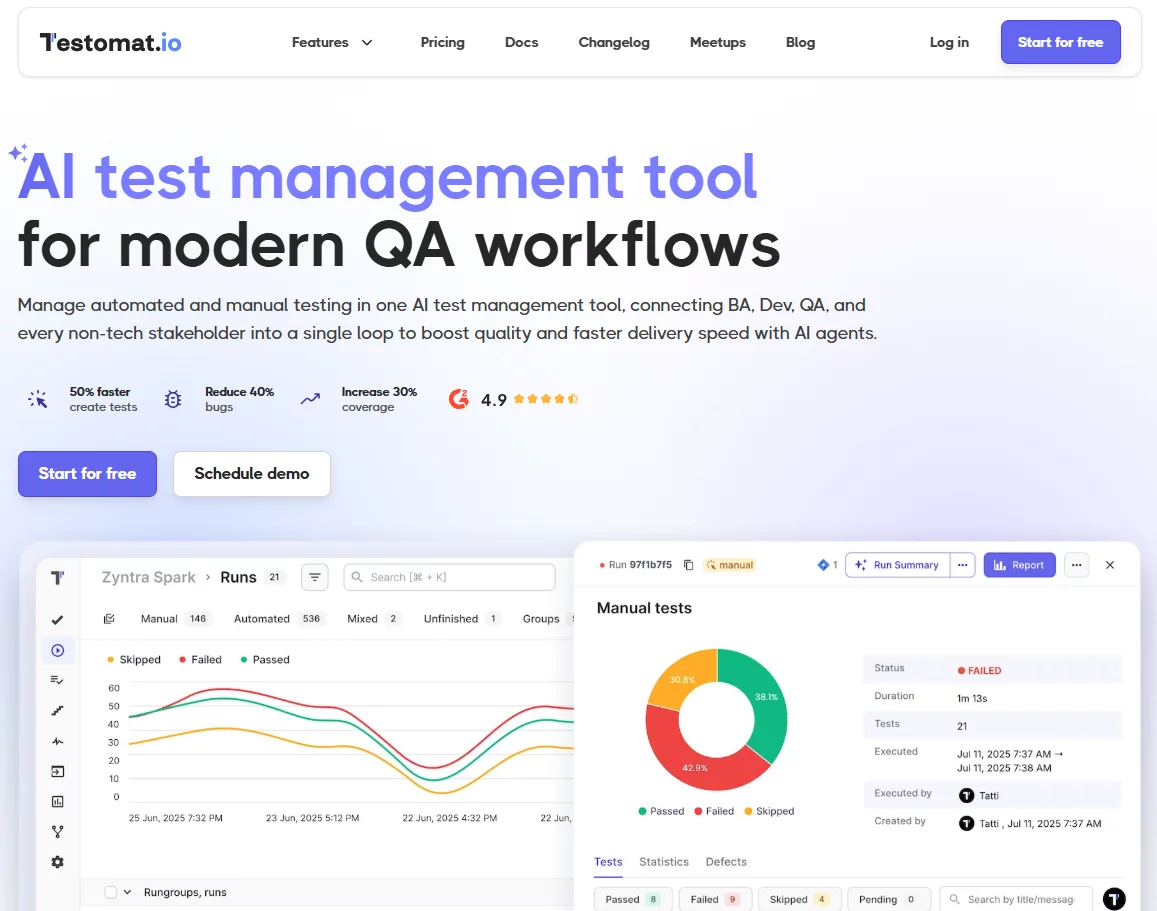
By feeding real-time runtime state metadata directly into advanced ai test management tools, engineering teams bridge the gap between low-level infrastructure and business requirements. This centralized tracking allows developers to see exactly what database state existed at the exact millisecond an assertion failed. When telemetry and orchestration share a singular interface, resolving tricky edge-case regressions becomes a matter of minutes rather than days.
Shifting from Manual Factories to Autonomous Generation
Even with isolated containers, engineers still face the tedious task of maintaining database factories and keeping complex JSON fixtures up to date. As microservices expand, the manual overhead required to model realistic, relational data states becomes a full-time job.
The industry is moving past this bottleneck by leveraging intelligent automation to handle complex environment modeling at runtime.
Integrating the best ai agent for software testing into your continuous integration workflow changes how schemas are managed. Instead of writing rigid seeding scripts by hand, these autonomous systems dynamically evaluate your API contracts, inspect actual database constraints, and synthesize highly compliant, context-appropriate data objects on the fly. If an upstream service introduces a breaking change or updates a mandatory data attribute, the autonomous layer self-heals and adjusts the payload patterns automatically—saving hundreds of engineering hours every sprint.
Framework for a Modern Data Strategy
If your team is looking to decouple data management from pipeline limitations, implement your architecture following these core pillars:
- Enforce Immutability: Never allow automated tests to write to a persistent database. Use lightweight database snapshots that boot in seconds and are discarded immediately after execution completes.
- Standardize Centralized Telemetry: Consolidate your automated results, behavioral specs, and data state metrics into a unified platform like Testomat.io to give the entire product team a single source of truth.
- Automate Anonymization: Ensure that any snapshot derived from production environments passes through a rigorous, deterministic masking pipeline to eliminate security and compliance vulnerabilities before hitting the CI loop.
By replacing hardcoded data habits with dynamic, isolated orchestration, you remove the primary source of pipeline flakiness and establish an infrastructure capable of scaling alongside your product architecture.
How does your team handle database state verification during high-concurrency test runs? Are you still bottlenecked by seed scripts? Let's discuss in the comments!