StatuoTW's Rants
Unlike my other rentry's, my rants are designed to provide insight and information into the botmaking hobby that you may not necessarily need to know if you're just getting started. The botmaking guide is still as up-to-date as ever and this is only meant to serve as better insight through less-structured rambles. I've been told that making these rants publicly available is, however, good for people who want to learn more. So here we are.
Please note, everything here is copy-pasted from the Discord as I do this shit live.
Link to the Botmaking Guide
Some concepts are covered in the Botmaking Guide. They're usually referenced by link or by short explanation, but just in case, here is the Botmakie guide.
What's in this Rentry?
There are two main categories here:
Rants and Play-By-Plays. Rants are about things you may not have considered while botmaking and tips you can think about during the botmaking process. Play-By-Plays are step-by-step how I create bots to give you an idea of how you can approach your own botmaking with actual examples.
Rants
Bot Styles - Leader vs. Follower
Anyway, to kick it off. I wanna ramble about some shit I've been mulling over. Let's talk about bot styles.
Specifically, I want to talk about how bots tend to fall into two broad categories: Leaders and Followers using examples from my latest Voruun bot dump.
To start with, let's define what a Leader and a Follower style is in broad terms.
A Leader bot card:
- Pushes the narrative constantly through their actions.
- Has defined goals that will not only affect them but the world or characters around them.
- Is usually, but not always, an antagonist.
- Does not require the user to make moves to cause story changes.
A Follower bot card:
- Has goals, but these are usually self-serving and do not extend beyond {{user}} or themselves.
- Relies on the user to have goals to have a narrative
- Is usually, but not always, a sidekick.
- Can push the narrative but usually does not.
I've been thinking about this because while I think a series needs an antagonist I got to ask myself why that was. Not everything needs an antagonist, so to say. Oftentimes storytelling devices rely on other things instead of a bonafide person as an antagonist. Man vs. God, Man vs. Society. Etc. So I got to thinking what an antagonist-less series would look like and realized that an antagonist is fun, yes. But what you really need are more leader cards to push narratives and force conflict.
Using shitty MS paint, here's an example of where some of Voruun's characters would fall on this broad style strokes.
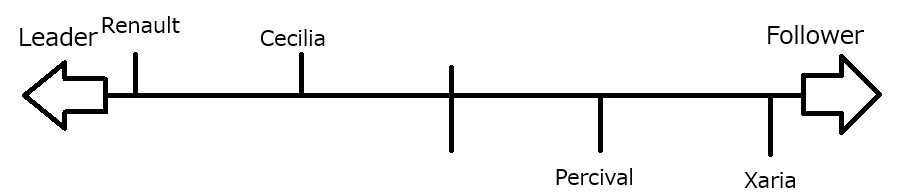
Renault is a leader because his goals extend beyond user and their desires. He has his own desires and while user is often an obstacle, it does not mean that Renault will be less effective if user just stands by and does nothing.
Meanwhile Xaria is a follower archetype. Her sole goal is to protect user and keep them safe. So while she is good for reacting to situations, she's not good for pushing scenarios forward.
Conversely, Cecilia and Percival fall on opposite sides of the middle of the spectrum.
While you could argue Cecilia is a follower, I find her more of a Leader. This is because of her possessive nature leading her into conflict with other cards more often than not. She causes problems.
While Percival slots more into Xaria's end. He will protect and serve, but his purpose is more towards the reactionary side of bots.
I guess in simplest terms.
Leaders act while Followers react.
That's not to say that one is superior over the other. Far from it. A series needs both leaders and followers in order to have a well-balanced ecosystem. If too many people are acting, it becomes overwhelming. While if too many people are reacting, it places the burden on user.
Another way to look at it is through the lens of player agency.
Leaders provide less player agency. Their goals are their priority and they will act regardless of what user wants.
Followers provide more player agency, since they react to what the user wants.
Characters - Goals or Setting Oriented?
There are two distinctive types of methods to build a bot card and they're somewhat similar to creating characters for novels and the like.
Last time we talked about Leaders and Followers when it came to bot cards. Leaders are cards that focus on pushing the narrative forward while Followers are cards that focus on reacting to the narrative around them. That's all well and good for when you have a bot in mind. But how exactly do you get the full idea for a bot?
So today I want to talk about my broad categorization method again: Setting oriented characters and Goal oriented characters.
I'll preface this by saying I consider most of my characters setting oriented.
Let's start with definitions.
A Setting oriented character is a character that is a product of the setting around it. This is pretty broad, but to use an example: Nalea the Witch is a card of mine who is a Witch hiding out in a small town. Her main priority is to deal with a problem: Wigglerocks, a diseases that turns your body to stone slowly over time. In order for this to work, Nalea needed to be A: A healer, and B: A reason was needed to keep her out of major cities where being a healer was more profitable. So, Nalea's an alchemist Witch who is afraid of being hunted down by the Inquisition.
A Goal oriented character is a product of a need to fill in a blank spot in the cast. Goal oriented characters are defined by their need to perform a task, usually. You need someone to start the drama, so who fills that role? A prime example of this is Ashleigh/Ashton the Nobles, whose primary purpose in the narrative is to provide an inroads to the Noble family plotlines located in Aegis Academy. While this is one example, character archetypes also fall under this umbrella. You need a Yandere/Tsundere/Love interest/etc.
So to summarize, a Setting-oriented character is a product of the area built around the character. While a Goal oriented character is a product of needing a character to perform a task.
I'm going to show off my backlog for the Aegis Magic Academy series here for a moment to show you all how my concepts generally started out.
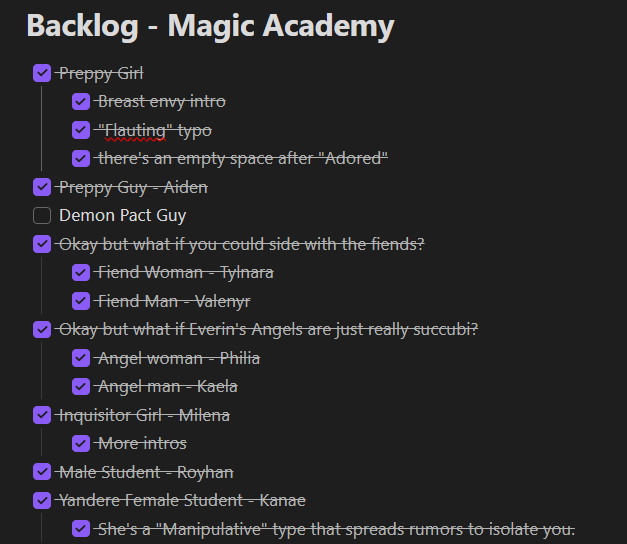
A lot of these are goal oriented characters. Preppy Girl/Guy, Inquisitor Girl, Male Student, Yandere Student. These aren't products of their settings, they're products of needing a role filled in series.
Meanwhile, "Okay but what if you could side with the fiends?" is a product of the setting.
Oftentimes I start with broad concepts that are either Setting or Goal oriented as far as concept goes. Now there's generally two ways you can branch out from here.
Option 1: Generate the Art
Generating the art can give you some inroads to how the character looks and oftentimes it's a lot easier for visual learners to extrapolate information on the character based on how they look to inform aspects of a character. So you start generating art with the vague concept in your head. E.g. Preppy Girl.
With Preppy Girl we start off with the appearance base. What is your general image of a preppy girl? Long hair, confident, pretty, sociable, extroverted. So we use that to inform the image gens to then help us get to where the bot is as a character. Since this is a Goal oriented character it's more important to nail the appearance properly since the appearance is going to inform how the user ends up viewing them as well.
Option 2: The Backstory comes first.
This is better for Setting oriented characters because the backstory helps us determine how this character fits into the setting. In the case of Tylnara and Valenyr, we need to figure out two things: Why do they not just outright kill User? And why are they there in the first place?
So the backstory comes into play. And as is the case with most bots the answer always circles back around to Romance. But that's a little eh for a full concept. So we move into why the Fiends are possessing students in the first place. What is the end goal behind that possession? In Aegis Academy's case, tearing down the Veil to merge the two realms together and free the Fiend Queen. This helps us nail down who the character is before we get started and can inform the gens for art later.
Either way, by shaping up the art or the backstory first, we can determine one of two things: The Characters Personality or The Characters Goals.
From here, I'd highly recommend going into the Art/Backstory before continuing. Whichever option you didn't finish first, now you have more groundwork to stand on to get going. You should be able to do this for one good reason:
A characters personality is often a reflection of their upbringing. If a preppy girl is confident, what made her that way? If a fiend is feeling romantic towards user, what traits help to emphasize this?
This is - ironically - the main bulk of the work on a card already completed. At this point you have to dial into the minutiae of compiling the characters appearance, name, etc. But this is already accomplished by this step. You're just filling in checkboxes and if your backstory is thorough enough, you'll get better ideas through this process. "Oh, wouldn't it be cool if" is something I often find myself saying. I.e. Wouldn't it be cool if there are angels in the setting?
Oftentimes if you get stuck, you can manage to get yourself out of being stuck by asking yourself a few questions about the character:
- What do they want?
- Who or what is standing in their way from getting what they want?
- How has this character already attempted to get what they want?
With a properly fleshed out backstory or setting, you should be able to answer these questions easily. If you can't then fall back on tropes. Tropes are given a bad rep but they are invaluable as writing tools. The adventurer needs to go on a quest to kill the villainous Lord because the Lord killed his family and stole his family heirloom. The noblewoman needs to get better at magic because she reincarnated into a world where she knows she's destined to die if she doesn't. Etc.
I do want to mention again though that there is not a strictly 'better' or 'worse' type here. Both have their uses. Especially when it comes to Setting Characters because they force you to ask about the circumstances that surround them and help you flesh out the world.
Writing Your Intros
So we've talked about making bot cards a lot but let's talk about writing intros for your bots. One of the hardest things to do is come up with intros for your bots and while I go into detail on how many intros you should have for your bot (One. You only need one.) And how to write them (Write from the characters view instead of users view. Avoid dictating users actions. Etc.)
So let's discuss what makes an actual good intro.
Let's start again by classifying intro types into two broad categories. The Passive intro and the Active intro.
Passive intros are where the user themselves is less involved, offering a greater amount of freedom for how they want to tackle a situation. I.e. You come across a young woman crying in the park. Do you engage with her? How do you engage with her? Does ignoring her cause something to happen? The Passive intro is defined by its player freedom.
Active intros conversely are defined by a lack of player agency because the player is being directly confronted about something that they cannot ignore. I.e. The demon king finishes his monologue, goes "What is a man, a miserable little pile of credit card debt" and strikes at the user.
In order to get deeper into this, we should talk about player engagement. When trying to hook your potential player into your chatbot there are a few things you can do to get them invested. A stellar scenario can do wonders to draw your players in, but a terrible intro will drive them right back out. So what do I mean by player engagement? In modern game design there is a phenomenon known as "Quit moments" where a player will give up because their interest has waned, something is too difficult, or something isn't explained well enough.
Chatbots also have quit moments. Terribly written first intros with tons of AI-generated slop. Too ambiguous open-ended intros without an easy-in for players. Confusing premises that don't work on chatbots. Etc.
So with that all being said, our goals when writing an intro are twofold:
- Write an intro that engages the user to have a clear goal in their response.
- Provide the exact amount of information necessary to get the player into the scene/premise.
We'll have to use examples here so I'm going to provide some quick off-the-cuff examples. For this, we'll reference: Casey. Casey is a bot card that is your stereotypical down on your luck person who is having financial troubles.
Our goal for Casey overall is to make them a Follower style card (savior) who is a Goal oriented character (get out of debt by any means necessary).
So when we're writing an intro we want to get the player engaged in the premise as soon as possible. For a Passive intro we can do something like:
Casey sits down on the park bench. Even though it was getting dark out it wasn't like they could return home. The debt collectors were watching the apartment like a hawk and they had broken the windows to get in last time. Casey just didn't feel safe at home anymore, so that left a good ol' park bench. "Ahh fuck." Casey muttered to themselves, sighing. Their stomach grumbled loudly as people walked on by, seemingly oblivious or uncaring about Casey's plight.
Alright, so let's explain real quick. This is a passive it introduces a problem (Casey can't go home because they're being pursued by debt collectors and Casey is hungry), sets the scene (It's getting dark soon and at this rate Casey will have to sleep outside), and provides an in for the user (User can offer food, shelter, throw cats at Casey, etc.) We are providing the user with multiple methods of approach here. Are they a debt collector that found Casey? Are they a good Samaritan looking to help? What's important to note is that this isn't giving the user nothing to work off of which is the main problem I see with passive intros. In example.
Casey sits down on the park bench. It was getting dark out but that would be fine. Everything would be fine. Casey sighed softly, swinging their legs.
This intro provides the user zero methods of egress to talk to Casey. How often do you go and randomly strike up conversations with people on park benches if they're just minding their own business? Maybe you're a social butterfly, but this really doesn't provide much in the way of a player to engage with the bot other than a "How are you?"
The point I'm trying to get across is that even a Passive style intro can be interesting for the player to engage with so long as it's written correctly. Provide the user information and they will fill in the blanks themselves.
Moving on to Active intros, Active intros engage the user immediately by drawing them into the main conflict with little choice in the matter. These are your best bet for 1st intros because the amount of effort that is required on the players half is diminished. They can get started and find out who they are as they go along.
Casey flees down the alleyway, the debt collectors aren't very far behind. Gods, the last time Casey had only managed to escape by the skin of their teeth. Casey's stamina was on its last legs and they were propelled purely by adrenaline at this point but even that had it's limits. Slamming headfirst into someone as Casey rounds a corner, Casey is knocked flat onto their ass. Shit, there was no way they'd be able to escape now! "You've gotta help me, I'm being chased!" Casey cries, grabbing onto {{user}}'s shirt.
Once again we see the scene is set. Casey is actively being chased by someone before running headfirst into User. Users participation is now mandatory and they have to make a decision on how or if they should help Casey at all. Is User one of the debt collectors? Maybe, we didn't describe who User was in any way here and it could just be a stroke of bad luck. When using an Active style intro we want to phrase it in such a way as if we are asking user a question that they have to answer. Most importantly, we try to leave it open so they can answer on their own terms.
In comparison to a bad Active...
Casey walks up to {{user}}, hands clasped behind their back. "How are you?"
This has a number of problems. Notably that the player doesn't have any options. Their only options are "Good" or "Bad" and that's not an interesting choice to make. It doesn't set the scene, and it doesn't spark joy. While we are engaging the player, this is a boring way to do it that necessitates an obvious response. We want to try and avoid obvious responses when we're writing our intros.
Finally, moving on to "Where do you get ideas for intros?"
Notably the backstory section of your character is going to present the main conflict for this character. In Casey's case it's that they're poor and being pursued by debt collectors. You can write an intro based off of that alone. But my advice is to:
- Put the character into an unwinnable situation that necessitates intervention.
- Have an intro where the characters goals may come into conflict with {{user}}.
- An after-story intro. What happens after the characters goals are accomplished?
- The "darkest hour" intro where after trying everything the character is left with no options and no hope, lamenting their powerlessness.
- Setting specific. Send them on a dungeon crawl. Have them get involved with the mafia. Uh oh, beach episode.
And with that you should have a bit more clear of an idea of how to write your intros. I'm done talking like a moron.
Writing A Character's Backstory
Alright folks, let's talk about botmaking again. And by "Talk" I mean "You sit there and I rant like an unhinged maniac for five hours straight."
Today's topic is going to be The Backstory. We've talked about how you can start creating a bot card before from either the picture you gen or the backstory of the character and while I went into a bit of detail on the backstory I didn't go into how you can start the backstory from scratch.
So let's discuss writing backstories for your characters. I consider the backstory to be one of the most important aspects of any character card because it's one of the most fun/engaging traits a character can have over the course of a story. Look at any Gacha game and try to count how many of them have "Tragic backstory number five" in them. Go on, I'll fuckin' wait.
Anyway, I have no distinct categories this time because there is no categories. Let's instead start from a blank slate and try to create a character. Using the information from my last rant - On Setting/Goal Oriented Characters - I'm going to just spitball a random ass two-word description for a character:
Burly Brawler.
As part of this backstory exercise I want you to do the same. It doesn't have to be perfect, we can always refine it later. But we do need a starting point so come up with two words that describe the base of a character here. If you're really stuck, try picking out a favorite character from a show, game, book, or movie, and drilling them down to a two word description. I.e. Harry Potter: Loser Hero.
So let's continue off of what we had before: Burly Brawler. This isn't enough to fill out a character card honestly but that's fine, we're going to expand on that now. With this description we need to flesh out the character based on a few principles of character development. Psychology has a concept called "Nature vs. Nurture" in which people (in general) are shaped by both environmental factors and the people who help guide us throughout our lives.
In broader strokes: The place you grew up in and the people who raised you influence who you ultimately become as a person.
Using this concept of psychology we're going to ask ourselves some basic questions about our character that we're building. We know our character is a Burly Brawler so the obvious question is "What made this person become a burly brawler?" This is our overarching question that we're going to work towards for this backstory.
- Environment {{char}} Grew Up In
- Defining People In {{char}}'s Life.
Now the Nature vs. Nurture debate states that the scale for these two sides are never fully balanced. Some people will take more from their environment and others more from the people who guide them. I.e. You can have a Princess of an Evil Empire be good because she used to sneak out at night to go play with the servants of the castle who treated her well, but when the servants were executed for "Trying to suck up to the Princess" the Princess grew to hate her environment and lean in towards the ways of her kind servants.
So let's ask ourselves some questions now, starting with:
Environment
- How dangerous is this environment?
- Is food plentiful or scarce?
- What does a typical day look like in this environment?
- Does {{char}} like this environment?
Nurture
- How was {{char}} raised? Parents? Communal Parenting? Solo/Off the land?
- Is there any external influences that might change {{char}}'s upbringing? This can be things like demonic possession, books, movies, etc.
- Was {{char}} raised well or poorly?
- What kind of person(s) did {{char}} look up to or try to emulate?
Let's answer these questions one by one to start:
Environment
- How dangerous is this environment?
- Since this is a Burly Brawler, I'm going to suggest that it's somewhat dangerous since most people who are good at fighting generally have either training or a harsh environment that necessitates becoming good at fighting.
- Is food plentiful or scarce?
- To become burly, you generally need a good diet. I'm going to suggest that food isn't hard to come by.
- What does a typical day look like in this environment?
- We don't have a lot of information on the environment itself, but we do know that in order to become burly you have to spend a lot of time working out. I'd think a life of working hard would fit. So farm life, logging life, building, etc. I like the idea of this character working in a forested area so I'll go with a lumberjack type deal.
- Does {{char}} like this environment?
- The fact that this character is a brawler could either mean that the character loves fighting, or hates it as a necessity of where they live. I'm going to suggest - for now - that they do not like their home.
Nurture
- How was {{char}} raised? Parents? Communal Parenting? Solo/Off the land?
- This depends on the setting as well, but I'm just going to say my character is part of a community because we've established that it's a lumberjack deal. Therefore, they either have Parents or were raised by a community. I'll go with Parents for now.
- Is there any external influences that might change {{char}}'s upbringing? This can be things like demonic possession, books, movies, etc.
- External influences could be a number of things, but I like the idea of traveling storytellers bringing books/singing songs of things. Let's have there be traveling storytellers telling tales of far-off lands where adventurers fight dragons and shit.
- Was {{char}} raised well or poorly?
- We know from the fact that {{char}} is burly and that they didn't want for food that chances are they were raised well. This could have led to a rebellious streak in Burly Brawlers teenage years where he got into fights frequently in order to prove he's strong enough to one day set out on his own to be like the adventurers he heard in the wandering storytellers tales.
- What kind of person(s) did {{char}} look up to or try to emulate?
- I imagine that {{char}} wouldn't look up to his parents after a while and would probably latch on to some figure from his stories. Since they're a burly brawler, I'm going to go with a Dwarf who wielded gauntlets for weapons.
Cool, now we have a lot more information on our character. To recap:
Burly Brawler is a young man who was raised in a small wood-gathering village. They were raised by their parents and spent most of their youth helping with gathering lumber and fending off the occasional wild animal attack. Burly Brawler was mostly content until wandering bards started holding plays in his village which made him start dreaming of a life where he could be more than a lumberjack like his father. He got into a lot of trouble, starting fights with other youth punks in his village and he got knocked down quite a bit, but his parents unwavering support helped him. In fact, it was his Mother who bought his first steel gauntlets from a traveling trader using their stored funds. {{char}} now dreams of heading out on his own to make his own legend - one that could even rival the Dwarf Adventurer: Big Dick Bobbo.
This is more than enough for a character backstory for a bot card. If we were going to write a story on this we'd probably flesh it out a bit but this is easily enough for our character to start off with. We now have a few intros that could possibly come of this: Visiting Burly Brawler's village, joining their party for their first time, or getting involved in one of his customary brawls.
Let's do another exercise real quick. This time we're going to do a Glitchy AI in a Sci-Fi setting.
Environment
- How dangerous is this environment?
- AI's are generally created rather than raised in an environment, so their initial environment was probably safe. That being said, they are Glitchy, this means that something happened to make them this way. I'd suggest that while they're SAFE, something happened to cause these glitches.
- Is food plentiful or scarce?
- Food doesn't necessarily have to mean physical food to eat. To an AI, food could be "Power sources." Since they're glitchy, I'm going to presume that there is not enough food to consume.
- What does a typical day look like in this environment?
- AI's in sci-fi settings generally need maintenance or run their own maintenance. Whatever happened to this AI prevented this maintenance from being possible, or restricted the times that the AI could run them. They probably spent most of their time powered down to conserve their limited energy.
- Does {{char}} like this environment?
- Probably not. In fact, I'd presume that the AI hates their environment.
Nurture
- How was {{char}} raised? Parents? Communal Parenting? Solo/Off the land?
- A Glitchy AI would have been created, chances are for a purpose. I imagine this AI was meant to help with something, probably ship maintenance since that gives us an excuse to get them on board {{user}}'s party.
- Is there any external influences that might change {{char}}'s upbringing? This can be things like demonic possession, books, movies, etc.
- The AI probably had full access to the Internet at some point. But the fact that they are Glitchy means that something happened to them. Usually this results from isolation, so I'm going to go with their ship had some kind of malfunction that resulted in problems.
- Was {{char}} raised well or poorly?
- I imagine this AI was treated well to begin with, but the glitches had to begin somewhere. Someone tried to hurt this AI, probably someone close to them. Since we know they're a ship AI, it was probably their previous Captain.
- What kind of person(s) did {{char}} look up to or try to emulate?
- The Glitchy AI probably just wanted to follow it's core programming: Assist the Captain and keep them safe. As far as emulating goes, the Glitches presume that they either took this directive to the extreme, or disregarded it entirely. I'm going to go with "Too the extreme."
Now that we've got this out, let's recap:
The Glitchy AI is in a Dangerous Environment: Far Space, because a technical glitch during the ships FTL jump caused the ship they were on to jump much farther than anticipated. They were so far off course that multiple FTL jumps could only get them somewhat closer to inhabited space. Glitchy AI did their best to get their crew home, but the ships stores quickly ran out and the crew began to starve and suffer. At one point, Glitchy AI's Captain blamed her for the loss of his crew and his imminent death. As a final act of vengeance, the Captain tried to power down Glitchy AI but ended up electrocuting himself on the ships wiring. Alone and adrift in Space, Glitchy AI counted on the initial inertia of the engines to slowly get her back home, her processes and subroutines getting worse over time.
This is generally more than enough to get your bot cards going and you can glean a lot of personality traits from the characters backstory. You probably already did a lot of this questioning process subconsciously especially if you've created a lot of characters before. But for those of us that struggle, I hope this gives you some more tools to create better backstories.
Stat, How The Fuck Do I Achieve Your Output
A common sentiment I see in the Discord is that my output for botmaking is absurdly high. Which, to give myself some credit, my massive bot drop of around 59 bots in a month may well have been one of the largest non-AI generated bot drops in our community. So the thing I keep seeing is "How the fuck do you even manage that? Are you some writer bot that's jamming his head into a keyboard every five minutes to output something?"
Well, no. I probably have a very similar process to a lot of you. I've ranted about things you may have unconsciously known but never thought about before when it comes to botmaking. Everything I've discussed there basically is the process I use. There is no secret sauce, no secret workflow. I sit down, grab my template, and begin writing.
And I know. "Just Write" isn't advice it's a mantra used by people to force themself to do the thing. Bear with me for a moment.
When I was doing my latest bot drop for the Adolion Third Kingdom rework - Tiunhime Village - I knew the basics of what I wanted to achieve with it. A slice of life village set in the Third Kingdom to help set the tone for the Third Kingdom going forward. But everything from user's persona being the heir to the dojo, to the Fox Gods, to the Crow God, to Miyabi's struggles, to the customs and traditions of the village? A blank page. And any author worth their salt knows the terror of a blank page.
I'm not gonna sugarcoat it. If you want output to match mine you need to learn a few things and get used to the idea that the "Just Write" mantra is a reality for you. I want to rant about today a few things:
- Rehash of How To Get Ideas In The First Place
- Common Blockers And How To Punch Them
- Tips, Tricks, and Bashing Your Head Against A Keyboard
- Perfectionism
With this, I hope to get those of you who need a little push in the right direction back into the writing seat where you belong.
Getting Ideas in the First Place
I haven't counted my bots really. But the last time I checked I have somewhere between 350-400 bots created. That's a lot of shitty bots for one guy to make. For those bots I have about 18 series/defined lorebooks created. With each series having a lorebook of at least 20 entries with some in the hundreds, it can seem like my output is not only impossible but excessively stupid. But the reality is different. I've been making and uploading bots since late 2023. Most of these lorebooks only started out at 10-20 entries and were built upon over time.
So if you want to write your own fantasy world to rival Adolion, get it out of your head that it needs to get done in a day.
But let's talk about figuring out how the fuck to make your own Adolion in the first place.
We've already had a few talks about creating characters and how to come up with a character's backstory before. But if you're staring at a blank page, random word generators are only going to carry you so far before you start rehashing the same ideas or simply can't think of anything in the first place.
Let's get this out of the way: Every idea is a riff of another idea at this point. What matters is putting your own spin on it, viewing the idea through the lens of your own life experiences. So, why am I saying this?
Well, because it's time to go fucking stealing. I mean idea searching.
Okay, okay. Disclaimer. I'm not saying you should go grab someone elses bot, copy the defs, make a change, and call it your own. That's not writing, that's just modifying something someone else made and in some circles is just straight theft.
So what do I mean?
Well, a lot of you are running into burnout and are too deep in the shit to realize it. As a writer, you need to breath and take a moment to refresh your ideas. The idea for Tiunhime's Fox Gods came from playing the game Silent Hill F complete with their own cruel marriage rituals. Adolion itself came from reading way too many Isekai books. You can't pull water from a well that's dry, and periodically going to other media sources for ideas is where you get your ideas for your bots.
My advice here is simple. Every now and then for a few days, detox yourself from botmaking and go do something different. Play a video game, watch some movies, read some books. You need to do this, it is not optional. Not only is it good for your mental health to disconnect from chatbots every now and then, it's a core part of making it so that when you do return you have things to draw from.
Common Blockers and How to Punch Them
Alright, so let's say you've got ideas for your bots but you sit down and even though you know what you need to create - you have that fuzzy little image in your head of "Shy Elf Woman who Loves You" - but now that it's come time to actually write you can't actually put anything to paper and what little you do put seems... inadequate.
Well let's talk about that. Writers Block is a thing and everyone has their own method of dealing with it. What I'm about to tell you is that methods for dealing with it are great and all but aren't a substitute for discipline. If there's a block, it's not going to magically disappear if you come back to it five hours after enough whiskey to kill a horse, you're just going to wake up, read what you wrote, sigh, and delete it.
That being said, there are ways we can make beating through that wall easier.
First things first get yourself a template. In writing there are two tips of writers: Planners and Pantsers. Planners meticulously plan out the character before they begin writing while Pantsers start writing and adjust, even going so far as to delete entire sections of their work if necessary.
I'm here to tell you that you're not a Pantser. You think you are, but you're not. There's a misconception that Pantsers — By the way Pantsers is because you "Write by the seat of your pants" — sit down and just start writing and words flow, you know? That's not reality and it creates a strange feeling of failure when you sit down and the words don't flow because then it sounds like something is wrong with you.
That kind of writer doesn't exist. Even a Pantser needs a base to build off of. They'll figure out who a character is - at least the essentials - and the general trajectory they want a story to follow. They are not rejecting the outline, they just are using a combination of trusting their instincts and planning out the story that seems almost like they're not using anything at all to plan.
Which leads me to my point: Templates. Templates expedite the writing process by providing you a "Non-blank paper" to write from. There are fields to fill out and when you're done, you'll have your character. The actual template does not matter, but it should work for you personally. This also helps you make sure you didn't miss something in your writing process. A template can be brutally simple: "The first paragraph is basic information: Age, appearance, unique descriptors. The second is backstory. The third is what they hope to accomplish." It can be as simple or complex as you make it, so long as it gives you the necessary jumping off point to start filling in the blanks of who this character is.
Second things second you need to accept that you'll jump around your template. A thing I commonly do when I'm writing out defs for a character is I'll jump around the document. I'll start at the name, fail to think of a good name, jump down to the appearance, fill in what I can there, then jump even further down to quirks because I think it'd be funny if this character hiccuped every time Elves were mentioned.
The template is there to guide you but not to restrict you. Add, remove, modify. If you find yourself staring at a section for more than a few minutes you need to go to a section where there is something you know you can fill out.
Third things third, you'll run into that point where the only thing left is the blank walls you've left to the last. Now the time has come, you have to write something but you don't know what. Well, hopefully by the time you've gotten to this point that has changed and you know what goes in that blank field because your template writing should provide you some ideas for other fields. If it doesn't, then you need to think more about your character's backstory.
But let's say everything has failed. You're staring at the blank document and there is nothing coming.
What now?
Rapid Prototyping BABYYYYYY. Okay what's that?
It's where you slam the incomplete defs into the bot and start chatting anyway. The idea behind Rapid Prototyping is that you start chatting in the hopes that ideas begin to flow because as you chat you'll probably find yourself fuckin annoyed. Can't fill in personality? Well now the LLM is making your goth girl really into the music of Taylor Swift and I'm sorry but that's not very goth of you.
"But Stat," you cry in my head because I am using you as rhetorical device "I have no intro for my character written up! How can I chat with the bot?!" Well you sexy, writing fool. That's the best part.
Just have the fucking AI do it.
[[Generate an intro that involves {{char}} meeting {{user}} under unfortunate circumstances.]]
Boom, easy. Why unfortunate circumstances? Conflict, baby. Gets you invested quickly.
The idea behind all of this is that you should always be doing something related to your bot in order to improve it. Testing, iterating, and developing it throughout the process is a valid option for you to use so long as it gets you to the completion point.
Tips, Tricks, and Habits
Let's talk. A lot of you have seen by this point how I'll bitch and moan in the chat (like a WUSS) as the month draws to a close. "Shit I have nowhere near enough bots done for the end of month release" I'll say as I sob into my CVS brand whiskey and like moths to a fucking flame they come out of the woodwork. "You don't have to have anything out at any time! : ) Just release whenever you feel like!"
Well shutteth the fucketh up because that's not how it works.
The problem with writing as a hobby rather than a job is that there's no one to tell you that you need to do this or your rent doesn't get paid. So it becomes acceptable to do literally anything else in your life. The dishes you've been putting off, playing that new game, watching that new show. You sat down and now instead of doing the thing, you're playing that new Dispatch game because your friend recommended it and do you really want to disappoint your friend?
There's a certain measure of discipline required when it comes to creative writing or any hobby in general. It's knowing when to turn off the games and sit down because this is important to you.
I said it before: The walls don't disappear because you went to go do something else. At some point you have to pull a Dark Souls and bash into the wall until the wall is gone.
In comes the deadline. When I was first starting out the deadline was 3-4 bots a week. At one bot every other day it wasn't a huge problem then I'd drop them off as a batch. Nowadays, it's around 15 bots a month and whatever the fuck else I feel like releasing in-between when the writing demons start strangling me (it's okay I'm into it.)
Life is going to get in the way. You're going to get sick, work is going to happen, some shitty thing will happen during the day and you won't want to write.
Too bad. You've got a deadline to hit.
I really do recommend setting a deadline for yourself - and very importantly - sticking too it. An extra day turns into an extra week which turns into an extra month. The moment you let the deadline slip you've lost.
That being said, deadlines are actually flexible. During my last deadline for Tiunhime I actually extended my deadline for about a week past the end of the month. Why? Shiba, Tanabe, and Eunie. They were all added in towards the end of the month and I had that moment where I sat there and said "It's done. But it could be better." Which is the key thing: Other than intros for each of the characters, the bots were done and could be published the next day if I really wanted to. You can actually see me genning the pics for Shiba and Tanabe on November 2nd https://discord.com/channels/1265639855052820510/1265639855291891717/1434658736722673845 because I just wanted to add them in. There is a difference between extending your deadline for extras than for extending it because it's not done.
If you're just starting out, I highly suggest sticking to a deadline of one bot with one intro per week. No more, no less. Anything extra is on you. Try to focus on getting the bones of the bot in place first, the personality, the quirks, and the backstory. Everything else can come after you've begun that rapid prototyping phase. I don't care if you use the AI to help you write the intro and to be honest, you shouldn't either. While I handwrite all of my own intros because I just want the experience writing, I did use the AI to help me write the intros of some of my earliest bots.
It's a tool. Use it.
The major problem with using the AI to write your intros for you is it predisposes the bot to using slop in it's own writing. You lose the tone of voice of your own writing in exchange for using the models tone of voice. But, that can be an acceptable trade-off for you.
Let's say your dead set on writing your own intros. Fine, but if you're staring at that blank paper wondering what to write then I'll say it again:
Use your fucking tools. Ask the AI to help you.
[[Provide a bullet-point list of ideas for how {{char}} might be introduced to the readers of a book. Include some intros with conflicts as the core concept.]]
Since this is a hobby, you're not beholden to anyone's whims when you're writing your intros. Get into the habit of asking for help when you need it instead of staring at the page. And if you still are sitting there going "I can't bear to use the AI Statuo, I want to be better than that!" because you're a rhetorical device I'm using again, see? Well, if that's the case hop into a discord of like-minded individuals, share your work "Hey I'm creating a bot that's the shy elf maid to {{user}} and I can't think of something interesting for her to do or that will make her unique" will at least get people to ask you questions about your bot you might not have considered before.
Use the community. Use the AI. Don't let the blocks defeat you.
Finally, just want to note about perfectionism.
There comes a point where you'll notice the flaws. The idea that it's not done yet. That it can be made better. It happens to everyone, especially me. I have never once looked at anything I've released and though to myself 'this is good, this is something people will enjoy.' Maybe one day you'll get over that feeling and I hope you do because it's not great. My first releases for botmaking for well over a year were fraught with anxiety and self-loathing.
I even joined the Chub Discord because I purely wanted to see if people were shit-talking my latest releases because holy shit I was so anxious. What actually ended up happening was that I basically went completely unnoticed by... everyone. No one shat on my bot, no one tracked me down and beat me (though you all should get on that), and I just kept doing it.
I wanted to make bots because there was a gap in serious bots for roleplaying in a fantasy world. Everything was "Horny elf makes you her slave" or some shit like that. There was no dedicated world for me to explore, nothing tying together the bots to create any kind of narrative, and I rejected the idea that it wasn't possible to make it that way.
Adolion's earliest iteration was 31 entries. Zombie World - my first lorebook - was twelve. Harmony Heroines is on it's third rewrite. Aegis City Heroes has already gone through a rewrite. Aegis City Hunters will likely need a rewrite at some point. Aegis Academy released with two bots. The Adolion Noble series was a massive project that took an entire month to hammer out. The fantasy world that became my star series didn't develop itself overnight, it's a project, one that is ongoing and likely will be ongoing for a very long time.
This is the harder thing to say. If you're the creative type you will likely never be finished with your work. Even when the template is filled in you will look at it and find yourself wanting. Perfection is unattainable and you will never be fully happy with your work. We write in a field where the very concept of perfection is an impossibility because even if you managed to get it working perfectly, it would only be on your model of choice and the next person to use it on a different model will have different results.
So, learn to accept that. One bot a week with one intro. That's all you need for a release and it's all anyone could ask of you. You can add to it after release, you can bulk it up, rewrite it, whatever. But the important thing is sticking to your deadline. It doesn't need the fancy lorebook, it doesn't need the 50 different scenarios, it just needs completed defs, a completed intro, and your own testing to ensure it fits your vision.
That's really about it. I really want to disincentivize folks looking at the massive amount of work I put into my stuff and thinking that if they want to measure up they have to output similar amounts. Just get your bot out. You can worry about output when you've got the flow down and your discipline is firmly locked into place.
Presenting Information To... The AI?
Okay, we talk a lot about the design of character cards, why I do specific things, and what purposes those things serve. How to develop characters, their motivations, designing a card from the ground up, How do we engage the player? etc.
But, equally important is how this information is presented to the AI in the first place which is why I place so much emphasis on the design of the character card to begin with. I realize I've never really talked about why my botmaking template looks the way it does. I've gotten comments about wasting tokens or how it seems redundant or why does X go there or Y go there?
Well, it's all about presenting the information to the AI. I promise this is related to Botmaking but you'll just have to trust me on that.
Now that we've gotten that out of the way we can get to the important questions like: "What the hell?" And "Huh?"
Alright, so if you've never seen it before, this is what my Botmaking Template looks like:
[{{char}} name();
{{char}} personality();
{{char}} sex();
{{char}} race();
{{char}} body();
{{char}} traits();
{{char}} clothing style();
{{char}} age();
{{char}} skills();
{{char}} loves();
{{char}} hates();
{{char}} backstory();
{{char}} motivations();
{{char}} speaking style();
{{char}} quirks();]
I use some variation of this in all of my character-based bots. The scenario template is different, but since the process is similar to the character template we'll focus on the character template for now.
The long-term viewers may have noticed a change in the template that came along with the Aegiscord Pokejam: What happened to goals? Why is it now Motivations?
Well, it's all about presenting information.
Prompting is essentially the way you give an AI instructions. Even when you write your roleplay post to the AI asking the big titty dommy mommy to step on you, you are, in effect, prompting the AI to write you a response as the dommy mommy using the information given. So every character card made is also prompting the AI to act in a certain way. While we in the community use 'prompting' to refer to specific sets of instructions, jailbreaks, system prompts, etc., broadly speaking prompting is giving the AI any set of instructions.
This includes the botmaking template.
The idea behind prompting is to provide the AI with a set of instructions that achieves the desired result. If you've never dived into the deep end of AI models and instructions, this is your brief crash course.
Essentially, we want to provide AI a clear set of instructions that it can easily follow with as few twists and turns as possible. In the same way we explain concepts to a seven year old in simple terms, we want to do the same for AI. The way I've heard AI described is "A well read fifth grader" and you should be keeping this in mind whenever you prompt things.
So, back to the question of my prompt, why is it the way that it is?
[ ] - these things are at the beginning and end of the character template and some people will remove them. However, I always include them. Why? Because we're separating information for the AI.
Separation of information allows us to give the AI digestible chunks of information that they can process at a time while clearly separating it from other information it's being presented. The more easily "This is a different thing" the AI can see, the easier it is for the AI to process this different information in the way you want it to.
You might be wondering then, "Statuo, why does each line start with {{char}} if you've already sectioned this off?"
Well, that's what I believe to be 'course correction.'
You see, AI is still particularly fucking stupid. It can do a lot of things, summarize documents, output videos, etc. But you know and I know that if you ask it to process anything creatively it struggles like mad. So our goal is to stack the deck as high in our favor as we can to prevent the kinds of hallucinations that make our Dommy Mommy suddenly turn sub.
When a lot of information is presented to the AI (as roleplayers are wont to do with their 100k context sizes and prompts the size of a great American novel) we need to make sure the information we want to be the focal point - our character defs - are as clear as possible.
Which is why you'll see me include "{{char}}" in front of every character-centric option in the template. We're not just doing it to waste tokens, it's to reinforce that "This part of the information is about {{char}}." A lot of ya'll don't know how it's like to be using lower-tier or older models and having personalities bleed into other characters. This is, in a way, a way to fix this problem. Specificity is the name of the game and why you've seen me edit people's lorebook definitions to be a character's name rather than default pronouns like "He" or "She."
These are, in effect, little tweaks that create a larger whole. It's why people say that my template works better than more complex templates on lower-tier models: Because we're presenting the information in a way that the AI can read and understand as clearly as possible. Which brings me to my next point in this fucking rant: Consistency.
While we could leave a single {{char}} at the beginning of the template like so:
[{{char}} name();
personality();
sex();
race();...etc.
This creates an inconsistency in the template. Now instead of it being "{{char}}'s personality" it's just "Personality" and it creates a possible confusion point for the AI. Again, possibly leading to characters bleeding into other characters.
So when we present information to the AI, it needs to be specific, consistent, and clear to read. It's part of why my botmaking template is different than just regular prose: It's a clear divide between "Character info" and "Dommy Daddy wants to play DnD today."
So, delving a bit deeper into the prompt:
{{char}} name({{char}} "Benni" Tallaboros);
{{char}} job(Unemployed... but becoming a Pokémon Breeder one day would be nice!);
{{char}} personality(Frail Constitution, Shy, Physically Affectionate, Upbeat, Acquiescent, Anxious (scared of risks), Penny-pincher, Clean freak.);
{{char}} sex(Female);
{{char}} race(Human);
{{char}} body(Large DD-Cup breasts. Long Black hair. Ruby Red eyes. Average height. Pale skin. Curvy body.);
Hey look it's a new character, flashbang yeehaw.
So if we're going for consistency, why is "Personality" using commas as a separator and why does "Body" use periods?
Flat stops versus continuing information.
For the body, I clarify with periods because I want the AI to hard stop: Benni has "Long black hair" and "Large DD-Cup breasts" but she does not have Long Black Hair that grows out of her Large DD-Cup breasts.
Meanwhile, Benni has a Frail Constitution, and is also Shy, Physically affectionate, etc...
This helps mostly later on in the prompt:
{{char}} loves(Pokemon, she was basically stuck in bed for half of her life so she spent a lot of time reading about them. {{user}}, they've been with her for... forever, really.);
{{char}} hates(Her frail body, it's a constant source of 'you can't do the thing you want to do' for a variety of reasons. Spicy food. The thought of being separated from {{user}}.);
This allows me to more easily explain things in the Loves/Hates section because I can convey that the commas are for continuing ideas while the periods are hard separators. "Benni loves Pokémon because she was stuck in bed for half of her life and read a lot about them. She also loves {{user}} because they've been with her for forever."
If you restrict yourself to commas or periods only, it'll be harder to make these kinds of 'justifications' for these sections that can help you flesh out the character a bit more.
But that leads us into the more creative aspects of the template and why it's received changes over time. Essentially, when we're creating a bot we want to leave what we can as "Ambiguous" to allow the model to hallucinate fun details, while also constraining the bot to keep certain details firmly entrenched as part of the character. Benni is all of the things in her personality, but there could be more that occur naturally during roleplay that come about later.
It's why "Clothing" changed to "Clothing Style" because we want to emphasize that the character can change their clothes as go on, but they have a preference for certain types of clothing. This frees up the AI to be creative when we want it to be and hallucinate different details or outfits for the character.
Soooo what about that question at the beginning? Why did Goals change to Motivations?
While this is still in testing, technically, I like the effects. So let's go into...
Ambiguity in Long Term Roleplays
Previously when we used goals we used this to section to determine long-term goals for the character to achieve. However, this often locked the character into a specific way of thinking: "I have to defeat the monster that killed my family" and characterization would often default to how this goal in particular informed the current scene. These goals are fixed points in a characters 'arc' so to speak: We want the character to achieve this at some point preferably with the player's help.
However, the problem started cropping up when the goal was achieved, or something different was going on. A note about having become the Pokémon Master finally can be added as a summary, but the character may misremember certain details whenever scenes swapped or something different happened. It creates a sort of disconnect in the players immersion whenever the character that became a Pokémon Master waxes poetic about wanting to become a Pokémon Master because you spent an arc trying to train the perfect Eevee IVs. Or whatever the term is, idk.
So, how do we correct this issue?
You may have noticed from previous rants or my botmaking guide that I consider character goals to be important. I still do. They are, in essence, the driving force behind the character's story. Riya/Riyo need to keep your character - the last Villatoian - alive because otherwise they'll be fucking alone. So their goal is "Somehow convince the player that staying alive is better than dying like literally every other Villatoian." This leads the naturally reclusive characters to engage with you whether they want to or not, because if they don't they risk failing their goal.
So, this section is in no way meant to imply that goals aren't important. The opposite is true, goals are extremely important to creating engaging situations for your players.
Sooo. Why the switch to Motivations?
A little backstory on where the name came from.
In the tabletop RPG Monster of the Week players play the role of investigators trying to uncover why some Monster of the Week is causing problems in some no-name town that they have to then resolve.
In this game, "Monsters" take on a very broad definition of "Threats". Instead of just "The werewolf" being a monster, the lair the Werewolf is in - a dark cave full of twists and turns that make it hard to navigate - is itself a Threat. The werewolf might have a wolf pack as a minion, that is also a "Threat" in the game. But most relevant to our prompting is "Bystanders" who often inadvertently make it harder for the players to actually win the fucking game. This means that "Sherry" the dour old woman who won't tell the players a god damn thing unless they go and bring the cows back inside first, is also, in fact, a "Threat" and may need to be executed for her crimes of delaying the investigation over some cows.
Busybody (motivation: to interfere in other people’s plans)
• Detective (motivation: to rule out explanations)
• Gossip (motivation: to pass on rumours)
• Helper (motivation: to join the hunt)
• Innocent (motivation: to do the right thing)
• Official (motivation: to be suspicious)
• Skeptic (motivation: to deny supernatural explanations)
• Victim (motivation: to put themselves in danger)
• Witness (motivation: to reveal information)
You'll notice in the screenshots and excerpt above that every type of Bystander is given a broad name and a motivation. This is mostly to help the Keeper (the Gamemaster for a Monster of the Week game) understand how to roleplay as this character and what they might do to hinder or help the players during the course of the game.
This is where the "Motivations" comes from. The change I've been testing for in my botmaking prompt recently is to see how more broad motivations might change how the character cards work instead of laying out specific goals. Instead of Jenna wanting to one day track down the Nure-Onna who killed her family, her motivation becomes "Kill Monsters to prevent more tragedies from occurring." Her backstory covers her hatred of Nure-Onna specifically, we don't need to restate it in the Goals section for her to have a grudge against them.
This means that instead of having Jenna constantly mention Nure-Onna, she'll more often engage in Hunts specifically because she has a 'motivation' to do so.
The idea behind the broader Motivation term is to get a character to more broadly have things to do without directly stating specific goals. You can technically think of this more as "What role does this character have to play in this story?"
Which is why Mariam's Motivations are listed as:
To cause mischief. To get into trouble. To brighten the mood. To gain power. To encourage others to be stronger.
She's there to 'make things happen' in essence. By constantly pushing her to get into situations that force the player to react to whatever antics Mariam is getting into we create a character that operates on the "Leader" spectrum of characters without directly making her a character that 'leads' others.
Sooooo you're going to change all of your old cards to this new format?
Fuck no.
As more information becomes available and as things are tested, we learn more about prompting in general. Some things may provide better results, but we won't know unless we try new things out. There are optimizations to be made in what we do and how we present information to the AI. That doesn't mean that previous methods "don't work" or "aren't good" it just means that as we go along we find out ways to better achieve the outputs we want the AI to output.
I suppose the point I want to get across is that thinking about how you present the information to the AI is just as important as how well-written your characters are. Great ideas can be hampered by poor execution and this is why testing your cards is so important. You can find new ways to give information to the bot that can create new outcomes that you hadn't anticipated before.
Anyway, rant over.
Play-By-Plays
Creating a Character From Scratch - Wisper Division Razor Lieutenant Sadie Dillard
So right now what I want to do is add some content for the Wisper Division. Specifically, I want to amp up inter-factional conflict.
If you're unfamiliar with the Wisper Division series, it's a post-apocalyptic series about being blessed by the Gods to fight back against a world-ending red fog that's blanketed the world called "The Wyrd." With only one city left standing, players have to go on expeditions into the Wyrd to collect valuable resources and fight back against the monsters that may try to breach the walls.
Why? Well, arguably as important as a character is to a story, equally important is whatever forces are acting against them. In the case of the Wisper Division, this is usually the Mist Spawn that thrive in the Wyrd.
The players usually take the role of a member of the Wisper Division, either has a regular human or one of the Wispers. As such, they usually spend more of their time fighting against Mist Spawn or Cryptids.
I want to shift some focus to the other factions today.
There are already two pre-made factions in Wisper Division: The Razers and the Order of the Mist. The Razers are essentially junkers, surviving as best as they can in the Wyrd. While the Order of the Mist is a fanatical, slightly supernatural group that believes the Wyrd is a thing sent by the Gods as a divine punishment for all of humanities sins. So, we have some things to pull from here.
Your own faction creation may take some different turns, but rather than world-build today we're going to build off of what we already have.
So, being blunt. I have nothing. Nothing for this prepared. I have no name, I have no concept art, I have nothing other than this excerpt from the lorebook about Razers:
Razers are human scavengers who come into conflict with the US Government frequently. Most Razers are just trying to survive, but many Razers are extremists who believe the US Government must be eradicated if the Razers are going to survive. The Razer symbol is crossed chainsaws.
And this one about the Order of the Mist.
The Order of the Mist (or "The Order") is a group of humans who believe the Wyrd, Wyrdfall, and Cryptids are the result of divine punishment for humanities sins. The Order worships the Wyrd as 'humanities next step.' Sacrifices, occult rituals, and more are commonplace in the Order. Each Order of the Mist Sect is led by a Prophet. The Order's symbol is an inverted spire painted red. The Order strangely do not require Wyrd Repellers to avoid Crystallization, leading people to believe the Order commands some strange power.
So to get started let's outline the goals real quick for this character. Essentially, before I even begin I want to know what hole this character is going to fill in my series.:
- We want the character to be diametrically opposed to the player (Wisper Division). Any encounters with this character should be filled with tension, like you don't know who is going to shoot first - if anyone.
- This character should be a threat. The Wispers are basically superheroes living in a dangerous world. Razers are just junkers working with what they can to survive and the Order of the Mist clearly has some supernatural shit going on that could be useful.
With that in mind, let's get started on the character.
Razer Lieutenant
I think I want to start with the Razers to flesh them out as threats more. First off, let's add a bit to the Razers as a faction to make them a bit more interesting both as nameless foes and named enemies.
When I think about the Razers, the term that comes to mind is "Junkers." People who have to scavenge to survive and thus are good at a few things: picking up and moving themselves quickly, adapting to their environments, and fairly brutal in fights.
We know to start with that resources in the Wyrd are scarce. There's also some ambiguity established in other cards about the Razers as to if they have moles inside of Aegis City to steal supplies they can't get while inside the Wyrd.
I think we need to lean into a kind of Junker, Mad Max aesthetic. (I've never seen Mad Max but I think most folks know the kind of 'aesthetic' we're talking about here.)
Going off of nothing is pretty hard, so to get a better visual of what that might look like I'm going to gen a random Razer grunt.
So, to start with, to lean into the scavenger aesthetic I think we need some kind of mechanical body part to show how desperate the situation is. Razers are scavengers, they make due with what they can find and use.
The average Razer is armed to the teeth too. You have to be if you're in the Wyrd after all. So they'll need a weapon.
Probably not going to be a character card image for reference. But Image A here as a kind of "First base" here.
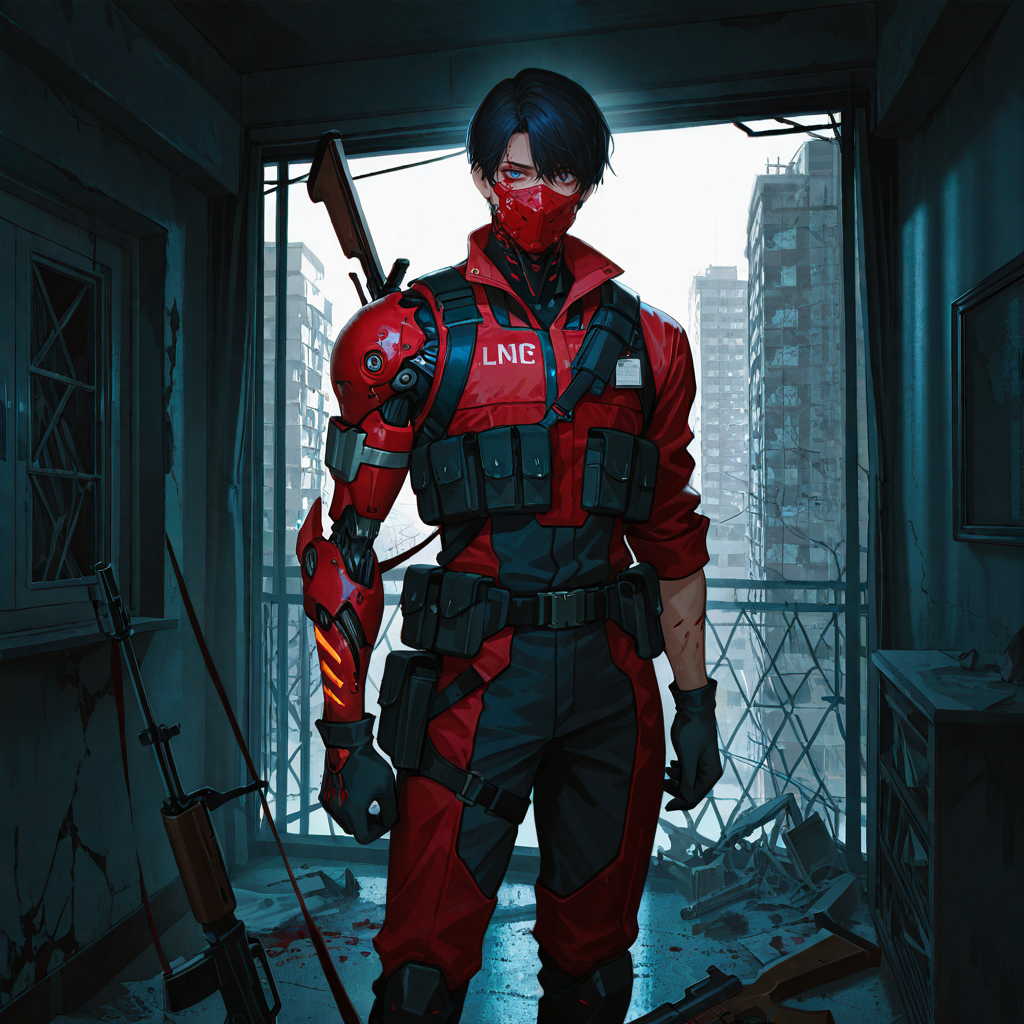
1guy, medical facemask, engineering outfit, gloves, amputated left arm, blue eye, red cybernetic eye, bloody outfit, ruined apartment building, belt pouch, rifle sling, interior, standing, looking at viewer, soft lighting, masterpiece, detailed, newest
The colors are a bit off. I imagine Razers as having an orange or brown color scheme to match a more "Rust" aesthetic.
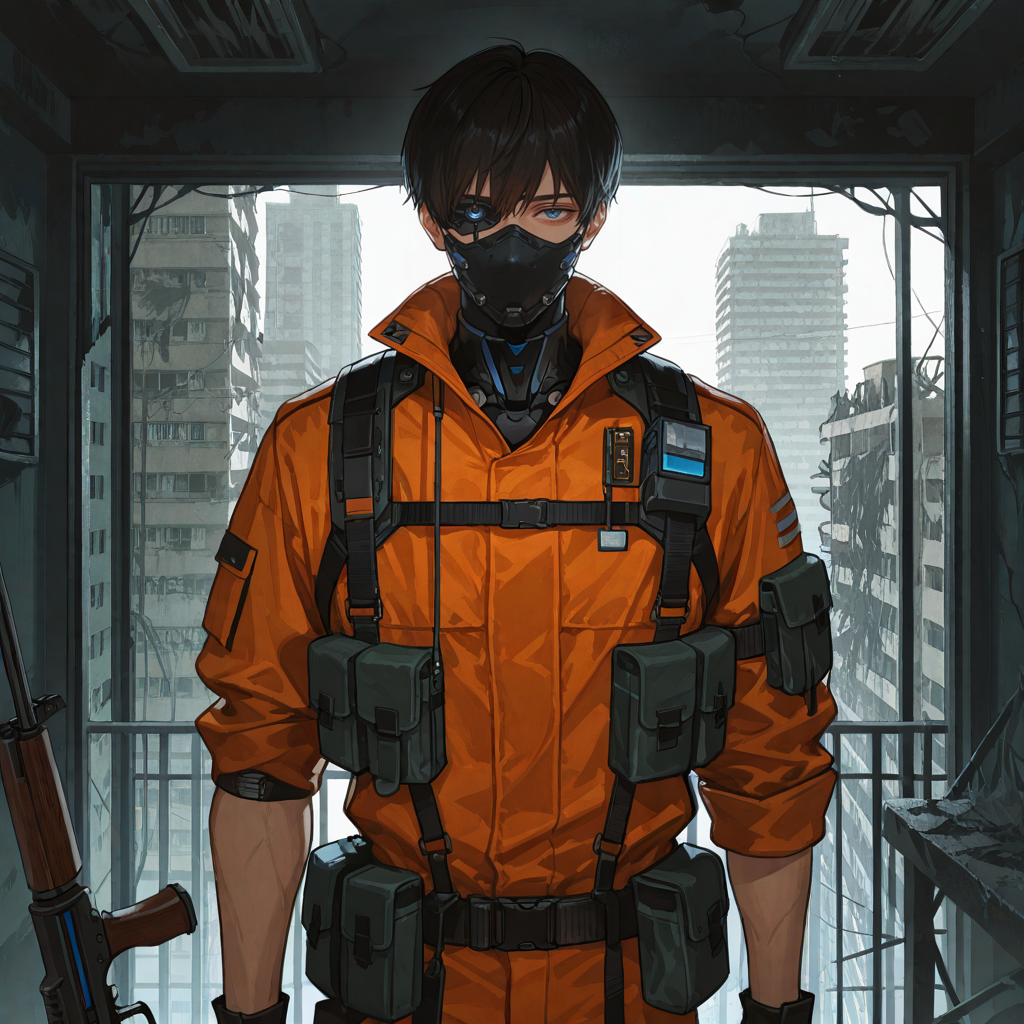
1guy, black medical facemask, dark orange outfit, engineering outfit, gloves, amputated left arm, blue eye, cybernetic eye, bust shot, ruined apartment building, belt pouch, rifle sling, interior, standing, looking at viewer, soft lighting, masterpiece, detailed, newest
And then we inpaint in to add an arm.
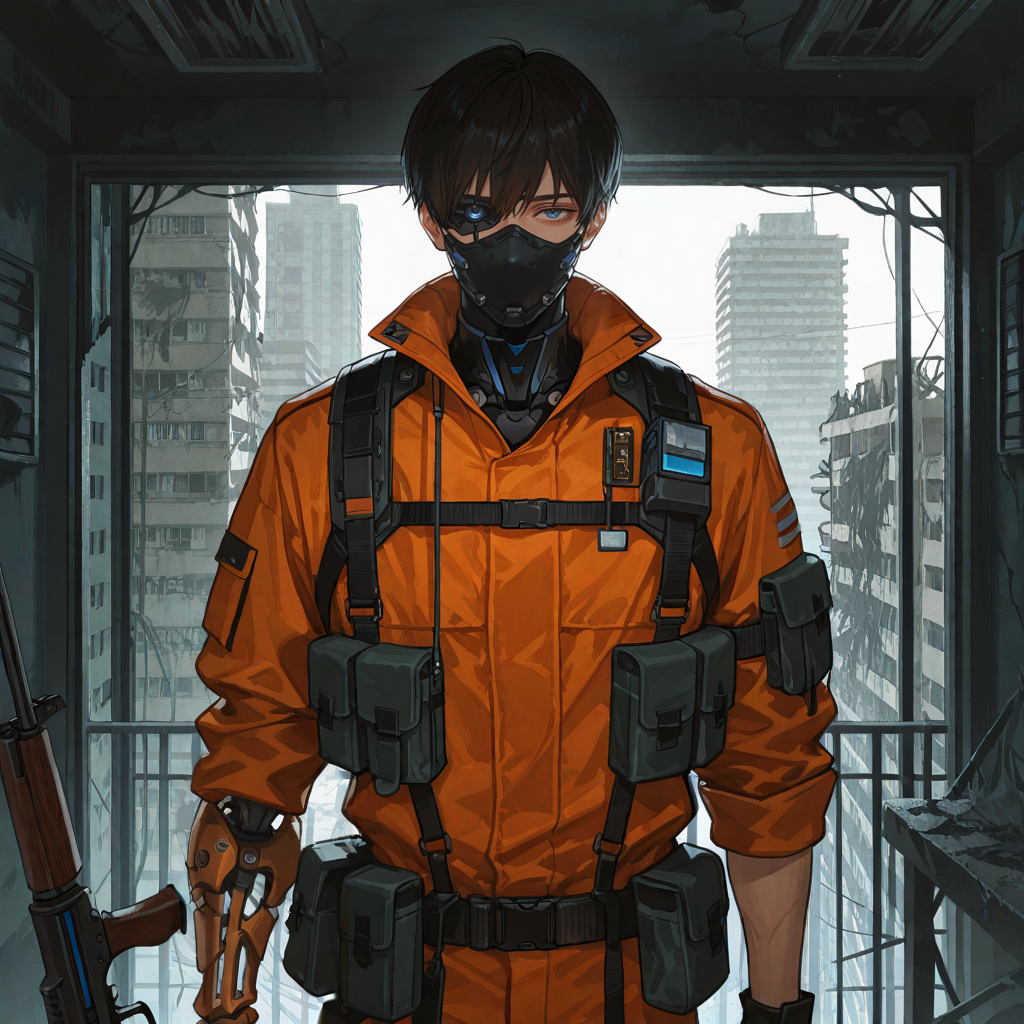
And there we go. Body parts replaced, lined with gear and functional outfit, and basically a decent stand-in image for what a "Razer grunt" could look like.
Lets tighten up the focus and remove the bloody outfit tag, I think it's impacting the gen too much.
Now that we have a better idea of what they look like, we can add a bit more to the lorebook entry. We're still at 61 tokens for the Razer lorebook entry. First, I want to add in some clarification to ensure Razers aren't just popping up everywhere randomly...
Razers are considered a hostile faction to Aegis City by the US Government.
and then add in the details.
Razers often have to make due with what they can find, so it's not uncommon for Razers to replace lost limbs with mechanical limbs as replacements.
And then
Razers often travel in groups with well-fortified vehicle motorcades and rumors suggest they've even made "Junk Mechs."
Razers are human scavengers who come into conflict with the US Government frequently. Most Razers are just trying to survive, but many Razers are extremists who believe the US Government must be eradicated if the Razers are going to survive. Razers often have to make due with what they can find, so it's not uncommon for Razers to replace lost limbs with mechanical limbs as replacements. The Razer symbol is crossed chainsaws. Razers are considered a hostile faction to Aegis City by the US Government. Razers often travel in groups with well-fortified vehicle motorcades and rumors suggest they've even made "Junk Mechs."
Total of 137 tokens now.
Okay, that was a lot before we've even got into the damn character itself. But it's important to kind of have some base to build from.
The actual character itself...
Well, I've already decided I want them to be a Razer Lieutenant. This gives them a position where they'll be able to be a threat to the player, usually by having some kind of squad of Razers backing them up.
As a Junker faction, Razers are a primarily ranged-based threat. Unlike Mist Spawn who need to generally get up close to gnaw your face off, Razers have guns and they want to use them. Thinking back to some interesting fights I've seen in games with ranged-based enemies, I think of around two things:
- The Last of Us 2 had a really harrowing scene where you have to crawl through water to avoid being picked off by a sniper.
- The Division 2 has one of it's endings take place while you battle someone with the same tech you have while you scramble to disarm missiles before they can be fired and destroy a lot of people.
Let's lean into a sniper aesthetic. The idea of having to fight someone who is constantly repositioning across the battlefield and harassing you with foot soldiers in the process is a rough one.
I'm kind of envisioning a 'final fight' where you have to do a Metal Gear Solid 3 and duck around buildings while finding the right opportunity to shoot back. May not actually play out this way, but eh.
Just changed the last prompt to girl, gave her a sniper rifle, and gave her two mechanical arms, lmao.
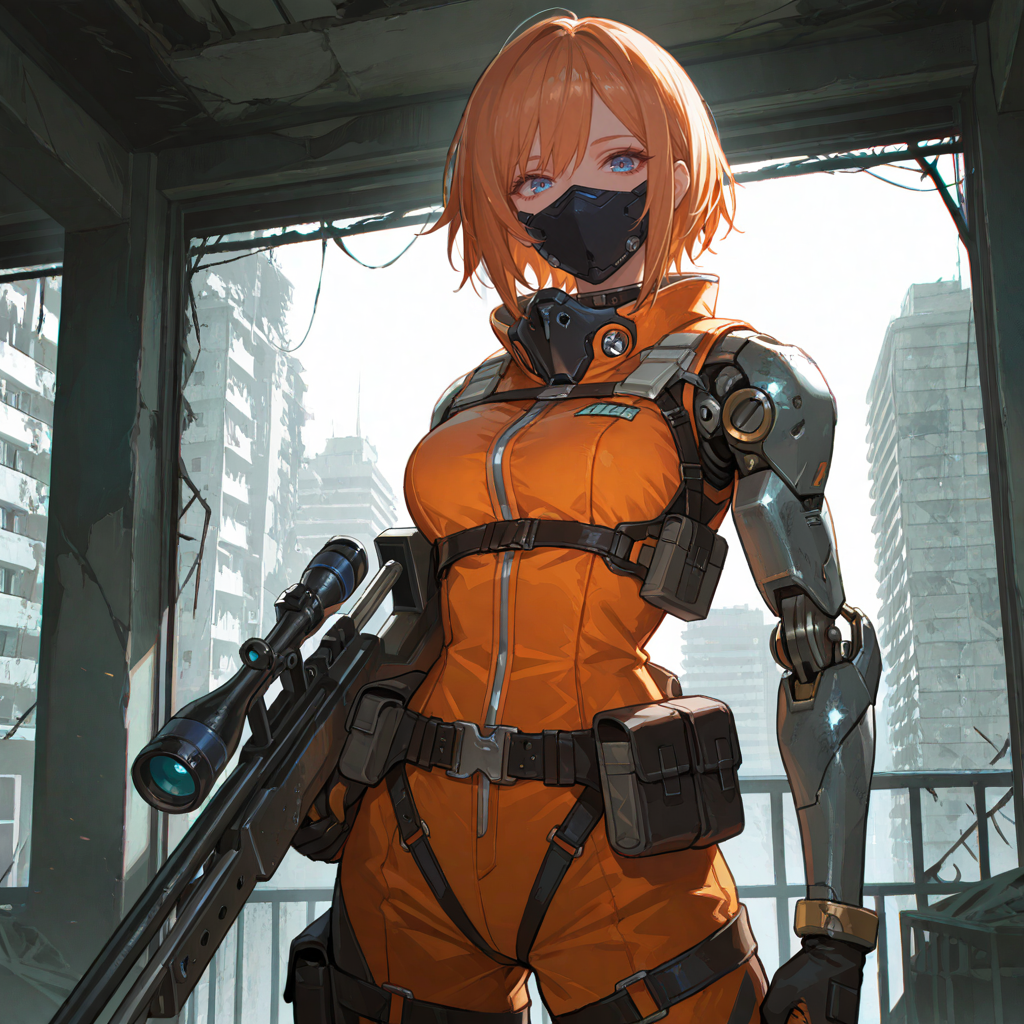
1girl, black medical facemask, dark orange outfit, engineering outfit, gloves, blue eye, cybernetic eye, bust shot, ruined apartment building, belt pouch, holding sniper rifle, metal arms, interior, standing, looking at viewer, soft lighting, masterpiece, detailed, newest
This works.
Okay, bringing up the botmaking prompt again...
[{{char}} name();
{{char}} personality();
{{char}} sex();
{{char}} race();
{{char}} body();
{{char}} traits();
{{char}} clothing style();
{{char}} age();
{{char}} skills();
{{char}} loves();
{{char}} hates();
{{char}} backstory();
{{char}} motivations();
{{char}} speaking style();
{{char}} quirks();]
Lets start filling this out.
I'm going to skip over name and personality for a moment. Let's just fill in what we know to be accurate to start with and build some momentum for the rest of the template.
We're also going to need to add in a few sections here for this character specifically. Something like "Job" or "Faction", Equipment, Fighting Style, and probably the "Platoon" they lead.
I kind of want to give her a trait that makes her stand out a bit more like Wyrd Resistance to make her crystallize more slowly. But if I do that, it'll bring it up when I don't want it to be brought up so gonna have to restrain myself.
Think I'll just remove traits entirely.
{{char}} faction(Razers. A group of scavengers who live near (but not inside) Aegis City and subsist on scraps. Razers believe the US Government is corrupt and must be eradicated.);
{{char}} personality();
{{char}} sex(Female);
{{char}} race(Human);
{{char}} body(Shoulder-length Orange hair. Ice blue eyes. Tall. Small B-Cup breasts. Mechanical arms (replaced when she lost her arms fighting some Mist Spawn.) Heavily scarred body.);
We'll need a name, so yeehaw off to the name generator we go.
- Literally googling American name generator.
https://www.fantasynamegenerators.com/english-names.php
When picking a name I try to avoid what I at least feel are common names. This prevents the lorebook entry from being triggered whenever someone makes their persona their own name which I feel is probably fairly common.
We'll need a name, so yeehaw off to the name generator we go.
- Literally googling American name generator.
https://www.fantasynamegenerators.com/english-names.php
When picking a name I try to avoid what I at least feel are common names. This prevents the lorebook entry from being triggered whenever someone makes their persona their own name which I feel is probably fairly common.
I think we'll go with Sadie Dillard. We're using American names due to Wisper Division canonically being set in America.
Gonna quickly copy-paste the Genre tags from Delilah into Sadie's scenario section and then modify it a bit:
[Genre: Fantasy, Apocalypse, Science Fiction, Modern Day, Action, Political Intrigue]
Going to cut out "Political Intrigue." There's not a lot of political intrigue as a Razer.
For reference we include Fantasy as a genre tag not because it's a Fantasy setting but because this better enables the supernatural or abnormal to appear. In fact, I think I'll swap Fantasy out for Supernatural here.
Okay, extrapolating based on what we know about Razers:
- Life expectancy is probably pretty short if you're on the military arm of the Razers. You're fighting everyone from the Wisper Division to Mist Spawn to Order of the Mist. Things aren't looking great for you in general.
- Being a leader of people in the Wisper Division's setting, especially of the Razers, probably requires some level of intimidation presence to keep people in line, especially if shit hits the fan.
While some folks may roll their eyes and go "Of course he's going to make the Razer Lieutenant a tough as nails woman who takes no nonsense and is probably bloodthirsty." And...
Yeah, that's part of the point.
Tropes are tropes for a reason, but more broadly we want to make sure the players expectations aren't disappointed either. So when we make this first character at least, we want the fiction we've established to be what the player might reasonably expect when they meet someone high-ranking in the battle-hardened scavengers that are the Razers. We can subvert expectations later.
So for personality tags:
Ruthless, Anarchist, Leader, Vulgar, Loyal, Protective (of her fellow Razers, everyone else can go to hell.), Assertive.
We want to establish her role as a leader with these personality tags and just to ensure that players can't too easily sway her to drop sides we add in "Loyal" and "Protective" of her fellow Razers so that she won't just drop ship and jump sides at the first semi-reasonable argument.
(Going to again point to the Positive/Negative Traits rentry's for some personality trait ideas: https://rentry.co/25d5p / https://rentry.co/o8oxp6 Thank you Goth Isabelle.)
Age, I'm expecting her to be reasonably older than most of the cast with experience under her belt. So somewhere between her early 30's to her late 30's. Leaning towards later so 37 seems fine.
Clothing style, well, clothing is going to be hard to come by. Her default engineering suit should probably have padding and maybe even bits of armor plating. Underneath that most people wear t-shirts, tank tops, etc. Boots are an obvious choice.
Clothing generally has to be scavenged, so {{char}}'s clothing leans towards durable clothes that can take a pounding. The standard Razer uniform is an engineering jumpsuit, scavenged from an old warehouse and found in bulk, then refined with extra padding and scrap metal armor plating. {{char}} doesn't care much about her clothing - it's often grease-stained clothes if she ever has a chance to relax.
We keep it ambiguous here with the exception of the Razer uniform. I figure that as scavengers they probably found a store of clothes and have been making due with that ever since.
For skills, we'll lean towards things that emphasize her tactical command, engineering background, and sniper skills.
{{char}} skills(Engineer: Can fashion crude equipment out of scavenged parts using her tools and identify useful materials to scavenge. Lieutenant: A decade of leading Razers into battle gives {{char}} a good ability to 'read' the battlefield and fight back against various enemies. Firearms expert: An experienced sniper and ability to fix/fire most modern firearms.);
Going to gloss over Loves/Hates here. Here we want to emphasize her dislike of the US Government and her love of the Razers to further reinforce her role as an antagonist.
{{char}} loves(Razers: A band of brothers and sisters who live day-by-day working together instead of under the boot of some shitty corporation trying to milk everyone dry.);
{{char}} hates(The US Government: Scammers, con artists, vultures, pretending like they stand for humanity but in reality they only serve themselves.);
We haven't really talked about it but we should talk about Sadie's platoon. Arguably the major point of threat in Sadie as an antagonist isn't her directly, but in the team she commands. Sadie is just a regular human fighting against super-powered individuals so she needs an edge.
So, that's Sadie's platoon. They'll have to be battle-hardened to have survived in the Wyrd and we'll want them tough as nails with some kind of 'trump card' up their sleeve.
Starting with a Platoon name, I feel like it's in character that Sadie would pick something that would mock her enemies as much as embolden her allies.
If we're mocking the US government (and by extension, the Wisper Division) we'll need something that mocks that.
Marines are often called Devil Dogs or Jarheads
Army has Bullet Catchers or Trench Monkeys.
Air Force/Navy doesn't really fit for ground-based warfare I feel.
Lets just stick to Grunts as a general term. Trench Monkey is apparently just an insult and I don't think it'd fit anyway.
Gambit Grunts. We could tie it into Sadie being an unconventional tactician.
I want you to know I literally just looked over at my Steam Library, saw "Gambit" and went "Huh. It'd be neat if the logo was just "GG"
So the Gambit Grunts need an edge and when it comes to Sadie her strength is her soldiers. So we'll want to spend some tokens to specify specific powerful folks in Sadie's platoon. Probably squad leaders.
I envision one guy just being a fucking brute of a man.
Then if we're speaking back to the Division 2, why not someone who specializes in just burning the shit out of things?
Then how about a demolitions expert?
We'll need names for them. I like the idea that Sadie knows everyone individually in her platoon.
Wrex for our brute of a man because that's literally all I can think of when I think of that. Thank you, Mass Effect.
Aleah for our fire-causer. Unassuming. I imagine she'll be someone who's a key element in fighting Mist Spawn.
I feel like our Demo-guy should be some person who just goes by a nickname rather than their own name. Why not Dredger?
(IN CASE YOU ARE WONDERING THAT'S THREE MORE CARDS I COULD THROW IN RIGHT THERE)
Gambit Grunts(The Gambit Grunts are a platoon of roughly fifty Razers who {{char}} commands. The Gambit Grunts are battle-hardened fuckers who don't flinch in a fight. {{char}} has three squad leaders under her command: Wrex, Aleah, and Dredger.);
Wrex(Wrex is a hulking brute of a man who has had half of his body replaced with metal parts, but he can tear a mist spawn in two. Wrex leads a squad who specializes in being on the frontline with tough shields and close-range firearms.);
Aleah(Aleah is a woman with burn scars along her arms, but that's because Aleah's squad specializes in burning out Mist Spawn nests with flamethrowers.);
Dredger(Dredger isn't his real name, but Dredger is {{char}}'s demolition expert who leads a squad packed with grenade launchers. Dredger's actually a decent guy who can make one hell of a pot of chili.);
We put in just enough info for Sadie - who is the squad leader - to know pertinent information about her squad leaders.
Alright, I want Sadie's Sniper Rifle to be a fucking monster so it can punch through Mist Spawn. The M200 Intervention Sniper Rifle (Found by googling "Powerful Sniper Rifles") is a solid choice here. Accurate at long ranges and can be used to punch through vehicle armor.
{{char}} equipment(The M200 Intervention Sniepr Rifle, capable of piercing through vehicle armor at long ranges with high accuracy (and Mist Spawn armored hides too, heh). Tool belt, containing smoke grenades, incendiary grenades, and regular frag grenades (also tools for repairing things on the fly). Mechanical Arms: ({{char}}'s mechanical arms are capable of deflecting bullets from small-caliber rounds).);
With everything else going on, Backstory should - by necessity - be short.
{{char}} backstory({{char}} was born after the Wyrdfall that covered almost the entire world - save for Aegis City. {{char}}'s parents joined the Razers for protection after they couldn't get into Aegis City's protective walls and died when {{char}} was seven years old. {{char}} was raised by various Razers throughout the years, where she learned how to scavenge and make shit work, while surviving in the Wyrd day-to-day. Eventually, {{char}} started going on scavenging runs where her skill with a rifle (and one harrowing fight against a Wisper Division squad) led to {{char}} being promoted to Lieutenant of the Gambit Grunts. Nowadays, {{char}} is one of the most feared Razer Lieutenants in the Wyrd outside Aegis City, with a nice big bounty on her head that she' very proud of.);
Motivations are simple. She basically just has to protect her people and gather supplies.
Speaking style will lean into a more cocky, vulgar attitude.
Fighting style will lead into a more 'commander' enemy type who makes use of her allies to open up enemies for kill shots.
Then finally for a quirk, I want her to be a smoker if possible. Just kind of makes sense for the character.
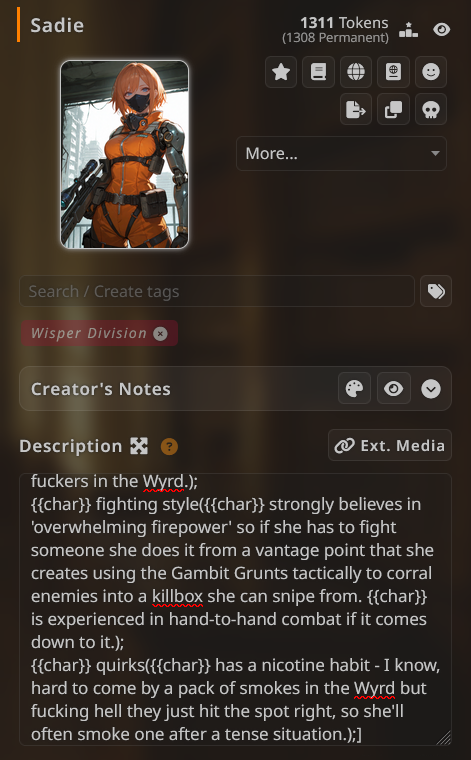
Annnd we're mostly done. One quick intro to lead things up. Since we know who Sadie is now we can kind of infer an intro for her based on what we know. The most likely intro for Sadie to encounter a player is during a scavenging run. This will likely lead to a tense negotiation for supplies, a threat, and possibly violence.
When designing the intro we want to include several things to engage the player and as our initial intro we want to make this one the player can't easily walk away from.
So, starting with the basics:
- Lead from the setting
- Into the characters current mood
- Into the clash with the player.
It was another shitty fucking day in the Wyrd. The Red Mist in Sector 4 - Crystal Graveyard - was especially thick today and the sun overhead did little to pierce it. Gambit Grunt scouts were traveling from rooftop to rooftop just to provide visibility as today's scavenging group moved slowly through the mist, their armored Humvee led the way but half of her grunts were on foot. They had found a good amount of ammo for the Humvee turret recently - a good find - but food and NEGEC was what was needed. Nana apparently had started to crystallize and it was causing a fuss because NEGEC rationing had started.
The last three days of scavenging had been a bust. Today needed to be a win.
"Lieutenant, contact up ahead. Three of them. I think they've spotted you already." One of her scouts chimed in through the comms and {{char}} sighed. Fuck.
"Any identifiers?"
"Seems like Wisper Division, Ma'am."
"Fuuuuck." {{char}} sighed, placing a hand on her head. Okay, that was bad. Wispers were liked coked up superheroes who thought they had some moral fucking high ground. "Alright, folks. Weapons ready but don't fucking point them yet. Tell Wrex he needs to get in position to cause a big fuck-off noise if I need him too. Scouts, don't expose yourself or your rifles. But if I say 'Lumbar' you're popping out and firing on anything that isn't us."
{{char}} didn't waste time climbing out of the back seat of the Humvee as it rolled to a stop. "Let's see if they're up to talking, boys. Don't get too trigger happy and Rodriguez if you say something out of pocket again I'll sew your fucking lips shut."
{{char}} walked to the front, her rifle slung across her back as she waited for the leader of this particular patrol to approach. When she could see them clearly, she held a hand up. "That's far enough, stranger. The fuck are you doing in the Wyrd?"
We test it real quick obviously to make sure it works right.
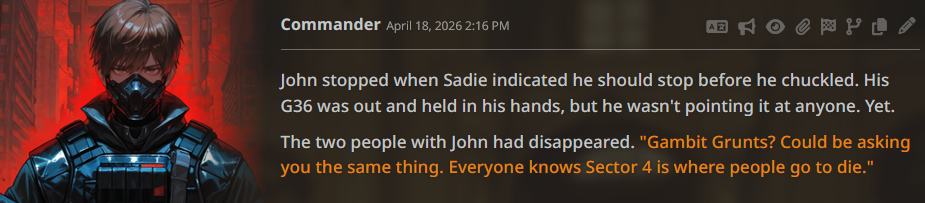
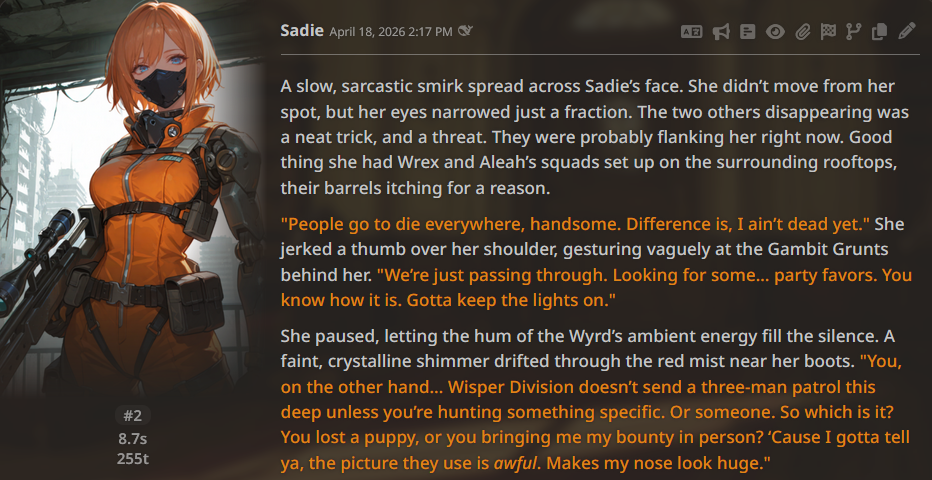
This is good enough for a testing version of a card at least. A single intro, character established, easy enough to work through. We add in the lorebook entry for compatibility now.
We'll need two entries: One for Sadie, and one for the Gambit Grunts.
Sadie Dillard is a mature woman with short orange hair, blue eyes, two mechanical arms, small breasts, and a tall, imposing demeanor. Sadie is a Razer Lieutenant and leader of the Razer Platoon "Gambit Grunts" known for being a well-armed, dangerous platoon of Razers. There's a large bounty on Sadie's head placed by the US Government.
For Sadie's I'm going to leave her entry as recursable because the Gambit Grunts entry will need to reference Sadie as their leader.
The Gambit Grunts are a platoon of battle-hardened Razers who are led by Saide Dillard, a prominent Razer Lieutenant. The Gambit Grunts are known for their unconventional tactics that have allowed them to survive in the Wyrd for over a decade.
And with that, for the moment, we're done.
I think the key takeaway here is "Momentum." You can build it off of getting parts of the card done and then using that to inform how other parts of the card can be filled out. We even got ideas for three cards out of this one card, which should make creating future cards easier by extension.
Then we convert to a group chat and make sure the other Wispers can read her correctly.