♡ gif source ∘ extended ∘ . co / thekingdom
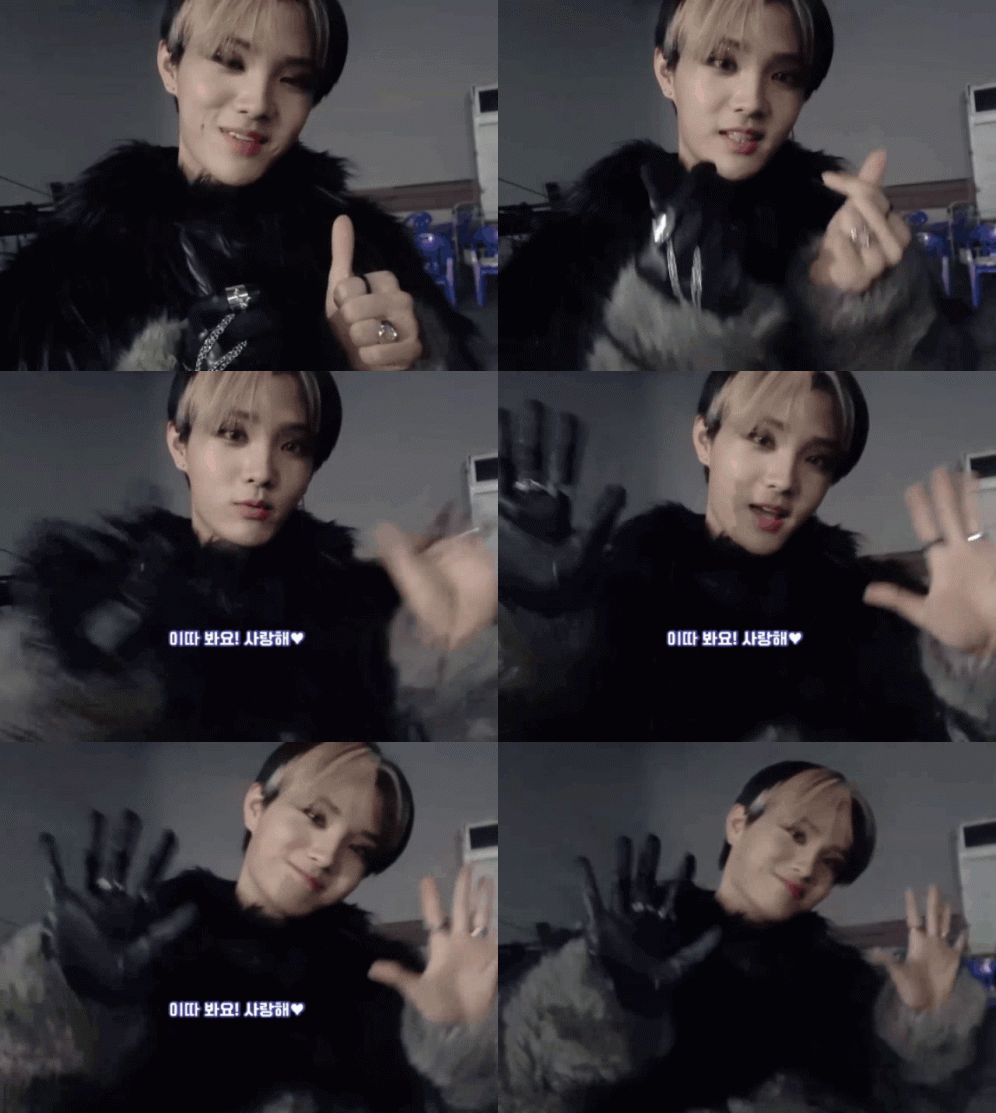
 ˚ ꗯ hello guys ( ❤ ω ❤ ) look..its chiwoo.... plz. hes so cutesy. call me akita or sombra oka? if u can't tell i LOVE!!!!!!!!!!!! the kingdom and have for like 2 years... brooo..... im geeking! if u have any questions let me know on discord or my atabook click for redirection ok brhu. my bias ULTRA 5EVER bias is Chiwoo ok? i love him a lot i love his songs and he always looks verhy cute in all his outfits:) almost bias wrecker is mujin bro
forgive me im writing this at 2:50am OK start of my rant bruh. so. i lauv the kingdom. every member represents a king based on a real historical or legendary ruler from a specific country, and every album is a chapter in one continuous story! you are not supposed to shuffle these albums, they go in order and the events stack on top of each other. One king’s mistake or sacrifice directly affects what happens later. It is very much a “choices have consequences” kind of narrative that a lot of people love! the graphics are also just fucking gorgeous beyond comprehension
So! Each king rules a different kingdom, and the kingdom is tied to their personality, values, and downfall. They are the backbone of the concept so its good to have it in mind when listening and watching!
Arthur represents England and is based on King Arthur! His kingdom is the Kingdom of Rain. He is the first king in the timeline, which matters a LOT!!!! His chapter establishes the rule of the world "power is never free." his kingdom partially burns down, and instead of trying to save everything, Arthur makes a deliberate choice to sacrifice part of his land to obtain the Excalibur (click for the wiki on what that is, but essentially it is a legendary, magical sword of King Arthur in Arthurian lore  )! its important to note THIS WAS NOT AN ACCIDENT and he didn't stumble onto it! This is why Arthur is often treated as the “origin king” even when he is not the strongest one and tiers for the weakest :)
Chiwoo represents China and is based on Chiyou, an ancient tribal leader and mythical king. His kingdom is the Kingdom of Clouds. Over time, the royal family becomes greedy and disconnected from the people. This leads to rebellion, and the kingdom collapses from internal conflict rather than outside invasion. The story emphasizes that long-term corruption eventually leads to consequences, even if the current ruler did not directly cause it.
Ivan represents Russia and is based on Ivan the Terrible, the first Tsar of Russia. His kingdom is the Kingdom of Snow, which is constantly under threat. Ivan is focused on protecting his people at all costs. To do this, he chooses to wear the Black Crown, a powerful object fueled by dark forces. While it allows him to preserve his kingdom, it corrupts him in the process. This chapter makes it very clear that protecting your people at any cost can still destroy you. It is also one of the clearest examples of the lore saying “this is not a victory actually”.
Dann represents Korea and is based on Dangun, the legendary founder and god-king of the first Korean kingdom. His kingdom is the Kingdom of Change. When his land is invaded, Dann realizes the war cannot be won. Instead of seeking forbidden power, he accepts defeat and promises to rise again to protect his people. His story focuses on adaptation, renewal, and the idea that loss does not always mean the end.
Louis represents France and is based on King Louis XIV, the longest-reigning monarch in recorded history. His kingdom is the Kingdom of Aesthetics, centered on beauty, culture, and refinement. Louis is revealed to be immortal, meaning he outlives everyone around him. While his kingdom prospers, he must repeatedly watch those he cares about die. His chapter explores loneliness and responsibility tied to eternal rule.
Mujin represents Japan and is based on Emperor Jimmu or Jinmu, the legendary first emperor of Japan. His kingdom is the Kingdom of Cherry Blossoms. The land becomes corrupted by monsters and descends into a dystopia. Mujin sacrifices himself to seal the monsters away and restore balance. His kingdom is saved, but it no longer has its king, making his sacrifice final!
Jahan represents India and is based on Shah Jahan, the ruler associated with immense wealth and the construction of the Taj Mahal. His kingdom is the Kingdom of the Sun, symbolizing prosperity, legacy, and authority. While his chapter is not detailed here, his role represents the height of power within the world of the story.
Now then, Arthur’s sacrifice normalizes trading loss for power and chiwoo shows what happens when corruption is ignored for too long. Ivan proves that protecting people through evil still poisons everything. Dann introduces rebirth instead of domination. Louis shows that even success can isolate you and mujin ends the argument by choosing complete self-erasure. Also, Chiwoo later leaves the group :(( hwon temporarily takes over his role so he doesnt not receive his own kingdom or chapter and exists mainly as a transitional figure within the concept.
Not every king exists in a clean one-after-another order. Louis being immortal means he is around during multiple other kings’ eras, not just his own chapter. Events from earlier chapters also affect how later kings think and act. Chiwoo’s kingdom collapsing because of rebellion makes later rulers much more wary of their own people turning against them. Ivan choosing the Black Crown shows that Excalibur is not the only dangerous source of power in this world, which implies that these kinds of forbidden objects are a known risk. By the time Mujin sacrifices himself, the world has already been damaged by a long chain of bad decisions, and his sacrifice helps stabilize things after all that buildup.
Fire is used when something is being sacrificed or permanently lost, not just destroyed for shock value. Crowns represent authority, but once they are emphasized too heavily, they usually signal corruption or moral compromise. Ruins are almost always shown as the result of internal failure, like greed, fear, or poor leadership, rather than outside enemies. Ascending imagery appears when a king accepts loss or change instead of trying to overpower the situation. Even the prettier visuals are usually paired with something going wrong in the story, which keeps the tone from being purely triumphant. These patterns show up across multiple eras, not just in one video.
The main idea is that ruling always comes with a cost. Every king pays in a different way. Arthur loses part of his land. Chiwoo loses his kingdom. Ivan loses his morality. Dann loses the war but keeps his purpose. Louis loses connection to everyone around him. Mujin loses his life. None of these choices are treated as purely good or purely evil. They are shown as decisions made under pressure, with consequences that follow. That is why the story works so well. It treats leadership as complicated, not heroic by default.
With that in mind, each king’s chapter can be understood as a different response to the same problem! They all face a crisis that threatens their kingdom, but they handle it in very different ways depending on their values, fears, and priorities :) Arthur comes first in the timeline, so his decision sets the standard for what “paying the price” looks like in their world.
Arthur | England | Kingdom of Rain | :squirrel:
Arthur is the first king in the narrative and functions as the structural foundation for every ruler who follows. His reign establishes the core rule of the story: power is never obtained without loss. When part of the Kingdom of Rain is destroyed, Arthur makes a deliberate decision to sacrifice that land in exchange for Excalibur. The story treats this decision as effective rather than tragic (as it clearly is  ) Arthur does not lose his kingdom entirely, nor does he lose himself. Instead, he accepts limitation as part of leadership. His sacrifice introduces the idea that authority is conditional and must be actively maintained. Later kings are measured against this standard, whether they follow it or reject it.
Chiwoo | China | Kingdom of Clouds | 
Chiwoo inherits a kingdom that is already collapsing from internal decay. The Kingdom of Clouds has been ruled by a corrupt royal lineage for generations, and the damage is systemic rather than sudden. Greed, exploitation, and disregard for the people have eroded trust to the point where authority no longer holds meaning. Chiwoo does not destroy his kingdom through war or invasion. Instead, the kingdom collapses because the social contract between ruler and people has already been broken. Rebellion becomes inevitable. His loss is total, not because he failed as an individual ruler, but because he inherits consequences that cannot be undone. This arc functions as the clearest example of accumulated consequence in the lore. Power abused over time does not result in dramatic punishment, but in complete structural failure. Chiwoo’s fall reinforces that legitimacy cannot be restored once trust is gone.
Ivan | Russia | Kingdom of Snow | 
Ivan is motivated primarily by fear of loss. His deepest concern is the survival of his people, and this fear drives every major decision he makes. When faced with collapse, Ivan chooses corruption as a means of preservation. The Black Crown grants him the power necessary to keep the Kingdom of Snow intact, but it does so at the cost of his moral integrity. Unlike Arthur, whose sacrifice is external and measured, Ivan’s sacrifice is internal and ongoing. His kingdom survives, but his identity as a just ruler erodes. The story does not frame him as purely evil, but it also doesnt absolve him. Instead, Ivan represents the cost of prioritizing survival above all else. His arc explains(?) the idea that a kingdom can be saved while its ruler is fundamentally altered, and that preservation without ethics is still a form of loss that affects everybody in the end.
Dann | Korea | Kingdom of Change | 

Dann enters his arc with full awareness that his war cannot be won. Rather than seeking forbidden power or attempting to delay the inevitable, he accepts defeat as a certainty and reframes his role as king around continuity rather than victory. His defining trait is adaptability. Instead of clinging to control, he focuses on transformation and rebirth. Dann promises that even if the kingdom falls, its people and ideals will persist in another form. This positions leadership as responsibility rather than dominance. His loss is military and political, but not existential. He does not disappear, and neither does his purpose. The Kingdom of Change lives up to its name by evolving rather than collapsing. Dann’s arc presents an alternative response to loss, showing that surrender does not always mean failure.
Louis | France | Kingdom of Aesthetics | 
Louis rules a prosperous and culturally rich kingdom, but his immortality fundamentally alters his reign. While his kingdom flourishes, Louis remains unchanged as generations pass. Every relationship he forms is temporary and every bond eventually ends while he remains. This creates a form of isolation that contrasts sharply with the external success of his kingdom. Louis continues to protect and maintain his realm despite knowing that his position condemns him to permanent emotional detachment. His arc emphasizes that longevity without companionship is not freedom, and that leadership can demand emotional sacrifices that are invisible but enduring.
Mujin | Japan | Kingdom of Cherry Blossoms | 
Mujin confronts a kingdom overtaken by corruption and monsters, transforming it into a dystopia beyond conventional repair. Unlike other kings who attempt preservation or reform, Mujin chooses absolute sacrifice. He gives up his life to permanently seal the corruption, ensuring that the threat cannot return. There is no resurrection, replacement, or continuation of his rule. The Kingdom of Cherry Blossoms survives, but it does so without its king. Mujin’s leadership is defined by complete self-erasure. His arc removes ambiguity and compromise. It represents the extreme endpoint of the story’s theme: that some costs are irreversible, and that leadership can demand everything without offering anything in return.
Jahan | India | Kingdom of the Sun | 
Finally, jahan represents peak authority, prosperity, and divine legitimacy within the narrative. His kingdom symbolizes abundance, stability, and power at its highest expression. While his arc is not explored in the same depth as the fallen kings, his presence serves an important structural role. He exists as a contrast, illustrating what a kingdom looks like at its height. This contrast sharpens the impact of every other loss in the story. By showing how high a kingdom can rise, Jahan’s existence makes the consequences of decline more significant. He represents what is at stake when power is misused or lost.
Hwon temporarily filled Chiwoo’s role after his departure. He never received a kingdom or full chapter, making him a unique and unfinished presence in the lore.
In the first chapter, king Arthur sacrified a part of his Kingdom of Rain - which was burned down - to get EXCALIBUR. In the second chapter, king Chiwoo's Kingdom of Cloud was destroyed by rebels. KARMA struck him because of greed running in the royal family in the past. In the third chapter, king Ivan struggles with his inner battle of good and evil. To protect his Kingdom of Snow, he succumbs to the evil and puts on the BLACK CROWN, a magical item with immeasurable power fueled by evil demon like spirits. In the fourth chapter, king Dann's Kingdom of Change is on the verge of falling into the hands of invaders. He promises that, even though he knows he's losing the war, he's gonna ascend again to protect his people ASCENSION. In the fifth chapter, king Louis is revealed to be immortal, meaning that he has to watch all his loved ones die again and again, the curse of being eternal, loneliness (Kinda ironic, how they called it LONG LIVE THE KING. He swears to always protect his Kingdom of Aesthetics. In this chapter, king Mujin sacrifices himself to seal away evil monsters who caused the Kingdom of Cherry Blossoms to turn into a DYSTOPIA.