The Mystery Dungeons TTRPG
2ɴᴅ ᴇᴅɪᴛɪᴏɴ
Supplementary Links Other pages that contain useful information relevant to the system: List of All Items & Effects List of All Pokémon Abilities & IQ Skills List of All Moves List of All Pokémon List of All Lore List of All Characters List of All Footprint Runes List of All Quests
Table of Contents
- What are we?
- Participating
- Rules
- Leveling & Ranks
- Abilities & IQ Skills
- Team Badges
- Damage Formula
- About Stats
- Stat Allocation
- Health & Overheal
- Changing Stats in Combat
- Charms
- Action Points
- Moves
- Altered Environments
- Non-Move Actions
- Recruited Pokemon & Summons
- Training for Attributes
- Training for Mastery
- Training for Stats
- Training for Moves
- Learning or Relearning Moves
- Resources
- Expansion & Map
- Events
- Countries
Things have been majorly reformatted and rearranged, and the Table of Contents is working as it should. List of items has been linked in the appropriate space. I even added hotlinks to some Keywords so readers can have better back-and-forth access to important contextual information while viewing some of the more rhetoric and terminology-based sections. :>
Disclaimer
Everything written here is subject to extensive changes, especially the numbers, Mason. Do not treat everything you read below in the rules as ironclad unless specified so.
If you edit this file, DO NOT DELETE what you are replacing. Use strikethrough to signify it is outdated until a final consensus has been achieved.
Getting Started
This chapter covers some basics. Let's get everyone settled in.
What are we?
The Mystery Dungeons is a collaborative /qst/ text-based role-playing game based on the Pokémon Mystery Dungeon spinoff series. Organized by two QMs, Players find themselves isekai'd to the world inhabited solely by Pokémon, intending to play on long campaigns.
| · | · |
|---|---|
| Most Players are expected to show up to play the part of the intrepid ex-human adventurer, answering the desperate plea to rescue the world from the clutches of world-ending evils. Here, each Player participates as a rolled Player Character of a Randomized Species in the Main Quests and Sidequests, leveling up and proving they have the strength to take on the challenges ahead of them. | 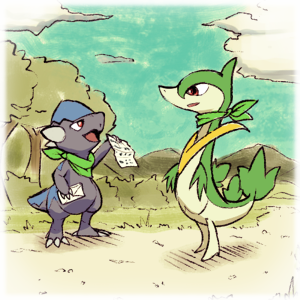 |
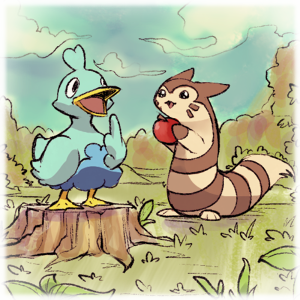 |
However, that's not the only option available for participants who just want to hop in and play as a Pokémon. Participants can roll a species to gain the benefits of being a Player Character, or simply choose what they want and act it out as an NPC. Villager, Law-mon, Elder, Outlaw... someone who runs the local shop, or inn, or service to adventurers is always a choice Participants can make to play as! They can even hand out Sidequests and do a bit of game-mastering themselves, should they stick around long enough. |
Participating
We are split into both /qst/ and Element. Major story elements are concentrated on the board while everything else is handled off-site to keep things tidy. We have two weekly sessions, normally held on Tuesdays and Saturdays on /qst/. These are the Story Quests, missions that progress the campaign.
A majority of us are American and thus follow our timezones, but we do have a small handful from around the world and insomniacs. If Participants feel as though they can't make it to these events, that's okay; players can host their own Sidequests (with proper GM-permission) and chat at all hours of the day between themselves in locational rooms in Element.
The one thing we uphold is randomness in using a rolling system for selecting player characters. While it's obviously not perfect, and sometimes an individual might end up with Pokémon they despise, cheating to reroll isn't banned and no one can prove that you did it, anyway. Unless you rolled on /qst/. Then we'll obviously see all your attempts. Regardless, it's done this way to keep the members diverse from the normal Riolu-Shinx-Vulpix whatever go-to's are popular. We still get them, despite it. Guess they're popular for a reason, huh?
Here is a List of All Pokémon and the finer details of the rules revolving around rolling them.
Rules
The one thing is that we expect some validity and truth to each Player's roll, but to be honest, if they're not using /qst/ already, it's not a big deal. It's not something we can verify nor are we particularly sticklers about upholding this rule. However, there are some others we do care about:
- We are a SFW group. Swearing; adult concepts, vulgarity, and harsh language is fine, but delving past that into sexual acts is banned.
- It's also asked that we keep the relative content of adventures and activities reminiscent of a game with a T for Teen rating. General edginess and blood or injuries are tolerated in reasonable amounts, typical shonen stuff. Meanwhile, gore, brutal horror, and murder are not acceptable. Death can be utilized (should be used very sparingly) for pivotal moments in a plot but is generally left untouched. We're still here to play Pokémon Mystery Dungeon, not a grimdark fantasy.
- Remember, ask this question in the context of a game: 'Will this action/event/detail change the rating from T to M?' If the answer is yes, do not do it. While things might not be so cut-and-dry, the basic gist is there.
- While a Character may be allowed their memories, it's required that any knowledge of constructing advancements in technology are forbidden. Sorry, Genius Backstory Character, you can't start another Industrial Revolution, the consequences would be disastrous! A Character can still remember everything if that's part of the origin, but no constructing things to throw the world forward a tech level or two.
- Don't go building any engines, advanced machines requiring power, computers, or most mechanical devices past the industrial revolution. Medical knowledge and practices, for example, are fine.
- When listing powers a Character might possess, it's alright to use Pokédex for inspiration, but not to take it as gospel. There are a lot of inconsistencies (heights, lore-powers, weights, etc) that just don't mesh correctly when taken into account. For heights, feel free to ask a GM, or reference the anime since they usually have a basic understanding of scale given that they have to place Pokémon next to humans all the time.
- Ex-Human characters (or those with a human backstory) are to be kept as Player Characters only.
Leveling & Ranks
Level requirements may be found here.
A Player Character can earn Experience and Rank Points as they participate in questing. This allows them to unlock stronger Moves, better rewards, and cooler Items to buy from shops. XP and RP are normally rewarded at the end of a main session or at the conclusion of a quest. Some missions might only reward one or the other.
- All Player Characters start at Level 5, regardless of their species.
NPCs are separated from the normal level progression and can start further (but may remain stagnant as they cannot earn XP through normal means) depending on how appropriate it is in regards to their origin.
- When creating an NPC, they can be any reasonable level. If they're just coming from humble beginnings and have lived all their life as a villager, they might be in the range of Level 20-40. If they're not a seasoned farmer and instead an aspiring adventurer, maybe they might even be less than Level 20.
- Avoid making NPCs of the Level 90-100 category.
Abilities & IQ Skills
Every Pokémon has access to at least one Ability. Only one of a Pokémon's potential Abilities may be the active one at a time. Players have a limited amount of space they may allocate active IQ Skills to, but Players are not limited to what IQ skills they would like to obtain.
List of All Pokémon Abilities & IQ Skills
Players are allowed to choose which Ability they may start off with, even including the Hidden Ability some Pokémon have. However, in order to change this selection after character creation, they must visit a vendor.
IQ skills are "purchased" with IQ (costs are listed next to the skill), which is obtained a variety of ways during play. The most prominent method is consuming Gummis or Honey, which grant a varying amount of points. Sometimes, they may be rewarded through play.
- There are three tiers that separate IQ skills by their general usefulness. A higher tier is more expensive. Players do not need to visit a vendor to purchase any of these skills.
A Player can roll from a special vendor (number displayed on the left side of the skill) to attempt to obtain an IQ skill for cheaper. Be sure to roll somewhere it can be verified!Tier 1 Discounted Roll costs 20 IQ.Tier 2 Discounted Roll costs 70 IQ.Tier 3 Discounted Roll costs 140 IQ.
Once an IQ Skill is acquired, there are several things to take note of.
- Each character has a Max of 10 IP (Intelligence Points).
- Each IQ Skill requires a certain number of IP to equip.
- There is no limit on the number of IQ Skills one can have equipped, only a limit to how much IP is available to use.
IQ items can be consumed in a special way at locations that offer drink or food services. They can mix your item into a smoothie, amplifying its effects and powers!
- Once turned into drink form, you gain +1d6 or +1d10 (matching type bonus) to its rewarded IQ amount.
- Drinks can be shared. However, this affects the reward amount.
- The item's base value is divided between each drinker, accounting for matching type bonuses. The corresponding dice bonus is rolled by the original item's owner and is also divided between each drinker.
Team Badges
Rank requirements may be found here.
A Character's Rank is shared with their Team, and rewards from the end of missions and rank-ups are to be distributed between all Team members. Joining another Team and being promoted to their Rank does not grant extra rewards to the Character (their Bag and Storage are still increased) as it is only given once per promotion. In the case a team might dissolve, the highest rank you have achieved will be maintained.
A team:
- Consists of a minimum of two Player Characters, with a maximum of four in one.
- Has a designated Team Leader. This might not mean anything during play, it just means they're the boss! Sort of.
- Has members who all contribute to Rank progression.
Rewards for each Rank:
- Rookie Rank:
- Allows purchasing from Kecleon Shops.
- Normal Rank:
- Blast Seed ×4
- Tiny Reviver Seed ×4
- Oran Berry ×4
- Bronze Rank:
- Sitrus Berry ×3
- Perfect Apple ×3
- Type-Gem ×4 of choice.
- Silver Rank:
- Reviver Seed ×3
- Heal Seed ×3
- Combat Manual x2
- Power Elixir x1
- Gold Rank:
- Icon Crystal ×3 of choice.
- Unlocks Kecleon Super Selection.
- Custom Team Accessory (All)
- Rescuer's Pack x1
- Platinum Rank:
- Razz Berry ×4
- Sitrus Berry ×4
- Adventurer's Bag (All)
- Diamond Rank:
- Encourage Seed ×3
- Vitality Seed ×3
- Lantern Badge (All)
- Ace Rank:
- Heart Seed ×3
- Power Elixir x3
- Unlocks Kecleon Ultra Selection.
- Master Rank:
- Joy Seed ×4
- Heart Seed ×3
- Bag Of Secrets x1
- Grand Master Rank:
- Wonder Gummi ×4
- Empowerment Seed ×1
- Grand Master's Bag
Combat & Combat Essentials
This chapter goes over combat, Stats, damage, and more.
Damage Formula
( BP + Combat Effect + STAB ± Resist ) - ( Opponent Def or Sp.Def - Atk or Sp.Atk Penalty) + CRIT = Damage Value
- BP: Base Power of the Move used. Taken from the normal BP of a Move divided by 10, rounding up. I.E., Drill Peck at BP 80 becomes BP 8.
- Level Damage Bonus: This represents the Character's natural strength improving as they gain experience. The damage bonuses can be found here.
- Combat Effect: The Character's Stat of the associated attack property combined with any positive values not directly related to Stats.
- If in the fringe case it occurs, they can have a negative Stat subtracted from the formula instead.
- STAB: Same Type Attack Bonus. If the Type of the attack matches one of the Types of the Character, they gain a STAB boost.
- Resist: Resistances. This represents the Type match-ups between Attacker and Defender. Sometimes, it might be favorable. Other times, it might not be.
- Opponent Def/SpDef: Reduces the damage of the Move by the Opponent's associated Stat value. Sometimes this may not be provided and the GM will be expected to handle it.
- Atk/Sp.Atk Penalty: This occurs whenever a Pokémon has their Offensive Stats lowered. It may also be self-inflicted either through a Move itself or choosing multiple targets.
- CRIT: If the Move is a Critical Hit (Rolled 20, 1d20), the attack immediately gains damage equal to the AP cost of the Move used. The move now ignores Defensive Stat Boosts and Atk/Sp.Atk Penalties.
STAB & Resistance
Using a Move with a Type corresponding to one of the User's will grant a Same Type Attack Bonus, while using one the Opponent is weak to will make it Super-Effective. Inversely, using a Move that the Opponent resists will make it Not Very Effective.
| AP Cost | STAB | Exceedingly Ineffective (¼) | Not Very Effective (½) | Super-Effective (2x) | Hyper-Effective (4x) |
|---|---|---|---|---|---|
| ≤4 | +1 | -6 | -3 | +3 | +6 |
| 5 | +1 | -6 | -3 | +3 | +6 |
| 6 | +2 | -7 | -4 | +4 | +7 |
| 7 | +2 | -7 | -4 | +4 | +7 |
| ≥8 | +3 | -8 | -5 | +5 | +8 |
Armor
The resilient hide inherent to some Pokemon can sometimes be matched by a similarly resilient will.
Sometimes, a Pokemon will possess "Armor." This Armor seldom takes shape as a knight's shining metal hull. Instead, it may take shape as a Garchomp's calloused skin, a Sirfetch'd's regal wherewithal, or a Medicham's reinforced soul. When an Armored Character takes Damage from Moves with Subtypes they possess Armor against, the incoming Damage is capped. A Pokemon's Armor can be 0, 1, or 2. These stages are known as...
- None
- The default. Damage is mitigated only by the Pokemon's Defensive Stats and Typing.
- Armor
- Singular instances of (Subtype) Damage are capped at 20. Defensive Stats and Typing apply before Armor.
- Hyper Armor
- Singular instances of (Subtype) Damage are capped at 12 and cannot KO the Pokemon. Defensive Stats and Typing apply before Armor.
At the moment Armor is acquired inside or outside of combat, a specific Subtype is selected and the Pokemon in question will gain Armor against Moves of that Subtype.
When Armor is applied to an already-Armored Pokemon, it automatically becomes Hyper Armor without a choice between Subtypes.
About Stats
| · | · |
|---|---|
| With a limited number of Stat Points, a Player may want to focus on their Character's specialties; specialize rather than generalize. This isn't a bad or less-viable way of building Character, but it would be wise to consider what looking deeper into the six different Stats and their purpose. | 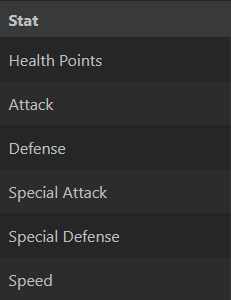 |
| Each Stat is an integral part of the way a Pokemon interacts with the world, and how the world interacts with them. Whichever Stats a Player chooses to invest in, and whatever archetype they embody, good Stat allocation can enable many different play styles. | Stats, their importance, details on how they work, as well as examples of them in use and other niche cases are covered here. |
HP
The HP Stat is a Pokemon life force, and their body's natural progression from frail and fragile to strong and durable.
- Each Stat Point increases Max HP by 2.
- Max HP also increases by 1 every few levels, regardless of Stat allocation.
- When a Pokemon's Max HP is above 30, damage from some Status Conditions is increased.
- A high HP Stat pairs well with other Defensive Stats.
Attack
The Attack Stat represents physical prowess, the strength with which a Pokemon can punch, kick, and throw.
- Each Stat Point increases Physical Damage by 1.
- Physical Damage given by Attack increases the damage dealt by the User with Physical Attacks by the same number.
- Physical Moves are often melee attacks.
- Most Multi-Hit Moves (Icicle Spear) are Physical.
Defense
The Defense Stat is an overall resistance, tolerance, & mitigation which a Pokemon has against Physical damage.
- Each Stat Point increases Physical Mitigation by 1.
- Physical Mitigation is used to decrease the damage taken by a Pokemon by Physical Attacks by the same number.
- Cover your weaknesses; Most Ground, Fighting, and Dark-Type Moves are Physical.
- Not many Moves can ignore Defense.
- Status Moves and Items can easily tear through the guard of a bulky target.
Special Attack
The Special Attack Stat represents magical prowess, and the strength with which a Pokemon can spew flame & frost.
- Each Stat Point increases Special Damage by 1.
- Special Damage given by Special Attack increases the damage dealt by the User with Special Attacks by the same number.
- Special Moves are often ranged attacks.
- Special Moves are likely to have varied Secondary Effects which sometimes inflict Status Conditions.
- More sources of Major Status Conditions weaken Physical Moves than Special Moves.
Special Defense
The Special Defense Stat is an resistance, tolerance, & mitigation which a Pokemon has against Special damage.
- Each Stat Point increases Special Mitigation by 1.
- Special Mitigation is used to decrease the damage taken by a Pokemon by Special Attacks.
- The majority of Spread and Room-Hitter Moves (Dazzling Gleam & Blizzard) are Special, making Special Defense a great Stat for less-tanky builds to invest in.
- A frail backline Character may have to rely on their bulkier allies to defend them from direct Physical attacks.
- Cover your weaknesses; Most Electric, Ghost, and Psychic-Type Moves are Special.
- Not many Moves can ignore Special Defense.
- Status Moves and Items can easily tear through the discipline of a bulky target.
Speed
The Speed Stat signifies the ability to move swiftly and decisively in battle, using quick thinking and reflexes to succeed.
- Unlike other Stats, Speed only increases Max AP by 1 at 1, 3, 5, and 10 Stat Points invested.
- Most Priority Moves (Quick Attack) are Physical, and many Physical Moves are less costly than Special Moves.
- At Max AP, it's possible to use two weak Moves in one turn.
- One strong Move will always beat two weak ones when facing an Opponent with high Defensive Stats.
Stat Allocation
Pokemon come in all shapes and sizes. Be them tiny and weak, big and strong, or anywhere in-between, through hard work and dedication in familiarizing themselves with the world, Player Characters can grow stronger than ever and find their niche through Stat Allocation.
- Pokemon acquire 1 Stat Point every 4 Levels starting at Level 5 until reaching 25 Stat Points at Level 100.
- Everyone starts out with 1 Stat Point they can allocate to any Stat they choose.
- They also start out with 1 Stat Point dictated by their species which they cannot choose, called a Species Bonus.
- Each Stat has a Stat Point cap of 10, but through Training, such limits may expand.
- N/A
Stat Allocation Example
| Stat | Points: 6 (+1) | Modifiers | Combat Effect |
|---|---|---|---|
| Health Points | 0 | Level 25 (26HP) | 26HP |
| Attack | 2 | Level Damage Bonus ɪ | +3 Physical Damage |
| Defense | 0 | ɴᴏ ʙᴏɴᴜs | +0 Physical Mitigation |
| Special Attack | 2 | Level Damage Bonus ɪ | +3 Special Damage |
| Special Defense | 2 | ɴᴏ ʙᴏɴᴜs | +2 Special Mitigation |
| Speed | 3 | Species Bonus | 6AP |
Shown above are the Stats of a Level 25 Raboot. It has a round, even spread of 2 Attack, 2 Special Attack, 2 Special Defense, and 3 Speed, making use of every last Stat Point it has.
- It has no investment in the HP Stat, meaning its Max HP is unchanged from the norm for its Level.
- The damage of its Physical and Special Attacks is +3; +2 from Stat allocation, and +1 to both from reaching Level 25.
- It has no investment in Defense, leaving it vulnerable to Physical Moves like Close Combat.
- It does have investment in Special Defense, meaning it takes -2 damage from all Special Moves like Dazzling Gleam.
- With 3 Stat Points in Speed, 2 from Stat Points, 1 from Species Bonus, it has a Max AP of 6.
- 6 Stat Points are given from the Raboot's Level, while 1 is given to it by its natural Species Bonus, leaving it with 7 Stat Points in-total.

A Pokémon's Species Bonus may vary- every Pokemon is different- however, all Pokemon, no matter what, are given the same amount of Stat Points dependent on their Level.
Health & Overheal
Life in this world is gifted with ample constitution to help bear the weight of the dangers which lie ahead.
As a Pokémon grows and first enters a state in which battling becomes possible, they are given a Max HP of 20, meaning they can sustain 19 damage before further exertion leads to unconsciousness. This Maximum number of Hit Points, or Maximum Health, increases gradually as a Pokémon levels up and in small bursts should they choose to invest Stat Points into their HP Stat.
When a character's HP is showcased, it is depicted as xx/yy, where x is their Current HP after sustaining any amount of damage, and y is their total Max HP.
One's Current and Maximum HP may represent many things. To name just a few:
- A dwindling reserve of Infinity Energy, with each attack traded making the next harder to muster up and realize as their power begins to weaken.
- A measure of overall physical state, reflecting any injuries they may have sustained and how much more their body can take before it stops responding.
-
A string of luck, with the odds of narrowly evading an attack slowly shifting out of favor before they've finally reached the end of their rope.
And anything in between!
Levels and Stat Points aren't the only means of altering a Pokémon's Max HP, however. Through Items and Moves, it is possible to shift their total maximum higher or lower, be it indefinitely outside of combat, or temporarily within the heat of battle.
- Heal Seeds may permanently increase the User's Max HP by 1 per use.
- They're quite the rare find, so choose wisely!
- Certain IQ Skills provide their benefactor an increase to their HP so long as they remain active.
- One mind can't track everything, so be sure to manage available IP!
- Prepared and Cooked Foods can give a quick heal beyond someone's natural limits until it is lost in battle.
- Consumables don't last forever, so strategize with the team!
- Moves which deal False Damage reduce their target's Max HP in battle.
- This can be hard to fix, so come prepared!
When an Item, Move, Ability, or Environment provides additional healing which extends beyond the upper cap of one's Max HP, it allows a Pokémon to act with more health than they'd normally be able to achieve. This overflow of HP is called Overheal.
- Overheal is capped at ½ a Pokémon's standard Max HP after all indefinite modifiers.
- Example: Sparks has 20/20 HP, and after a relaxing day at the spa, he is reinvigorated, gaining 20 Overheal. Unfortunately, due to his low Max HP and lack of HP investment, Sparks only gains 10 Overheal, and enters his next battle at 30/20 HP.
- Later on, Sparks returns to the spa after growing stronger, entering with 30/30 HP and leaving with 45/30 HP.
- If Max HP is an odd number, round up.
- Example: Sparks has 20/20 HP, and after a relaxing day at the spa, he is reinvigorated, gaining 20 Overheal. Unfortunately, due to his low Max HP and lack of HP investment, Sparks only gains 10 Overheal, and enters his next battle at 30/20 HP.
Fainting & Getting KO'd
When a Pokémon's HP reaches 0, they enter a state of exhaustion, unable to battle!
After a Pokémon faints, they're no longer capable of fighting, and unable to use Items or Moves. However, if one of their Allies were to grant them a Reviver Seed, they could get back on their feet and keep the pressure up!
- When revived via Item usage, the Pokémon in question may act on the same round they were revived with no penalties.
- Reviver Seeds are not automatically used when someone faints, even if they have one in their inventory. They must be used by an Ally. With permission, an Ally can use a Reviver Seed from the fainted party's Inventory to revive them.
- If they have not been revived and combat has concluded, they are automatically revived at ⅓ Max HP.
Changing Stats in Combat
Some Moves can increase Stats for the duration of a battle. These are called Stat Modifications; they stack and each field cannot be altered beyond +6/-6. In these cases, they behave similarly to Stat Points, with the exception of Speed. Do not assume they are completely-identical to Stat Points, instead refer to this when needed.
- Accuracy is added (or subtracted) to the Move's Accuracy value.
- As Crit Ratio increases, the range on a D20 needed to land a Critical Hit is expanded.
- Evasion Range decides what number roll the a Pokémon must achieve in order to land a hit on an Opponent.
- Speed can be modified similarly to other Stat Mods, with AP increasing or decreasing by 1 for every stage, regardless of one's actual Speed Stat. Uniquely, increases will always tick back to 0 by 1 every round after they are applied, while decreases will not.
| Stage ↑ or ↓ | Offense/Defense Mods | Accuracy Mod | Crit Mod Range | Evasion Mod Range |
|---|---|---|---|---|
| Stage +6 | +6 | +8/20 Accuracy | 2 to 20 (+12) | 1 to 13 (+12) |
| Stage +5 | +5 | +5/20 Accuracy | 5 to 20 (+10) | 1 to 11 (+10) |
| Stage +4 | +4 | +4/20 Accuracy | 10 to 20 (+8) | 1 to 9 (+8) |
| Stage +3 | +3 | +3/20 Accuracy | 14 to 20 (+6) | 1 to 7 (+6) |
| Stage +2 | +2 | +2/20 Accuracy | 16 to 20 (+4) | 1 to 5 (+4) |
| Stage +1 | +1 | +1/20 Accuracy | 18 to 20 (+2) | 1 to 3 (+2) |
| Stage 0 (Default) | ɴᴏ ʙᴏɴᴜs | Roll 1 (Player Critical Miss) | Roll 20 (Player Critical Hit) | Dodges on 1 (Opponent Critical Miss) |
| Stage -1 | -1 | -1/20 Accuracy | - | Opponent gains +2/20 Accuracy |
| Stage -2 | -2 | -2/20 Accuracy | - | Opponent gains +4/20 Accuracy |
| Stage -3 | -3 | -3/20 Accuracy | - | Opponent gains +6/20 Accuracy |
| Stage -4 | -4 | -4/20 Accuracy | - | Opponent gains +8/20 Accuracy |
| Stage -5 | -5 | -5/20 Accuracy | - | Opponent gains +10/20 Accuracy |
| Stage -6 | -6 | -6/20 Accuracy | - | Opponent gains +12/20 Accuracy |
Decreasing Speed
If a Character's Speed Stat is lowered in combat with Moves like String Shot, they will lose 1 AP, down to a minimum of 4 AP. If a Character is at 4 AP and a Speed-decreasing Move is used on them, they instead become easier to hit by 1 on a D20, making ≥2 accuracy Moves never miss them.
Each +1 to hit on a D20 is equivalent of 1 (5%) Accuracy, meaning a Character with a maximum AP of 4 will be automatically hit by all ≥6 accuracy Moves while at -6 Speed.
| Stage # | Speed (Default 4AP) | Speed (6AP) | Speed (8AP) |
|---|---|---|---|
| Stage 0 | Dodges on 1 (Opponent Critical Miss) | 6 AP | 8 AP |
| Stage -1 | Opponent gains +1/20 Accuracy | 5 AP | 7 AP |
| Stage -2 | Opponent gains +2/20 Accuracy | Dodges on 1 (Opponent Critical Miss) | 6 AP |
| Stage -3 | Opponent gains +3/20 Accuracy | Opponent gains +1/20 Accuracy | 5 AP |
| Stage -4 | Opponent gains +4/20 Accuracy | Opponent gains +2/20 Accuracy | Dodges on 1 (Opponent Critical Miss) |
| Stage -5 | Opponent gains +5/20 Accuracy | Opponent gains +3/20 Accuracy | Opponent gains +1/20 Accuracy |
| Stage -6 | Opponent gains +6/20 Accuracy | Opponent gains +4/20 Accuracy | Opponent gains +2/20 Accuracy |
Charms
Action Points
AP represents the precious few actions a Character is swift enough to make in a fast-paced combat situation. A good way of thinking is that the timescale is only a handful of seconds at best. Make every moment count.
Each Character starts the game with 4 Base AP, which determines how many actions they can take in a given turn. AP can be increased through investing Stat Points into the Speed Stat at a 2:1 ratio, with exception, (See Stats) or increasing Speed via Moves or various Items and Abilities throughout the course of a battle. The Maximum AP of a Speed Stat-invested Character is 8.
Attacking Move AP Cost
If a Move has an unusual PP value, I.E. 25, 35; round up.
- 40PP: 4 AP
- 30PP: 5 AP
- 20PP: 6 AP
- 10PP: 7 AP
- 5PP: 8 AP
The AP cost of any given Attacking Move is based on its mainline PP cost. Stat-increasing or decreasing Moves have their cost determined by their overall effectiveness. (See Status Moves) Status Condition Moves may have a flat cost associated with them. Some Moves may cost more than others at similar power due to their Additional Effects.
Moves that have a higher AP cost than the Character's AP Pool can be Trained to be used even when they lack the AP to use them. (See Training) In these cases, the Move's AP value is ignored and instead costs their total AP Pool, meaning they can ONLY afford to use that Move on a given turn, taking no other actions.
Single-Turn Actions
If a Character has enough AP to act multiple times in a single turn, they can. However, there are limitations to performing multiple actions.
- The total AP costs of the actions performed cannot exceed the Character's Maximum AP.
- All Actions must have the same Focus.
- Only 1 Status Move can be used in a single turn.
Choosing Focus
A Character attempting to take multiple actions in a single turn must choose a Focus. There are two to choose from: Opponent & Allies. These may also be considered Offensive or Defensive actions.
- Opponent Focus ᴏʀ Offensive Actions: The Character must direct all actions on Hostile Targets, whether a single enemy or several.
- Allies Focus ᴏʀ Defensive Actions: The Character must direct all actions on Themselves or other Friendly Targets.
Environmental actions are also considered Allies, unless the Environmental Action directly affects an Opponent.
About Turns & Rounds
*In combat, a turn will be a Pokémon's chance to act. *
A round is split into two turns: (Ally) Turn and (Opponent) Turn. When it is either side's turn, all Characters on the aforementioned side will be prompted to do whatever they choose to, but only within their turn. Whichever side goes first may vary, but each side always gets 1 turn. After both sides have had their turn, the round ends, and the next one starts. The cycle repeats until combat ends.
Moves
A Pokémon's methods of interacting with the world may differ from those of others, but one thing is always consistent; Moves.
Moves are separated into two categories:
- Attacking Moves, which directly deal some form of damage to an Opponent. Sometimes, they might also have a Secondary Effect which can apply a Major or Minor Status Effect to the User or Opponent.
- Status Moves, which are not meant to directly deal damage to an Opponent. These usually interact with Stats both positively and negatively, states of the battlefield, or other niche uses.
To hit an opponent, the Player must roll a d20 to determine if the attack lands. Unless otherwise stated, most Moves work like this:
- A Critical Fail (Rolled 1, d20) results in a miss.
- 2-19 results in a normal hit.
- A Critical Success (Rolled 20, d20) results in a Critical Hit.
The Miss and Crit ranges can change depending on the Move used. The Move's Accuracy is determined by the number not included in the range, which cannot exceed 20. Moves that are originally 100% Accuracy can miss on 1, and are represented as ≥2. Otherwise, Moves that might have a ≥7 Accuracy have a miss range of 1-6.
PP & Limited Use Moves
Some Moves possess a PP count in place of their Accuracy. In these cases, the Move does not usually miss outside of outstanding circumstances, but only has a limited number of uses before its PP needs to be recuperated, either over time, or through the use of certain PP-restoring Items.
When a Move's PP runs out, it can no longer be used. Not until it's been replenished.
Damage Categories
The means through which Pokémon influence the world may vary in more ways than one.
- Standard Damage: Don't mind the pain, we're built for it!
- Traditional Attacks which reduce a target's HP, with the final damage number being influenced by the User or Opponent's modifiers.
- True Damage: It pierced through our defenses..!
- Unblockable Attacks which ignore Stats, Stat Mods, and all other forms of mitigation or amplification, provided the Attack lands.
- Sources of True Damage negation are scarce and expressly refer to True Damage when it is able to be mitigated.
- Unblockable Attacks which ignore Stats, Stat Mods, and all other forms of mitigation or amplification, provided the Attack lands.
- False Damage: Were these wounds always here..?
- Traditional Attacks which instead reduce a target's Max HP, rather than their current HP, and prevent healing past the new maximum.
- When their Max HP is reduced below their actual HP, their health remains as effective overheal until the False Damage is cleared.
- When a Pokemon's Max HP is reduced to or below 1, they suddenly lose energy and their HP depletes to 0 immediately.
- Example: 20/20 HP Sparks takes 10 False Damage, and now sits at 20/10 HP. After taking just 9 False Damage, Sparks reaches 20/1 HP and faints.
- False Damage can be modified and mitigated as if it were Standard Damage.
- False Damage is cleared immediately by Heal Seeds, Revivers, and Defense-Awakening's full heal.
- Traditional Attacks which instead reduce a target's Max HP, rather than their current HP, and prevent healing past the new maximum.
- Flat Damage: It's ugly work at best, but it'll do!
- Simple Attacks which abide by Type Effectiveness but ignore mitigation and modifiers.
- Type Effectiveness alters the final damage number like normal.
- Simple Attacks which abide by Type Effectiveness but ignore mitigation and modifiers.
- Typeless Damage: This isn't how skilled adventurers fight!
- Traditional Attacks which ignore Type Effectiveness but abide by mitigation and modifiers.
- All other modifiers alter the final damage number like normal.
- There is no way to acquire STAB with ???-Type Moves.
- All other modifiers alter the final damage number like normal.
- Traditional Attacks which ignore Type Effectiveness but abide by mitigation and modifiers.
Direct & Indirect Damage
Getting hurt in battle is inevitable, even for bystanders. Don't get caught in the crossfire.
When Damage of any kind is sustained, it will fall into one of three directions unless stated otherwise:
- Direct Damage
- Sources: Single-Target Moves, Items, Environment*
- Indirect Damage
- Sources: Spread & Room-Hitter Moves, Self-Damage (Status Moves), Traps, Environment*
- Chip Damage
- Sources: Major & Minor Status Conditions, Self-Damage (Attacking Moves), Damage Over Time (DoT), Altered Weather, Field Hazards, Environment
*Conditional
If no specific source of damage is specified in a Move, Ability, or Item description, damage from any and all sources is implied unless it would conflict with the information seen above. Furthermore, when a description uses the term "(In)direct Damage," it refers to both Direct and Indirect Damage.
Type Qualities
Each Type has its own plethora of quirks & specialties, but some allow Pokemon to inherit unique traits.
- Normal-Types have their Normal-Type Moves unaffected by Altered Weather.
- Flying-Types are immune to Field Hazards, except Stealth Rock.
- Poison-Types are immune to Poisons, and have advantage on clearing Toxic Spikes.
- Ground-Types are immune to Sandstorm's negative effects, and Thunder Wave.
- Rock-Types are immune to Sandstorm's negative effects.
- Bug-Types are immune to Social Moves without permission.
- Ghost-Types are immune to Rooted & Immobilized.
- Steel-Types are immune to Poisons & Sandstorm's negative effects.
- Fire-Types are immune to Snow's Hungry Status.
- Grass-Types are immune to Powder & Gas Status Moves.
- Electric-Types are immune to Paralysis.
Move Subtypes
Eighteen Types can only cover so much. Moves are often classified with certain Subtypes which indicate a trend in their use or application, along with the occasional added strengths & weaknesses. When Infinity Energy gathers through the use of certain Moves, it collects in specific areas of the body, or behaves uniquely when it's released.
Aura Moves
Moves which alter, weaponize, or utilize one's Aura to achieve an effect no other Move can match.
| Moves | |||||||||||||||||||||||||||||||
|---|---|---|---|---|---|---|---|---|---|---|---|---|---|---|---|---|---|---|---|---|---|---|---|---|---|---|---|---|---|---|---|
| Aura Sphere | Final Gambit | Life Dew | Volt Tackle | ||||||||||||||||||||||||||||
| Aura Wheel | Fireball | Mystical Fire | Water Pulse | ||||||||||||||||||||||||||||
| Brave Bird | Flare Blitz | Oblivion Wing | Wave Crash | ||||||||||||||||||||||||||||
| Chi Strike | Focus Blast | Origin Pulse | Wood Hammer | ||||||||||||||||||||||||||||
| Dark Pulse | Focus Punch | Power Shed | |||||||||||||||||||||||||||||
| Detect | Force Palm | Pyro Ball | |||||||||||||||||||||||||||||
| Double-Edge | Geomancy | Rest | |||||||||||||||||||||||||||||
| Dragon Pulse | Heal Pulse | Reversal | |||||||||||||||||||||||||||||
| Esper Wing | Heart Swap | Spirit Break | |||||||||||||||||||||||||||||
| Fiery Wrath | Ice Hammer | Terrain Pulse |
Blast Moves
Moves which involve bullet-like projectiles, lots of kinetic energy and pressure, or the use of one's body as a projectile.
| Moves | |||||||||||||||||||||||||||||||
|---|---|---|---|---|---|---|---|---|---|---|---|---|---|---|---|---|---|---|---|---|---|---|---|---|---|---|---|---|---|---|---|
| Acid Spray | Focus Blast | Pyro Ball | Syrup Bomb | ||||||||||||||||||||||||||||
| Aura Sphere | Gyro Ball | Rock Blast | Weather Ball | ||||||||||||||||||||||||||||
| Barrage | Hydrosnipe | Rock Wrecker | Zap Cannon | ||||||||||||||||||||||||||||
| Beak Blast | Ice Ball | Rollout | Giga Impact-Agile | ||||||||||||||||||||||||||||
| Bullet Seed | Magnet Bomb | Sandblast | |||||||||||||||||||||||||||||
| Draco Meteor | Mist Ball | Searing Shot | |||||||||||||||||||||||||||||
| Egg Bomb | Moonblast | Seed Bomb | |||||||||||||||||||||||||||||
| Electro Ball | Mud Bomb | Shadow Ball | |||||||||||||||||||||||||||||
| Fireball | Octozooka | Sludge Bomb | |||||||||||||||||||||||||||||
| Foam Burst | Pollen Puff | Snipe Shot |
Explosive Moves
Moves which create incredible, volatile explosions which make no compromise on collateral damage.
Explosive Moves damage anything and everything range.
| Moves | |||||||||||||||||||||||||||||||
|---|---|---|---|---|---|---|---|---|---|---|---|---|---|---|---|---|---|---|---|---|---|---|---|---|---|---|---|---|---|---|---|
| Explosion | Self-Destruct | Misty Explosion | Mind Blown |
Sound Moves
Moves which channel through one's voice or the sounds they create.
Sound Moves completely bypass Substitutes & Protection Moves.
| Moves | |||||||||||||||||||||||||||||||
|---|---|---|---|---|---|---|---|---|---|---|---|---|---|---|---|---|---|---|---|---|---|---|---|---|---|---|---|---|---|---|---|
| Alluring Voice | Eerie Spell | Perish Song | Sparkling Aria | ||||||||||||||||||||||||||||
| Boomburst | Grass Whistle | Psychic Noise | Supersonic | ||||||||||||||||||||||||||||
| Bug Buzz | Growl | Relic Song | Thunder-Agile | ||||||||||||||||||||||||||||
| Chatter | Heal Bell | Roar | Torch Song | ||||||||||||||||||||||||||||
| Clanging Scales | Howl | Roar Of Time | Uproar | ||||||||||||||||||||||||||||
| Clangorous Soul | Hyper Voice | Round | |||||||||||||||||||||||||||||
| Clangorous Soulblaze | Metal Sound | Screech | |||||||||||||||||||||||||||||
| Confide | Noble Roar | Sing | |||||||||||||||||||||||||||||
| Disarming Voice | Overdrive | Snarl | |||||||||||||||||||||||||||||
| Echoed Voice | Parting Shot | Snore |
Light Moves
Moves which utilize blinding light, or strike hard and fast at the speed of light.
| Moves | |||||||||||||||||||||||||||||||
|---|---|---|---|---|---|---|---|---|---|---|---|---|---|---|---|---|---|---|---|---|---|---|---|---|---|---|---|---|---|---|---|
| Aurora Beam | Judgment | Moonblast | Prismatic Laser | Tail Glow | |||||||||||||||||||||||||||
| Aurora Veil | Light Of Ruin | Moongeist Beam | Shock Wave | Thunder-Strong | |||||||||||||||||||||||||||
| Bitter Malice | Light Screen | Moonlight | Signal Beam | Thunderbolt | |||||||||||||||||||||||||||
| Blood Moon | Light That Burns The Sky | Morning Sun | Solar Beam | Volt Tackle | |||||||||||||||||||||||||||
| Confuse Ray | Lightning | Night Daze | Solar Blade | Wish | |||||||||||||||||||||||||||
| Dazzling Gleam | Lumina Crash | Night Daze | Spark | ||||||||||||||||||||||||||||
| Depletion | Lunar Dance | Night Shade | Spotlight | ||||||||||||||||||||||||||||
| Flash | Luster Purge | Nihil Light | Sunny Day | ||||||||||||||||||||||||||||
| Flash Cannon | Mind Blown | Photon Geyser | Sunsteel Strike | ||||||||||||||||||||||||||||
| Glitzy Glow | Mirror Coat | Power Gem | Swift |
Wind Moves
Moves which manipulate the wind or alter the atmosphere directly.
| Moves | |||||||||||||||||||||||||||||||
|---|---|---|---|---|---|---|---|---|---|---|---|---|---|---|---|---|---|---|---|---|---|---|---|---|---|---|---|---|---|---|---|
| Air Cutter | Roar | ||||||||||||||||||||||||||||||
| Bleakwind Storm | Sandsear Storm | ||||||||||||||||||||||||||||||
| Blizzard | Sandstorm | ||||||||||||||||||||||||||||||
| Fairy Wind | Sandstorm | ||||||||||||||||||||||||||||||
| Gust | Silver Wind | ||||||||||||||||||||||||||||||
| Heat Wave | Springtide Storm | ||||||||||||||||||||||||||||||
| Icy Wind | Tailwind | ||||||||||||||||||||||||||||||
| Ominous Wind | Whirlwind | ||||||||||||||||||||||||||||||
| Petal Blizzard | Wildbolt Storm | ||||||||||||||||||||||||||||||
| Razor Wind |
Slicing Moves
Moves which excel at cutting, chopping, and rending objects and Pokemon alike.
| Moves | |||||||||||||||||||||||||||||||
|---|---|---|---|---|---|---|---|---|---|---|---|---|---|---|---|---|---|---|---|---|---|---|---|---|---|---|---|---|---|---|---|
| Aerial Ace | Kowtow Cleave | Razor Shell | X-Scissor | ||||||||||||||||||||||||||||
| Air Cutter | Leaf Blade | Sacred Sword | |||||||||||||||||||||||||||||
| Air Slash | Megahorn | Secret Sword | |||||||||||||||||||||||||||||
| Aqua Cutter | Mighty Cleave | Slash | |||||||||||||||||||||||||||||
| Behemoth Blade | Night Slash | Smart Strike | |||||||||||||||||||||||||||||
| Bitter Blade | Population Bomb | Solar Blade | |||||||||||||||||||||||||||||
| Ceaseless Edge | Psyblade | Spacial Rend | |||||||||||||||||||||||||||||
| Cross Poison | Psycho Cut | Stone Axe | |||||||||||||||||||||||||||||
| Cut | Quick Draw | Tachyon Cutter | |||||||||||||||||||||||||||||
| Fury Cutter | Razor Leaf | Vacuum Cut |
Biting Moves
Moves which involve latching onto things using one's fangs, jaws, or clamp down in an otherwise ferocious manner.
| Moves | |||||||||||||||||||||||||||||||
|---|---|---|---|---|---|---|---|---|---|---|---|---|---|---|---|---|---|---|---|---|---|---|---|---|---|---|---|---|---|---|---|
| Bite | Ice Fang | ||||||||||||||||||||||||||||||
| Crunch | Jaw Lock | ||||||||||||||||||||||||||||||
| Fire Fang | Poison Fang | ||||||||||||||||||||||||||||||
| Fishious Rend | Psychic Fangs | ||||||||||||||||||||||||||||||
| Heart Stamp | Super Fang | ||||||||||||||||||||||||||||||
| Hyper Fang | Thunder Fang |
Dancing Moves
Moves which carry with them flow and power through the act of dance.
| Moves | |||||||||||||||||||||||||||||||
|---|---|---|---|---|---|---|---|---|---|---|---|---|---|---|---|---|---|---|---|---|---|---|---|---|---|---|---|---|---|---|---|
| Aqua Step | Petal Dance | ||||||||||||||||||||||||||||||
| Clangorous Soul | Quiver Dance | ||||||||||||||||||||||||||||||
| Dragon Dance | Revelation Dance | ||||||||||||||||||||||||||||||
| Feather Dance | Swords Dance | ||||||||||||||||||||||||||||||
| Fiery Dance | Teeter Dance | ||||||||||||||||||||||||||||||
| Lunar Dance | Victory Dance |
Social Moves
Moves which use social interaction and communication as a means to transfer power in the form of different effects.
| Moves | |||||||||||||||||||||||||||||||
|---|---|---|---|---|---|---|---|---|---|---|---|---|---|---|---|---|---|---|---|---|---|---|---|---|---|---|---|---|---|---|---|
| Attract | Malignant Chain | ||||||||||||||||||||||||||||||
| Baby-Doll Eyes | Parting Shot | ||||||||||||||||||||||||||||||
| Captivate | Play Nice | ||||||||||||||||||||||||||||||
| Confide | Rage Powder | ||||||||||||||||||||||||||||||
| Flatter | Spotlight | ||||||||||||||||||||||||||||||
| Follow Me | Swagger | ||||||||||||||||||||||||||||||
| Hypnosis | Taunt |
Punching Moves
Moves which include strikes with the User's hands, paws, or otherwise pummel the target with brute strength and determination.
| Moves | |||||||||||||||||||||||||||||||
|---|---|---|---|---|---|---|---|---|---|---|---|---|---|---|---|---|---|---|---|---|---|---|---|---|---|---|---|---|---|---|---|
| Brick Break | Hammer Arm | Poison Jab | Thunder Punch | ||||||||||||||||||||||||||||
| Bullet Punch | Headlong Rush | Power-Up Punch | Wicked Blow | ||||||||||||||||||||||||||||
| Chi Strike | Ice Hammer | Rage Fist | |||||||||||||||||||||||||||||
| Comet Punch | Ice Punch | Rapid Flow | |||||||||||||||||||||||||||||
| Dizzy Punch | Jet Punch | Rock Smash | |||||||||||||||||||||||||||||
| Double Iron Bash | Mach Punch | Shadow Punch | |||||||||||||||||||||||||||||
| Drain Punch | Mega Punch | Sky Uppercut | |||||||||||||||||||||||||||||
| Dynamic Punch | Meteor Mash | Smite | |||||||||||||||||||||||||||||
| Fire Punch | One Blow | Sucker Punch | |||||||||||||||||||||||||||||
| Focus Punch | Plasma Fists | Surging Strikes |
Kicking Moves
Moves which involve strikes with the User's feet, legs, or otherwise whack the target with great power and grace.
| Moves | |||||||||||||||||||||||||||||||
|---|---|---|---|---|---|---|---|---|---|---|---|---|---|---|---|---|---|---|---|---|---|---|---|---|---|---|---|---|---|---|---|
| Axe Kick | Rolling Kick | ||||||||||||||||||||||||||||||
| Blaze Kick | Stomp | ||||||||||||||||||||||||||||||
| Double Kick | Stomping Tantrum | ||||||||||||||||||||||||||||||
| High Jump Kick | Surging Strikes | ||||||||||||||||||||||||||||||
| Jump Kick | Thunderous Kick | ||||||||||||||||||||||||||||||
| Low Kick | Triple Axel | ||||||||||||||||||||||||||||||
| Low Sweep | Triple Kick | ||||||||||||||||||||||||||||||
| Mega Kick | Trop Kick | ||||||||||||||||||||||||||||||
| Rapid Flow |
Powder Moves
Moves which take granular forms, often leaving behind a heavy, hard-to-clean mess of sand and dust.
| Moves | |||||||||||||||||||||||||||||||
|---|---|---|---|---|---|---|---|---|---|---|---|---|---|---|---|---|---|---|---|---|---|---|---|---|---|---|---|---|---|---|---|
| Befuddle | Rage Powder | ||||||||||||||||||||||||||||||
| Magic Powder | Salt Cure | ||||||||||||||||||||||||||||||
| Poison Powder | Sandstorm | ||||||||||||||||||||||||||||||
| Powder | Silver Wind | ||||||||||||||||||||||||||||||
| Powder Snow | Sleep Powder |
Gas Moves
Moves which dispense plumes of aerosol or fill the air itself with power.
| Moves | |||||||||||||||||||||||||||||||
|---|---|---|---|---|---|---|---|---|---|---|---|---|---|---|---|---|---|---|---|---|---|---|---|---|---|---|---|---|---|---|---|
| Befuddle | Poison Gas | ||||||||||||||||||||||||||||||
| Clear Smog | Smog | ||||||||||||||||||||||||||||||
| Corrosive Gas | Smokescreen | ||||||||||||||||||||||||||||||
| Cotton Spore | Spore | ||||||||||||||||||||||||||||||
| Dragon Breath | Strange Steam | ||||||||||||||||||||||||||||||
| Flamethrower | Stun Spore | ||||||||||||||||||||||||||||||
| Haze | Sweet Scent |
Arena Moves
Moves which affect or alter a defined or enclosed space without preference for one side or the other.
| Moves | |||||||||||||||||||||||||||||||
|---|---|---|---|---|---|---|---|---|---|---|---|---|---|---|---|---|---|---|---|---|---|---|---|---|---|---|---|---|---|---|---|
| Block | Haze | Snowscape | |||||||||||||||||||||||||||||
| Clamp-Alt | Imprison | Sunny Day | |||||||||||||||||||||||||||||
| Court Change | Leafage-Alt | Trick Room | |||||||||||||||||||||||||||||
| Defog | Magic Room | Water Sport | |||||||||||||||||||||||||||||
| Electric Terrain | Misty Terrain | Whirlpool-Alt | |||||||||||||||||||||||||||||
| Fire Spin-Alt | Psychic Terrain | Wonder Room | |||||||||||||||||||||||||||||
| Freezy Frost | Rain Dance | Mud Sport | |||||||||||||||||||||||||||||
| Grassy Terrain | Rock Tomb-Alt | ||||||||||||||||||||||||||||||
| Gravitas | Sand Tomb-Alt | ||||||||||||||||||||||||||||||
| Gravity | Sandstorm |
Move Subcategories
Below is a list of important Subcategories which indicate the patterns large swathes of Moves will be lumped in with.
Recoil & Screens
Certain Moves hurt the User almost as much as their Opponent, while others negate some of the damage of Moves before they land.
| Damage Dealt/Received | Damage Recoiled/Reduced |
|---|---|
| 1-10 | 3 |
| 11-20 | 6 |
| 21-30 | 9 |
| 31-40 | 12 |
| ≥41 | 15 |
Charge Moves
Instant gratification is a deceptive feeling. Some Pokémon prefer a more calculated approach to battle, studying their enemy before acting.
While a Pokémon is choosing action in battle, they may occasionally come across a Move lacking in punch or purpose. Solar Blade, Hyper Beam, and Dig are unique and diverse examples of Moves which require additional input from the User to operate at full potential. All powers falling under this subset are referred to as Charge Moves.
Charge Moves may be used instantly, but gain a boost in damage when paired with the Channel action, sometimes acquiring additional effects.
Channeling
By Channeling, a Pokémon gathers energy from their environment, faith, strength of will, or everything in between, and aims that fervor towards their cherished goal.
Executing a Channel action:
- Consumes the User's entire action economy* for the round.
- Semi-Invulnerable Moves allow the choice of spending Channeling time in a semi-invulnerable state.
- Allows them to utilize the full potential of any and all Charge Moves in their Moveset, increasing their damage by 8.
- This effect lasts until:
- A Charge Move has been successfully used.
- The User faints, becomes Confused, or chooses to cease Channeling.
- The battle ends.
- This effect lasts until:
- Activates any Ability, Move, Item, or IQ Skill effects dependent on Channeling.
- Example: A Farfetch'd with Skull Bash and Solar Blade in his Moveset will gain Skull Bash's Defense boost upon Channeling, even if he decides to use Solar Blade.
- If that same Farfetch'd also has Razor Wind, he will gain a Stat boost from it and Skull Bash at once.
- Caveat: The protective state of a Semi-Invulnerable Move is not activated upon Channeling without commitment to only that Move.
- Dedicating the initial Channel action towards digging, flying, etc., will allow only Semi-Invulnerable Moves to benefit from being Channeled.
- Example: A Farfetch'd with Skull Bash and Solar Blade in his Moveset will gain Skull Bash's Defense boost upon Channeling, even if he decides to use Solar Blade.
- Indicates to nearby combatants that someone is preparing a powerful attack.
- Beware. Particularly dangerous Opponents may hold strength beyond what average Pokémon can resist...
Below are examples of Charge Moves, or Moves affected by the Channel action.
| Name | Base Power | Action Points | Accuracy | Type | Property | Description |
|---|---|---|---|---|---|---|
| Solar Blade | 4 BP | 7 AP | ≥2 | Grass | Physical | Charge Move. While in Harsh Sunlight, this Move behaves as if the User Channeled. While in Rain, Fog, Snow, or Sandstorm, damage is decreased by 6. |
| Skull Bash | 4 BP | 8 AP | ≥2 | Normal | Physical | Charge Move. When the User begins Channeling, their Defense Mod is increased by 1. |
| Hyper Beam | 6 BP | 8 AP | ≥3 | Normal | Special | Charge Move. The User's Special Attack Mod is decreased by 1. |
| Dig | 0 BP | 6 AP | ≥2 | Ground | Physical | Charge Move. The User may commit their Channeling action to digging deep under the battlefield. Most Moves miss Pokémon crawling through the Earth. |
| Aromatherapy | - | 4 AP | - | Grass | Status | The User is cured of all Major Status Conditions. The User may select additional Allies to cure at the cost of 2 AP each, or just one additional target while Channeling. |
| Rain Dance | - | 4 AP | - | Water | Status | The Weather is changed to Rain. The User may summon Heavy Rain at the cost of 2 AP extra, or while Channeling. |
Utilizing any of the Channel-dependent effects seen in the Move list above will remove the User's Channeling status, forcing them to Channel again for additional applications.
Semi-Invulnerable Moves
Positioning is key to any successful plan. Using the environment to its fullest can mean being prepared for any ambush.
When Pokémon dig into the Earth or fly high into the air, it's a simple fact of reality they become harder to face head-on. Certain attacks are specifically based around assuming a position which makes strategic planning easier for their User while their victim has trouble reaching the desired target. Whether the Pokémon in question is digging through soil, flying through the sky, diving deep underwater, or traversing another realm, the obfuscation between User and Opponent renders many otherwise viable paths of attack unusable.
Such Moves will henceforth be known as Semi-Invulnerable Moves.
Entering a Semi-Invulnerable State:
- Requires Channeling, voiding all other actions which require it.
- Prevents the User from targeting—or being targeted by—anyone not on the same playing field.
- A list of Moves able to target Pokémon in Semi-Invulnerable positions can be seen below these bullet points.
- Protects the User until their ability to remain in their position is compromised.
- Invulnerability Duration:
- Dig brings the User underground before emerging at will.
- The tunnel excavated may allow for others to follow or invade.
- Fly brings the User into the air before landing at will or upon tiring.
- Pokémon of sufficient strength and size may carry others with them.
- Bounce brings the User into the air before landing the following round.
- Dive brings the User underwater before resurfacing the following round.
- Pokémon who can breathe underwater do not possess this limitation.
- Phantom Force brings the User into the undertow before resurfacing at will.
- Sudden feelings of dread may force them to resurface at random.
- Dig brings the User underground before emerging at will.
- Invulnerability Duration:
- Allows the User to return to the battlefield with or without letting the inciting attack follow through.
- Doing so does not reapply Channeling for use in other actions.
- Opens up the growing opportunity for Opponents to find means to force the User out of hiding as time goes on.
- Beware. There is always a counter to overly-defensive tactics in battle.
| Can Hit: | Dig | Fly | Bounce | Dive | Phantom | ||||||||||||||||||||||||||
|---|---|---|---|---|---|---|---|---|---|---|---|---|---|---|---|---|---|---|---|---|---|---|---|---|---|---|---|---|---|---|---|
| Aura Sphere | ✔️ | ✔️ | ✔️ | ✔️ | ✔️ | ||||||||||||||||||||||||||
| Bulldoze | ✔️ | ❌ | ❌ | ❌ | ❌ | ||||||||||||||||||||||||||
| Disarming Voice | ✔️ | ✔️ | ✔️ | ✔️ | ❌ | ||||||||||||||||||||||||||
| Earthquake | ✔️ | ❌ | ❌ | ❌ | ❌ | ||||||||||||||||||||||||||
| False Surrender | ❌ | ✔️ | ✔️ | ❌ | ✔️ | ||||||||||||||||||||||||||
| Fissure | ✔️ | ❌ | ❌ | ❌ | ❌ | ||||||||||||||||||||||||||
| Flower Trick | ✔️ | ✔️ | ✔️ | ✔️ | ❌ | ||||||||||||||||||||||||||
| Flying Press | ❌ | ✔️ | ✔️ | ❌ | ❌ | ||||||||||||||||||||||||||
| Gust | ❌ | ✔️ | ✔️ | ❌ | ❌ | ||||||||||||||||||||||||||
| Hurricane | ❌ | ✔️ | ✔️ | ❌ | ❌ | ||||||||||||||||||||||||||
| Kowtow Cleave | ❌ | ❌ | ❌ | ❌ | ✔️ | ||||||||||||||||||||||||||
| Magical Leaf | ✔️ | ✔️ | ✔️ | ✔️ | ❌ | ||||||||||||||||||||||||||
| Magnet Bomb | ✔️ | ✔️ | ✔️ | ✔️ | ❌ | ||||||||||||||||||||||||||
| Muddy Water | ❌ | ❌ | ❌ | ✔️ | ❌ | ||||||||||||||||||||||||||
| Shadow Punch | ✔️ | ❌ | ❌ | ❌ | ✔️ |
| Can Hit: | Dig | Fly | Bounce | Dive | Phantom | ||||||||||||||||||||||||||
|---|---|---|---|---|---|---|---|---|---|---|---|---|---|---|---|---|---|---|---|---|---|---|---|---|---|---|---|---|---|---|---|
| Spirit Shackle | ❌ | ✔️ | ✔️ | ✔️ | ✔️ | ||||||||||||||||||||||||||
| Surf | ❌ | ❌ | ❌ | ✔️ | ❌ | ||||||||||||||||||||||||||
| Swift | ✔️ | ✔️ | ✔️ | ✔️ | ❌ | ||||||||||||||||||||||||||
| Thousand Arrows | ✔️ | ✔️ | ✔️ | ✔️ | ❌ | ||||||||||||||||||||||||||
| Triple Arrows | ✔️ | ✔️ | ✔️ | ✔️ | ❌ | ||||||||||||||||||||||||||
| Twister | ❌ | ✔️ | ✔️ | ❌ | ❌ | ||||||||||||||||||||||||||
| Dig | ✔️ | ❌ | ❌ | ❌ | ❌ | ||||||||||||||||||||||||||
| Fly | ❌ | ✔️ | ✔️ | ❌ | ❌ | ||||||||||||||||||||||||||
| Bounce | ❌ | ✔️ | ✔️ | ❌ | ❌ | ||||||||||||||||||||||||||
| Sky Drop | ❌ | ✔️ | ✔️ | ❌ | ❌ | ||||||||||||||||||||||||||
| Dive | ❌ | ❌ | ❌ | ✔️ | ❌ | ||||||||||||||||||||||||||
| Phantom Force | ❌ | ❌ | ❌ | ✔️ | ✔️ | ||||||||||||||||||||||||||
| Shadow Force | ✔️ | ✔️ | ✔️ | ✔️ | ✔️ |
Multi-Hit Moves
Not all Moves are as strong as others, but sometimes, quantity may beat quality.
These are Moves capable of hitting a single target "multiple times" at once, such as Fury Swipes. Multi-Hit Moves are treated a bit differently as opposed to how they are in the mainline Pokemon games. Unlike most Moves, Multi-Hit Moves use damage dice in place of BP, meaning a Player will roll the Move's respective damage die a certain number of times, with the sum of said rolls being the resulting damage.
Multi-Hit Moves, similar to Room-Hitters, do not accept Offensive Stats directly. Instead, for every 5 Stat Points in either Offensive Stat (Attack or Special Attack, whichever applies to the Move), an extra damage die is added to the Move's respective damage dice. The most common damage dice are D8, and D10, with niche cases excepted.
| Name | Base Power | Action Points | Accuracy | Type | Property | Description |
|---|---|---|---|---|---|---|
| Fury Swipes | 3+2D4 | 6 AP | - | Normal | Physical | Multi-Hit; Roll 2D4, add 1D4 every 4 Attack. |
Depending on external factors, the damage of these Moves, like all Moves, may be increased or decreased. Here is how such cases are handled.
- Type Effectiveness affects the final damage number as normal.
- Attack and Special Attack increases and decreases (such as Swords Dance) affect the final damage number as normal.
- Defense and Special Defense affect the final damage number as normal.
- STAB affects the final damage number as normal.
- Critical Hits cannot occur naturally without the use of Laser Focus or Items which guarantee a Crit.
- Multi-Hit Moves, in spite of their name, are treated as 1 Attack mechanically.
- When Burned or Frostbitten, only 1 damage die can be used, regardless of Offensive Stats. However, the Tamper Scarf Item and Skill Link Ability function as normal.
- The same goes for if the User does not possess enough AP to use the Move effectively.
- Opponent Evasion increases and User Accuracy decreases all decrease the final damage number by 1 for each Stage.
Selective Multi-Hit Moves
Certain Multi-Hit Moves function differently from the rest of the crop.
| Name | Base Power | Action Points | Accuracy | Type | Property | Description |
|---|---|---|---|---|---|---|
| Swift | 3D4 | 6 AP | 6 PP | Normal | Special | Multi-Hit: Selective. This Move may shoot up to 3 stars, with each of them costing 1 PP and being individually targetable. The maximum Damage Dice and PP increases by 1 every 5 Attack. |
As seen here, Swift is a Multi-Hit Move with one caveat. It's "Selective." This means...
- Each of the Move's damage dice consumes 1 PP and can be directed towards one or more unique targets.
- It has a limited Max PP which can be considered the Attack's "ammo". When one shot is fired, one ammo is lost.
- The amount of dice used in the Attack is decided by the User. It can be just one die to conserve PP, or all of them.
- The Move's description states the maximum amount of dice which can be divvied out in one use.
- Often, Selective Multi-Hits will have their maximum damage dice—as well as their Max PP—increase with the User's Stats. This further broadens their ability to spread damage out across a wide array of targets.
Here is an example of what Swift looks like at 10 Attack.
| Name | Base Power | Action Points | Accuracy | Type | Property | Description |
|---|---|---|---|---|---|---|
| Swift | 5D4 | 6 AP | 6 PP | Normal | Special | Multi-Hit: Selective. This Move may shoot up to 5 stars, with each of them costing 1 PP and being individually targetable. The maximum Damage Dice and PP increases by 1 every 5 Attack. |
Selective Multi-Hits, beyond these key differences, function identically to Multi-Hits outside of a few circumstances...
- Selective Multi-Hits are considered several Attacks when targeting multiple Pokemon, but not while used multiple times on the same individual in one Turn.
Double-Hit and Triple-Hit Moves
If neither quantity nor quality are enough, perhaps a greater gamble will be adequate.
Some Moves which hit multiple times, such as Triple Axel or Gear Grind, function differently from normal Moves, and have more in common with Multi-Hit Moves, but have a few key differences which set them apart.
Double/Triple-Hit Moves, similar to Multi-Hit and Room-Hitters, do not accept Offensive Stats directly. Instead, they scale accordingly with Stat Points in their respective Stats, displayed below.
Double-Hit bonus as follows:
| Hit | 5 Attack | 10 Attack | - | - | - | - | - | - | - |
|---|---|---|---|---|---|---|---|---|---|
| First | +0 | +0 | - | - | - | - | - | ||
| Second | +1 | +2 | - | - | - | - | - | ||
| Third | +2 | +4 | - | - | - | - | - |
Triple-Hit bonus as follows:
| Hit | 5 Attack | 10 Attack | - | - | - | - | - | - | - |
|---|---|---|---|---|---|---|---|---|---|
| First | +0 | +0 | - | - | - | - | - | ||
| Second | +1 | +2 | - | - | - | - | - | ||
| Third | +2 | +4 | - | - | - | - | - |
Regardless of the bonus, damage per hit cannot exceed 10, and a 1 is a miss.
Depending on external factors, the damage of these Moves, like all Moves, may be increased or decreased. Here is how such cases are handled.
- Type Effectiveness affects the final damage number as normal.
- Attack and Special Attack increases and decreases affect the final damage number as normal.
- Defense and Special Defense affect the final damage number as normal.
- STAB affects the final damage number as normal.
- Critical Hits cannot occur naturally without the use of Laser Focus or Items which guarantee a Crit.
- Triple-Hit Moves, in spite of their name, are treated as 1 Attack mechanically.
- When Burned or Frostbitten, only 1 damage die can be used, regardless of Offensive Stats.
Style Moves & Alt-Casting
As a Pokemon's most potent form of self-expression, some Moves are split in two, allowing their users to broaden their horizons with just one Move Slot.
On occasion, a Move's effect will differ significantly based on how and when it is used. These Moves are called...
Style Moves
...and they are identified by their flippant nature, switching between one variant and another after each use. In practice, these Moves are split into three categories.
- Strong Style
- Stronger Attacks with higher AP Costs.
- Agile Style
- Weaker Attacks with less costly drawbacks.
- Crafty Style
- Unique Status Moves.
Style Moves are always paired, and may not have duplicates of the same Style. When one is used, it flips between its 2 unique Styles upon use, commonly Strong & Agile. For example...
| Name | Base Power | Action Points | Accuracy | Type | Property | Description |
|---|---|---|---|---|---|---|
| Rock Smash | 4 BP | 5 AP | ≥2 | Fighting | Physical | Style: Strong, Repeatable. 11-20; The Opponent's Defense Mod is decreased by 1. |
| Rock Smash | 4 BP | 4 AP | ≥3 | Rock | Physical | Style: Agile. A quick, improvised attack with thrown rubble and debris. |
As seen here, Rock Smash-Strong—its base form—is a 5 AP Fighting-Type Move which can lower a target's Defense Mod, while Rock Smash-Agile is a 4 AP Rock-Type Move which can be used to hit a target at range. Let's see it in practice.
- Round 1: Sparks used Rock Smash-Strong!
- Sparks slams his fist down on the enemy, and the Strong-Style Rock Smash lands with no issue.
- Rock Smash's Style switches!
- Sparks slams his fist down on the enemy, and the Strong-Style Rock Smash lands with no issue.
- Round 2: Sparks used Rock Smash-Agile!
- Now Agile-Style, Sparks grabs a handful of rubble and flings it at his enemy!
- Rock Smash's Style switches back! Its Agile Style is no longer available.
- Now Agile-Style, Sparks grabs a handful of rubble and flings it at his enemy!
As seen here, a Style Move will always flip-flop between its two Styles, starting in its base Style (in this case, Strong) and ending in its alternate Style (in this case, Agile), before looping over again. But its base Style said it was "Repeatable", didn't it..?
Let's try that again...
- Do-Over! Round 2: Sparks used Rock Smash-Strong!
- Sparks once again goes for a punch right after the last, and instead of Agile, this one's Strong-Style again!
- Rock Smash's Agile Style is still available!
- Sparks once again goes for a punch right after the last, and instead of Agile, this one's Strong-Style again!
Although not all base Styles are able to be recast back-to-back, Rock Smash's Strong Style is. When a Move's description states "Style: (???), Repeatable" it means its initial form may be used at will, but its secondary Style still requires its first to be used before it's ready.
But what about "Crafty Style?"
| Name | Base Power | Action Points | Accuracy | Type | Property | Description |
|---|---|---|---|---|---|---|
| Return | 6 BP | 6 AP | ≥3 | Normal | Physical | Style: Strong. This Move's BP is increased by 2 for each conscious member of their Team. |
| Return | - | 4 AP | - | Normal | Status | Style: Crafty. The User returns to a nearby member of their Team and may add the AP Cost of this Move to their Dodge Action for that Turn. |
As seen here, Return-Strong damages the target while Return-Crafty... is a Status Move! Once used, Return-Strong becomes Return-Crafty, and vice-versa.
- Round 3: Sparks used Return-Strong!
- Sparks runs up to the Opponent and gives them a piece of his mind. Violently!
- Return's Style switches! Its Strong Style is no longer available.
- Sparks runs up to the Opponent and gives them a piece of his mind. Violently!
- Round 4: Sparks used Return-Crafty!
- Rather than continuing to pummel his target, he swiftly dashes back to his nearest Team Member, and prepares to dodge...
- Return's Style switches! Its Crafty Style is no longer available.
- Rather than continuing to pummel his target, he swiftly dashes back to his nearest Team Member, and prepares to dodge...
Style Moves are quite unique, but they have a considerably less complex sister mechanic called...
Alt-Casting
When a Move is listed with "can be Alt-Cast," it means that, like Style Moves, they're a 2-in-1 package deal. Unlike Style Moves, there is no inherent limit to when each variant can be used. Rather than flipping between two Styles, the User simply Casts them... Alternatively!
| Name | Base Power | Action Points | Accuracy | Type | Property | Description |
|---|---|---|---|---|---|---|
| Pollen Puff | 9 BP | 7 AP | ≥3 | Bug | Special | 15-20; The Opponent is afflicted with Powdered. This Move can be Alt-Cast. |
| Pollen Puff | 4 HP | 4 AP | ≥2 | Bug | Status | This Move heals the Pokémon it targets. |
As seen here, Alt-Casting Pollen Puff turns it from a Special Attacking Move to a Healing Status Move. This can be done at any time, with any limits built-in to the description of the Move and its Alt-Cast.
That's all there is to it, but here are some additional rules for Style Moves and Alt-Casts.
- When one Move variation is Disabled in any way, both versions are unable to be used, Style and Alt-Cast alike.
- This does not occur in the event one or both variants have unique PP counts and one runs out.
- When a Style Move is copied, it must follow the Style order on current and subsequent copies, rather than allowing the User to cast the exact variant they copied.
- When a Style Move TM is slotted into a Channeling Rod, it may only use its Base Style, without switching variants.
- Alt-Casts are also inaccessible when their Base variant is slotted into a Channeling Rod.
- When a Style Move misses its target, it still cycles to its next Style.
- The current Style remains even after fainting and being Revived.
Spread & Room-Hitter Moves
Not to be confused with Multi-Hit Moves.
Moves that can target more than one Opponent at a time and hit several different Opponents at once, such as Dazzling Gleam, are called Spread Moves. However, for each additional Opponent targeted after the first (Opponents targeted by move >1), a damage penalty of -3 is incurred, subtracted from the final damage number.
- When the User uses a Spread Move, they can choose how many Opponents they would like to hit with the attack, up to 3 possible targets.
- The only moves that are exempt from the damage penalty are Explosion, Self Destruct, and Misty Explosion. Instead, for each additional Opponent targeted, an Ally must also be selected to receive damage in return.
- For every target selected, the User must roll a D20. Each D20 represents a target, and rolling a number which would cause the Move to miss results in it missing the target in question.
Moves that always target all available Opponents, such as Earthquake or Blizzard, are called Room-Hitters. Unlike Spread Moves, they incur an inverse effect.
- When the User uses a Room-Hitter Move, they will always target the maximum number of Opponents present in a battle. This means they can bypass Spread Moves' limit of 3, however, the User does not have any control over what and how many Opponents get hit.
To understand the specifics of Room-Hitter Moves, a few things must be considered:
- Offensive Stats do not affect Room-Hitter Moves and their damage output.
- A Character's Level Bonus, as well as Stat Mods like Swords Dance, however, do.
Ambushing & Priority Moves
Some Moves are more graceful than most, and are not only easier to use, but also often unexpected. Others are plenty applicable in battle, but can give opportunistic battlers with few principals an edge before the fight begins.
When a Pokémon is neither actively in a battle nor aware of another's presence, attacking them:
- Ensures the Move used will land, ignoring Accuracy checks.
- May not ignore Accuracy checks in poor visibility or from certain Major Status Conditions.
- If the Move is listed as Ambush-OK, the attack will result in its additional effects applying regardless of roll or prerequisites.
- I.E. Brine's bonus damage will apply even when the target is above ½ HP, Fell Stinger's Attack Mod increase will apply even if the attack doesn't KO, and Karate Chop will guarantee a Critical Hit due to its increased Crit Ratio.
- Priority Moves will have their First Impression bonus applied.
- I.E. Brine's bonus damage will apply even when the target is above ½ HP, Fell Stinger's Attack Mod increase will apply even if the attack doesn't KO, and Karate Chop will guarantee a Critical Hit due to its increased Crit Ratio.
Moves which have AP Costs lower than what they would normally be, such as Quick Attack, are called Priority Moves. When they are used on an Opponent who has not been damaged by an attack before, they deal increased damage from a First Impression.

- When a Priority Move is used against an Opponent who hasn't been harmed yet, it will deal increased damage, 1:1 with the decreased AP Cost of the Move.
- I.E. Quick Attack will deal +1 damage, and Extreme Speed will deal +2 damage. This is signified by the (-x) next to the base AP cost of the Move, such as Quick Attack's 5(-1) AP.
- This effect only activates when the Opponent has not sustained (In)direct Damage. If they have sustained Chip Damage, the effect still applies.
- When Priority Moves lose their Priority, be it due to Psychic Terrain or Queenly Majesty, their AP reduction is removed, and with it, the First Impression mechanic.
Strike Moves
Some Moves grow dynamically as they are used, enabling otherwise luck-dependent strategies.
When an Attack states its effects are depending on x number of "Strikes", it guarantees that the effect stated will occur after the Move has been successfully used x times.
- A Move which states "After two Strikes, this Move's next use is a Critical Hit" will always be a Critical Hit on its third successful use.
- This effect may be carried over across battles, but not between Quests or long stretches of time.
Healing Moves
In a world as hectic as this one, a little peace and tranquility is needed where there is usually only pain.
| Original % | HP Healed |
|---|---|
| 25% | 2 |
| 50% | 4 |
| 75% | 6 |
RP Moves
A special category listed underneath your character sheet, these are two move slots that are separate from your actionable moves. These cannot be used for anything particularly serious, such as in a Main Quest or Sidequest (or any adventure with stakes or gain). They are simply there for you to play around with in downtime or to show off your abilities.
- You can cycle in replaced moves into these slots.
- Forgotten moves can be added in for no cost.
Status Moves
Moves that deal no damage are called Status Moves, and the effects may very greatly between each one.
As stated earlier, A Character may only use one Status Move during their turn, even if they may have more than enough AP to use several. Choosing to use a Status Move prevents the User from being able to utilize other Status Moves in conjunction, but does not prevent the use of Items or attacking Moves, should they have the AP for them. These also are still affected by the choice of Focus:
- Status Moves that are intended to lower an Opponent's stats or apply a bad condition, which normally target Opponents, Adjacent Opponents, or Adjacent Pokémon, are considered Offensive Actions.
- Status Moves that directly affect an Opponent through the environment, such as Trick Room or deploying Spikes, are also considered Offensive Actions.
- Status Moves that apply a beneficial condition to the User or their Allies, which normally target Self, Adjacent Allies, or All Allies, are considered Defensive Actions.
- Status Moves that affect the environment but are not normally intended to target an Opponent, such as Rain Dance or Grassy Terrain are also considered Defensive Actions.
Status Effects
Some Moves cause Status Conditions. There are Major Status Conditions and Minor Status Conditions. Only one Major Status Condition can be active at a time on a single Pokémon, while Minor Status Conditions are near-limitless.
-
Major Status Conditions
- Paralysis: A tense, voltaic shock disconnects mind from body. The miss range of the Afflicted's Moves is increased by 5, and their Max AP is decreased by 2 but not below 4. However, instead of missing, they will instead seize and fail to act. The Accuracy penalty ignores the unusual accuracy effects of certain Moves, I.E. Swift. Lasts 3 Rounds.
- Confusion: A dizzying, esoteric fog plagues the mind. The miss range of the Afflicted's Moves is increased by 5. However, instead of missing, they will target the closest ally. A critical fail will cause the Afflicted to damage themselves. Disables the Channel action. Lasts 4 Rounds.
- Poison & Badly Poisoned: A sickening, vitriolic venom runs through the system. The Afflicted suffers DoT.
- Burn: A harsh, rending burn scars the body. Reduces the damage of the Afflicted's Physical Moves by 5 and removes STAB. The Afflicted suffers DoT.
- Sleep: A gentle, soothing call beckons the attentive back to sleep. The Afflicted's Max AP is decreased to 0, meaning they are now asleep. AP returns in increments of ¼ of Max AP value each turn until back to normal (round up if needed), or until they are directly attacked. For move purposes, the User is considered asleep until their AP returns to normal.
- Frostbite: A sharp, bitter chill disrupts the senses. Reduces the damage of the Afflicted's Special Moves by 5 and removes STAB. The Afflicted suffers DoT.
- Freeze: A powerful, stifling chill prevents movement. The Afflicted is Frozen for 2 Rounds and cannot act. Incoming damage is reduced by 3. -2AP to thaw out on the third round. (See Non-Move Actions)
Damage Over Time (DoT)
Sometimes, a Character will be afflicted with damage that isn't immediately noticeable, but if they just ignore it as the time passes by, they'll certainly start to feel it.
| DoT Type | Max HP 1-30 | Max HP 31+ |
|---|---|---|
| Burn & Frostbite | 2 | 4 |
| Poison | 2 | 4 |
| Badly Poisoned | 4 | 6 |
Minor Status Conditions
- Debuffing Statuses
Status Conditions which decrease a Pokémon's effectiveness, often with numerical penalties.- Flinched: The Afflicted is rendered off-balance and uneasy, causing their Attacks to be less accurate by 12.
- Lasts 1 Round.
- Maelstrom: The Afflicted takes Burn/Frostbite DoT from elemental hazards encircling their every movement.
- Lasts 3 Rounds.
- Revealed: The Afflicted stands out amidst the battlefield, causing Moves targeting them to never miss due to Accuracy checks.
- Lasts 3 Rounds or until the Status Condition it is paired with ends.
- Hungry: The Afflicted's moves have their damage reduced by their AP Cost.
- Lasts until consuming food of any kind.
- Bleeding: The Afflicted is unaffected by all Healing sources as they leak energy faster than it replenishes.
- Lasts until the User Takes a Break.
- Blinded: When executing an Action which necessitates a target, the Afflicted randomly selects one, Allied or Opposing.
- Lasts 1 Round.
- Blinker: The Afflicted is unable to perceive other Pokemon. They are unable to target Pokemon with Contact Moves, or those they have not seen recently.
- Lasts 1 Round.
- Silenced: The Afflicted is unable to speak or use Sound Moves.
- Lasts 2 Rounds.
- Exposed: The Afflicted loses all immunity and resistance to specific Types.
The Types in question depend on the source of this Status Condition. They will be stated in the description.- Lasts until the battle ends.
- Deprived: The Afflicted is unaffected by Healing sources and is unable to Heal others.
- Lasts 3 Rounds.
- Cursed: The Afflicted takes 6 True Damage every Round.
- Lasts until they KO an Opponent or faint.
- Salted: The Afflicted takes Poison DoT. If the Afflicted is Water or Steel-Type, they take Badly Poisoned DoT.
- Lasts until they Take a Break.
- Flinched: The Afflicted is rendered off-balance and uneasy, causing their Attacks to be less accurate by 12.
- Binding Statuses
Status Conditions which limit a Pokémon's options.- Rooted: The Afflicted is tethered to the source of this Status Condition, preventing them from straying very far from it—if at all. Should they be stronger than what tethers them, it will be pulled along with them.
- Lasts until the source of this Status is destroyed or sustains 15 Damage after mitigation.
- Immobilized: The Afflicted is restrained, stuck, or frozen, making movement very difficult. Ends the effects of Run Away and Emergency Exit.
- Lasts 2 Rounds.
- Petrified: The Afflicted is unable to act and their Major & Minor Status Conditions are cured.
- Lasts until sustaining Chip or (In)Direct Damage.
- Traumatized: While Sleeping, the Afflicted takes Burn/Frostbite DoT from strong night terrors.
- Lasts until the Afflicted wakes up.
- Enchained: The Afflicted is unable to access their Bag, and their Worn Item has no effect.
- Last 3 rounds or until the User faints.
- Transfixed: All but the Afflicted's last-used Move as of acquiring the Status Condition is Disabled.
- Lasts 2 Rounds.
- Sealed: The Afflicted's Moves are Disabled, allowing only the use of their Attack Art.
- Lasts until its secondary Status ends.
- Disabled: The Afflicted is unable to use the Move or Ability targeted by this Status Condition.
- Lasts 3 Rounds.
- Infatuated: The Afflicted's Moves are Not-Very-Effective against the Pokémon who inflicted this Status.
If the Afflicted is a Feral Pokémon, the User can spend their own AP commanding it to use a Move they've witnessed on a target of their choice—abiding by Focus rules—and may give simple directions on where it should go. Pokémon of a higher level than the User may be prone to disobeying and lashing out.- Lasts 2 Rounds.
- Rooted: The Afflicted is tethered to the source of this Status Condition, preventing them from straying very far from it—if at all. Should they be stronger than what tethers them, it will be pulled along with them.
- Buffing Statuses
Status Conditions which increase a Pokémon's effectiveness, often with numerical bonuses.- Elusive: The Afflicted is immune to Altered Environments, Unremitted, and is harder to sense through non-visual means.
- Lasts 3 Rounds, or until the Source ceases.
- Sleepless: The Afflicted is immune to Sleep.
- Lasts 3 Rounds.
- Invisible: The Afflicted is unable to be seen.
- Lasts until using an Item, Move, or directly interacting with another Pokémon.
- Healthy: The Afflicted is immune to Major Status Conditions and negative Stat Mods.
- Lasts 3 Rounds.
- Aqua Ring: The Afflicted heals 1 HP every turn. Can be Baton Passed.
- Lasts 3 Rounds.
- Ingrained: The Afflicted heals 2 HP every round. Moves never miss the Afflicted.
- Lasts until the User's Rooted Status ends.
- Commanding: The User cannot attack, but in-turn, using a Move before Allies causes subsequent Ally Attacking Moves of the same Property to deal +1 damage, increasing every successive use until +6. If the User's Move was a Status Move, subsequent Ally Status Moves cause a +1 to either Defense of Special Defense, whichever is lesser. If both Defense and Special Defense are equal, both are increased. All increases are doubled for Dondozo. If an Ally does not use the correct Property, their increases are nullified.
- Elusive: The Afflicted is immune to Altered Environments, Unremitted, and is harder to sense through non-visual means.
- Positioning Statuses
Status Conditions which influence or depend on a Pokémon's physical position.- Raised: The Afflicted floats, becoming immune to Hazards, Terrain, and Ground-Type Moves. Obstacles are easier to cross.
- Lasts 1 Round, or until its source ceases.
- Grounded: The Afflicted is anchored to the ground, meaning they always suff Hazards, Terrain, and Ground-Type Moves. Obstacles are harder to cross.
- Lasts 1 Round, or until its source ceases.
- Sky High: All Moves not used by other Afflicted miss the Afflicted except for Gust, Thunder, Twister, Sky Uppercut, Hurricane, Smack Down, and Thousand Arrows. If the Move causing the effect is Sky Drop, after 1 round, the User drops the Afflicted and they take damage. Cannot be inflicted while under the effects of Gravity.
- Substitute: The Afflicted is hiding behind a Substitute with a Max HP equal to the amount it took to create.
- This Substitute will take damage in place of the Pokemon behind it, should they be targeted. This does not account for any lingering effects they are suffering.
- Seeded: The Afflicted loses 2 HP each Round, healing the User by that same amount.
- Lasts 5 Rounds or until the User faints.
- Wishing: For 1 round, the Afflicted calls upon a Wish. After the effect ends, a Wish is formed.
- A Wish can be interacted with at any time, and can be used as a bonus action at no cost, healing whoever uses it for 4 HP. There is no limit to the number of Wishes that can be made. Can be stolen by Snatch.
- Raised: The Afflicted floats, becoming immune to Hazards, Terrain, and Ground-Type Moves. Obstacles are easier to cross.
- Attacking Statuses
Status Conditions integral to how specific Moves function.- Countering/Mirroring/Metal Burst: For until the User is Damaged by a Physical/Special/Physical or Special Move, Damage from said Move is stored and released upon the User's next Attack, with its Damage added onto the Attack and increased by 3/3/0. The Damage increase from Counter/Mirror Coat/Metal Burst is not affected by STAB or the User's Offensive Stats.
- Pain Split: The Afflicted stores the Damage they take. At the start of the 4th Round, the User may use Pain Split to inflict the stored Damage to an Opponent. Effect ends early when the Afflicted faints or they don't use Pain Split, losing the stored damage.
- Lasts 4 Rounds.
- Bound: The Afflicted takes Damage equal to that which is dealt by Moves to all other Afflicted.
- Lasts until the Afflicted sustains Damage of any kind.
- Perishing: The effects of Burn, Frostbite, Poison, Badly Poisoned, or Cursed against the Afflicted activate immediately, dealing 3 Rounds of DoT instantly and removing both this Status and all Major Status Conditions.
- Pursued: If the Afflicted chooses to attack anyone other than the User, the Source Move's Damage is increased by 4. Should they not be struck again, it's only a matter of time until the User and the Afflicted meet again.
- Lasts until struck with the Source Move again, or as long as it takes for business to be settled.
- Unremitted: The User is alerted of the Afflicted's presence, and they will be Damaged by the source of this Status Condition will damage all Afflicted upon its expiration, calculated with the User and Afflicted's respective Offensive and Defensive Stats at the time of application.
- Lasts 2 Rounds, but this Condition may be safely ended by leaving the affected source area.
- Unique Statuses
Status Conditions with miscellaneous or quantifiable effects.- Powdered: The Afflicted is coated in blast powder. When they use or are hit by a Fire-Type Move, they explode and the effect ends. Effect is made greater by adding more blast powder.
- Chilled: The Afflicted is coated in a layer of frost. When they are hit by an attack Super-Effective against Ice, they shatter and the effect ends. Effect is made greater by adding more frost.
- Muddied: The Afflicted is weighed down by Earth. When they are hit by an attack Super-Effective against Ground, they take +4 damage and the effect ends. Stacks up to 3 times.
Imbuing Effects
Certain Status Moves or circumstantial sources can apply a Major Status Condition to an attack or Item. When a Move is listed with Imbue-OK, it can be used to apply its respective Status Condition in one of the following ways:
- Imbuing a Move.
- This causes the Move to guarantee the application of a Status Condition upon successfully landing the attack.
- This can be done to any Physical Move, but Special Moves can only be Imbued through the use of the Enchanter IQ Skill.
- This causes the Move to guarantee the application of a Status Condition upon successfully landing the attack.
- Imbuing an Item.
- This causes the Item to guarantee the application of a Status Condition upon succeeding in its use case.
- I.E. an electrified Iron Thorn will apply Paralysis when it lands, a poisoned Oran Berry will apply Badly Poisoned when eaten, and a smouldering Silk Scarf will apply Burn when worn.
- Certain Items cannot be Imbued with certain Status Conditions, seen below.
- This causes the Item to guarantee the application of a Status Condition upon succeeding in its use case.
| Can Imbue: | Moves | Berries* | Items | ||||||||||||||||||||||||||||
|---|---|---|---|---|---|---|---|---|---|---|---|---|---|---|---|---|---|---|---|---|---|---|---|---|---|---|---|---|---|---|---|
| Toxic | ✔️ | ✔️ | ✔️ | ||||||||||||||||||||||||||||
| Toxic Thread | ✔️ | ✔️ | ✔️ | ||||||||||||||||||||||||||||
| Poison Powder | ✔️ | ✔️ | ✔️ | ||||||||||||||||||||||||||||
| Will-O-Wisp | ✔️ | ❌ | ✔️ | ||||||||||||||||||||||||||||
| Thunder Wave | ✔️ | ❌ | ✔️ | ||||||||||||||||||||||||||||
| Stun Spore | ✔️ | ✔️ | ✔️ | ||||||||||||||||||||||||||||
| Sleep Powder | ❌ | ✔️ | ✔️ | ||||||||||||||||||||||||||||
| Spore | ✔️ | ✔️ | ❌ | ||||||||||||||||||||||||||||
| Lovely Kiss | ✔️ | ❌ | ❌ | ||||||||||||||||||||||||||||
| Sweet Kiss | ✔️ | ❌ | ❌ |
*Berries and all perishable Items eventually spoil after Imbuing them, preventing them from being kept in one's Inventory outside of battle.
Imbue-OK Moves can not be used in the following ways:
- Imbuing a Staff, Wonder Orb, or TM without damaging the Item.
- An Imbued Wonder Orb may only apply its Status Condition when a Pokémon is struck with it directly.
- Imbuing another Pokémon's Moves.
- The Enchanted IQ Skill allows its User to ignore this stipulation, provided they succeed the necessary Accuracy roll.
- Imbuing a Status, Spread, or Room-Hitter Move.
- Imbuing an active combatant's Item without permission or succeeding an Accuracy roll or difficulty check.
Awakening & Berserk
When a Pokémon's best isn't enough, they can temporarily increase their power beyond their normal limits by using a specific item.
Consuming an Empowerment Seed will grant the User the Special Status Condition, Awakening. While under the effects of Awakening, the User's Stats are greatly increased, and if they have access to a Mega Evolved Form, will automatically assume that form and its benefits.
- If the Pokémon has multiple Mega Evolved Forms, they may choose which one they would like to adopt.
- If the Pokémon has a Gigantamax form, they may assume that appearance throughout the duration of Awakening.
- No, you do not become giant. Or get the weird cloud thing.
- If the Pokémon has a Gigantamax form, they may assume that appearance throughout the duration of Awakening.
- Outside of combat, the Awakened Pokémon may roll at advantage for any given action.
- The effects of an Empowerment Seed may last for the better part of any given day, or until the end of a rigorous life-or-death combat scenario.
A Pokémon's highest Stat determines which Awakening State is selected.
- Should HP be a Pokémon's highest Stat, their second-highest Stat will be considered for determining their Awakening State.
- Stat Points gained through level up, Training, Species Bonus, as well as Abilities & IQ Skills which explicitly affect Stats influence the outcome.
- Stat Mods, Items, as well as Abilities & IQ Skills which provide simple damage increases are not considered.
- The effects of Awakening may exceed the Afflicted's natural limitations and Stat caps.
| Awakening State | Primary Effect | Secondary Effect |
|---|---|---|
| Offensive-Awakening (Attack & Special Attack) | +5 to both | The User's Moves have the activation conditions for their Primary Effects fulfilled, and their attacks cannot miss. On the Round of activation, their Moves deal +1 damage per KO'd ally. |
| Defensive-Awakening (Defense & Special Defense) | +10 to both | The User becomes immune to unfavorable Status Moves and the Secondary Effects of Moves. On the Round of activation, their HP is fully restored. |
| Haste-Awakening (Speed) | +4AP | Once per Round, one Move can be used at no AP cost in addition to their standard actions. All Moves which roll ≤10 will miss the User. Their Evasion bonus bypasses Accuracy from Offensive Empowerment. |
Berserk State: I can't take any more of this!
While in battle, an Awakened Pokémon may spiral out of control and lash out in a frenzy as a result of the overwhelming power granted to them. This effect occurs when consuming an Empowerment Seed or achieving Awakening through other means, and begins the Round after Awakening was acquired in combat. Those under the effects of Awakening must beat an increasing Berserk check, lest they lose control.
- Every Ally Turn, the Critical Fail chance (Rolled 1, D20) increases by +2 and reaches its maximum at +12. Attack rolls which fail this check will instead randomly target an Ally.
- This can be mitigated by Taking a Break, which resets the Berserk chance back to 1.
Altered Environments
Some Moves affect the environment in a manifold of different, unique ways. Below is a collection of different environmental alterations one may encounter which have an effect on how they interact with the world and combat at large.
Here are some examples of what a Pokemon might expect to happen when applying Altered Environments.
- Round 1: Sparks used Rain Dance!
- The Terrain rolls in.
- Pokemon become more resilient against Fire-Type Moves, and Water-Type Moves become stronger.
- The Terrain rolls in.
- Round 2: Rattata used Sunny Day, but it failed!
- All Weather & Terrain must persist for at least 1 Round after it is created before it can be dispelled or overwritten.
- Round 3: Rattata used Sunny Day!
- Rain is washed away and replaced by Harsh Sunlight.
- Pokemon become more resilient against Water-Type Moves, and Fire-Type Moves become stronger.
- Rain is washed away and replaced by Harsh Sunlight.
Alternatively...
- Round 3: Feral Rattata used Sunny Day! It put in extra effort!
- At a heightened AP Cost or after a Channeling Action, Extreme Weather can be summoned with notably stronger effects.
- Rain is washed away and replaced by Intense Sunlight.
- Pokemon become more resilient against Water & Ice-Type Moves, and Fire-Type Moves become stronger.
Next, new challengers appear...
- Round 4: Abra used Magic Room!
- Altered Room Moves do not clash with Weather or Terrain.
- Pokemon within the room become unable to access their Items until the User faints.
- Altered Room Moves do not clash with Weather or Terrain.
- Round 5: Feral Ralts used Trick Room!
- They do, however, clash with each other, and can be overwritten at any time by another Altered Room without a grace period.
- Magic Room is disrupted and replaced with Trick Room.
- Pokemon within the room have their Speed altered until the User is damaged.
And lastly, another enemy joins the battle...
- Round 6: Mienshao used Rock Tomb-Alt!
- Extreme Terrain Moves function just like Terrain, but require a roll to see who ends up caught in them.
- The Intense Sunlight persists! Stinging Soil manifests!
- Pokemon within the Terrain suffer Recoil on all their Attacks, even Allies if they're unlucky!
The battle is over! In summary...
- Terrain overrides other Terrain, Weather overrides Weather.
- Terrain and Weather Moves cannot be overridden until they've lasted a complete Round.
- Altered Room Moves are only overridden by other Altered Rooms, and cannot override Terrain or Weather.
Altered Weather
The dungeon or battlefield can have its Weather Conditions modified by certain Moves and Abilities. Only one of these can be active at a time. Applying a new Weather Condition replaces the old one unless otherwise stated.
- Harsh Sunlight: "The Sunlight turned Harsh!"
- The clouds clear and the sun focuses its rays.
- Decreases the Damage of Water-Type Moves by 3 and increases the Damage of Fire-Type Moves by 3.
- Solar Beam and Solar Blade hit immediately.
- Activates Chlorophyll, Dry Skin, Flower Gift, Forecast, Leaf Guard, Solar Power, Protosynthesis, and Orichalcum Pulse.
- Castform attains Sunny Form.
- Cherrim attains Sunshine Form.
- Weather Ball becomes Fire-Type and its BP is increased by 5.
- Synthesis and Morning Sun heal for +2 HP.
- Intense Sunlight: "The Sunlight turned Extremely Harsh!"
- The clouds disappear and the sun scorches the Earth.
- Water & Ice-Type Moves have their Damage decreased by 3 (cancels STAB if applicable) and the Damage of Fire-Type Moves is increased by 3.
- Synthesis and Morning Sun heal for +4 HP.
- Pokémon cannot be Frostbitten.
- The clouds clear and the sun focuses its rays.
- Rainfall: "It started to Rain!"
- Clouds dim the skies overhead and raindrops fall.
- Decreases the Damage of Fire-Type Moves by 3 and increases the Damage of Water-Type Moves by 3.
- Thunder and Hurricane bypass Accuracy checks.
- Activates Dry Skin, Forecast, Hydration, Rain Dish, and Swift Swim.
- Castform attains Rainy Form.
- Weather Ball becomes Water-Type and its BP is increased by 5.
- Solar Beam and Solar Blade have their Damage decreased by 6.
- Synthesis and Morning Sun heal for -2 HP.
- Moonlight heals for +2 HP.
- Dungeon Floor becomes Defused. Explosions cannot occur.
- Heavy Rainfall: "It started to Rain Heavily!"
- Clouds overtake the sky and a torrential downpour begins.
- Fire & Ground-Type Moves have their Damage decreased by 3 (cancels STAB if applicable) the Damage of Water-Type Moves is increased by 3.
- Synthesis and Morning Sun heal for -4 HP.
- Moonlight heals for +4 HP.
- Pokémon cannot be Burned.
- Clouds overtake the sky and a torrential downpour begins.
- Clouds dim the skies overhead and raindrops fall.
- Sandstorm: "The Sandstorm is raging!"
- A dust storm kicks up and fills the air in a tempest.
- Every round, all Pokémon on the floor for take 1 damage unless they are Rock, Steel, or Ground-Type; have Sand Force, Sand Rush, Sand Veil, Magic Guard, or Overcoat.
- Activates Sand Force, Sand Rush, and Sand Veil.
- The Special Defense of Rock-Types is increased by 3.
- Weather Ball becomes Rock-Type and its BP is increased by 5.
- Solar Beam and Solar Blade have their Damage decreased by 6.
- Shore Up heals for +2 HP.
- Synthesis and Morning Sun heal for -2 HP.
- Intense Sandstorm: "Earth takes to the sky!"
- Sand and stone cut through the air all around.
- Ground-Type Moves ignore immunities.
- Sand and stone cut through the air all around.
- A dust storm kicks up and fills the air in a tempest.
- Snow: "It's beginning to Snow!"
- Clouds gather and snowflakes start to collect on the ground.
- Activates Forecast, Ice Body, Snow Cloak, and Slush Rush. Ice Face changes Eiscue to Ice Face Form.
- Castform attains Snowy Form.
- Weather Ball becomes Ice-Type and its BP is increased by 5.
- Blizzard bypasses Accuracy checks.
- Solar Beam and Solar Blade have their Damage decreased by 6.
- Synthesis and Morning Sun heal for -2 HP.
- Moonlight heals for +2 HP.
- Allows Aurora Veil to be used.
- Bitter Snowstorm: "It's too cold!"
- A blanket of snow conceals sky & Earth alike.
- All but Ice or Fire-Type Pokemon have their Max AP decreased by 1, but not below 4.
- Those same Pokemon exposed to the elements are afflicted with Hungry after ending their Turn in the snow.
- A blanket of snow conceals sky & Earth alike.
- Clouds gather and snowflakes start to collect on the ground.
- Fog: "A Fog is rolling in!"
- A thick mist obscures everything near and far.
- Subtracts STAB from Electric-Type Moves (cancels the bonus if applicable).
- Castform attains Rainy Form.
- All Moves have their Accuracy decreased by a range of 3.
- Weather Ball remains Normal-Type and its BP is increased by 5.
- Solar Beam and Solar Blade have their damage decreased by 6.
- Synthesis and Morning Sun heal for -2 HP.
- Moonlight heals for +2 HP.
- A thick mist obscures everything near and far.
- Ominous: "The weather feels foreboding!"
- A sickening stagnation takes over the atmosphere.
- All Moves have 1 PP, with the exception of Normal & ???-Type Moves. Only Leppa Berries can replenish PP in Ominous Weather.
- If the Move in question has extra PP, it is decreased to 1. If it has less than 1, it is unchanged.
- Icon Crystals are unable to be used.
- Weather Ball becomes Typeless and its BP is increased by 5.
- Decreases the Max AP of everyone on the floor by 1, but not below 6.
- A sickening stagnation takes over the atmosphere.
Altered Terrain Moves
The dungeon or battlefield can have its Terrain Conditions modified by certain Moves and Abilities. Only one of these can be active at a time. Applying a new Condition replaces the old one.
- Electric Terrain:
- Increases the Damage of Electric-Type Moves by 3.
- Pokémon cannot fall Asleep or be affected by Yawn while in the Terrain.
- Lasts 5 Rounds.
- Grassy Terrain:
- Increases the Damage of Grass-Type Moves by 3.
- Heals everyone on the floor for 2 HP each Round.
- Decreases Damage of Bulldoze, Earthquake, and Magnitude by 5.
- Lasts 5 Rounds.
- Misty Terrain:
- Decreases the Damage of Dragon-Type Moves by 3.
- Pokémon cannot be afflicted by Major Status Conditions while in the Terrain.
- Lasts 5 Rounds.
- Psychic Terrain:
- Increases the Damage of Psychic-Type Moves by 3.
- Priority Moves become Disabled while in the Terrain.
- Lasts 5 Rounds.
Extreme Terrain Moves
Considered a more volatile spin on the four main Terrain Types, Extreme Terrain forces everyone involved to suffer various negative effects— even the User and their Allies.
Upon summoning an Extreme Terrain, the User must roll 1D20 for each nearby Pokemon, Allies included. Each successful roll allows for a Pokemon to be caught.
- Rolls ≤12 allow a Pokemon to escape the Extreme Terrain before it affects them.
- Its Accuracy is increased by the User's Special Defense Stat at a 1:1 ratio.
More on escaping...
- A Pokemon's Stats may allow them to escape freely after being caught. I.E. Sparks with 8 Speed may leave Burning Ground at any time.
- Ghost-Type Pokemon are able to escape freely.
- The Abilities Arena Trap & Shadow Tag guarantee 1 additional Pokemon of the User's choice is caught by or exempt from the Terrain.
- The Abilities Run Away, Levitate, and Emergency Exit guarantee an escape.
- Moves which inflict Raised or are otherwise capable of pushing/pulling Pokemon may free them from an Extreme Terrain.
- The Moves Block, Mean Look, & Spider Web prevent Pokemon from escaping Extreme Terrain once they're caught within.
| Terrain | Effect | Escape Stat | Environment |
|---|---|---|---|
| Stinging Soil | Inhabitants suffer Recoil +2 on all their Moves while inside, Status included. | 8 HP/Def | Caves |
| Sinking Sand | Inhabitants have their Max AP decreased by 2 while inside, but not below 4. | 8 HP/Def | Sandstone |
| Burning Ground | Inhabitants are afflicted with Burn regardless of Type. It is incurable while inside. | 8 Speed | Volcanic |
| Rushing Water | Inhabitants roll all Attacking Moves at disadvantage while inside. | 8 HP/Sp.Def | Underwater |
| Scathing Tide | Inhabitants are afflicted with Bleeding. It is incurable while inside. | 8 Def | Taiga |
| Tangling Roots | Inhabitants have their Max AP decreased by 1 while inside, but not below 4. Their Accuracy is decreased by 2. | 8 Atk | Flower Fields |
Altered Room Moves
Thought to be an advanced form of Screen Moves, the Moves Trick Room, Wonder Room, and Magic Room have various effects and similar rules.
Instead of manifesting a barrier in the way of the target, Altered Room Moves create a threshold in a large radius around the User's position as of casting them.
- All Altered Room Moves will end upon their User being incapacitated or exiting the threshold of its activation area themselves.
- Any Move that nullifies or bypasses Screens will also do so to Altered Room Moves, unless stated otherwise.
- Dig, Dive, Fly, Sky Drop, and Phantom Force render their User immune to the effects of Altered Room Moves until formally entering them, even while crossing through.
- Other Pokémon may exit the area if the battle allows for it.
- Altered Rooms cannot be moved from where they were first cast.
- When an additional Altered Room is created within another, one or both are destroyed, unless they are identical, in which they are intensified.
Battlefield Hazards
Sometimes, the environment may prove more dangerous than it seems. These cases are Field Hazards and Traps. Some may be intentionally set by a Move, Item, or Ability, while others appear randomly in a dungeon, and may catch a Pokémon off-guard at any moment.
Hazards
Hazards are placed in battle by Pokémon and only affect those with an Offensive Focus. Rolls within the effect ranges afflict the User (or whoever has the Hazard on their side of the field) with the effect. They can be applied up to three times.
| Hazard | Layer 1 | Layer 2 | Layer 3 |
|---|---|---|---|
| Spikes | 1-6; Deals 4 True Damage. | 1-8; Deals 5 True Damage. | 1-10; Deals 6 True Damage. |
| Pointed Stones | 1-6; Deals 4 Flat Rock-Type Damage. | 1-8; Deals 5 Flat Rock-Type Damage. | 1-10; Deals 6 Flat Rock-Type Damage. |
| Poisoned Spikes | 1-6; Inflicts Poisoned. | 1-8; Inflicts Poisoned. | 1-8; Inflicts Badly Poisoned. |
| Steel Spikes | 1-6; Deals 4 Flat Steel-Type Damage. | 1-8; Deals 5 Flat Steel-Type Damage. | 1-10; Deals 6 Flat Steel-Type Damage. |
| Sticky Web | 1-6: Speed decreased by 1. | 1-7; Speed decreased by 1. | 1-8; Speed decreased by 1. |
Traps
Traps are triggered during battle whenever they are introduced prior to combat: "There are Traps on this floor, beware!" The first lowest roll below a specific threshold (default of ≤5, can be dictated by the GM) activates the trap and uses it up.
| Trap | Description |
|---|---|
| Blast Trap | When stepped on, causes an explosion that randomly affects two combatants. |
| Mega-Blast Trap | When stepped on, causes an explosion that randomly affects five combatants. |
| Apple Trap | Whoever steps on this gets pelted by a pile of apples! The Activator takes 6 true damage and receives a Big Apple. |
| Grimy Trap | Whoever steps on this gets a face-full of Nasty Food! |
| Hunger Trap | When stepped on, causes immense hunger! The Activator is afflicted with Hungry. |
| Sandblast Trap | Whoever steps on this gets a face-full of sand! The Activator's Accuracy is decreased by 1. |
| Poison Trap | Whoever steps on this gets nauseous! The Activator is afflicted with Poison. |
| Shutter Trap | Whoever steps on this feels like they're forgetting something! The Activator is afflicted with Disabled. |
| Lethargy Trap | Whoever steps on this suddenly feels heavier! The Activator's Speed is decreased by 1. |
| Spiked Trap | Ouch! Sharp spikes just popped out! The Activator takes 6 true damage. |
| Slumber Trap | It wouldn't be so bad if you just took a nap..! The Activator is afflicted with Sleep. |
| Spin Trap | Whoever steps on this has their whole world start spinning! The Activator is afflicted with Confusion. |
| Shock Trap | Woah! A jolt of lightning just shot out! The Activator is afflicted with Paralysis. |
| Trip Trap | Whoever steps on this feels like the ground suddenly rose up! The Activator's Held/Worn Item is dropped. |
| Shiny Tile | Whoever steps on this feels like there's something nice here..! The Activator randomly receives a nice Item. |
| Wonder Tile | Whoever steps on this feels a sense of wonder! The Activator's Stat changes are reset. |
| Cleanse Tile | Whoever steps on this feels a sense of relief! The Activator's Status Conditions are removed. |
Non-Move Actions
AP can also be used for Non-Move actions, such as defending another Character, using Items, or other environmental actions.
Block: Anticipate (predict) an incoming hit for a teammate, foregoing your resistances. Roll a 1d20, where a value of ≤4 means defensive stats are nullified for the duration of the Block. This uses a turn. Priority moves can bypass a block. Blocking can fail if the user is smaller than the teammate.
Brace: Take no actions for a turn to increase the User's Defense or Sp.Def Stat by +4.
Channel: Take no actions for a turn to increase the User's next Attacking Charge Move's damage by 8 or activate the bonus effect of certain Status Moves, whichever comes first.
Environment: A Character can interact with something in the environment around them. You don't specifically have to say "Environment."
Break: Take no actions for a turn to reset both positive and negative Stat changes to their neutral state. It returns to neutral in increments of ±1.
Dodge: A Character can elect to use their AP to Dodge. 1 AP spent Dodging decreases the Hit Chance of an incoming attack by 1, at a ratio of 1:1. (Needs to be tested at different values.)
Item: Use an Item. Items have varying AP costs.
Hazard Clear: The player can roll to attempt to remove any Field Hazards in battle or to uncover any hidden Traps.
Recruited Pokemon & Summons
Sellswords, Tamed Beasts, Elemental Monsters, everyone's looking for their lot in life. Sometimes that lot can be on the side of the heroes!
Most Allied NPCs will commonly be controlled by the GM, but occasionally, they might follow the lead of the Pokemon who paid, fed, or created them, relinquishing control of their Actions to a Player Character.
While controlling multiple ordinary Pokemon characters, none of them are beholden to the Actions and rules of one another—Focus, the One-Status Rule, and AP Pools are not shared; it as though one Player has multiple Player Characters.
Feral Pokemon, however, are different. Ferals can be split into two categories: Ferals and Dungeon Ferals.
- Ordinary Feral Pokemon exist outside of Mystery Dungeons. They are beasts, and nothing but. They are typically more defensive than aggressive.
- These Pokemon cannot be convinced to join forces through traditional means.
- Dungeon Ferals exist within Mystery Dungeons. They are made of mysterious power and attack ordinary Pokemon—sometimes even themselves—on-sight.
- These Pokemon can be swayed by an authoritative or compassionate voice, under the right circumstances. Though, only a human presence can so easily bring Dungeon Ferals to life.
- Certain Moves are able to trick Ferals into avoiding their User or targetting another Pokemon—even one of its Allies—with a random Move.
- These Moves are: Hypnosis, Grass Whistle, Supersonic, & Sing.
- The Infatuated Status Condition can be used to temporarily compel any weak-willed Feral to work with the one causing it, under their command.
Commanding Ferals
An Infatuated Feral's potential Actions are as follows.
Attack: Use a Move. The Feral takes from its own Moveset and the Commander's own AP Pool to cast this Move, abiding by Focus rules.
Relocate: Walk elsewhere. Move to another position nearby.
Dismiss: Snap out of it. The Feral returns to its senses and resumes its usual pattern of behavior. This occurs automatically after 2 Rounds, starting when they are first Infatuated.
Commanding Illusions
Illusions, sometimes known as Clones or Copies, are constructs of light and sometimes energy without a mind and typically without a physical form, rendering them unable to interact with the world through conventional means. They are controlled by the one who maintains their presence. When one is summoned by a Pokemon, its Actions may controlled independently of their own, albeit with a limited list of options available to it.
- A newly-summoned Clone has 1 Max HP + the Summoner's HP investment, and is Typeless.
- It has no other Stats of its own, and uses its Creator's Stats to calculate the damage of Moves used through it.
- When its HP reaches 0, the Illusion disperses and its Creator sustains False Damage equal to 1 + 1 for each Ally in the battle.
- It can not be healed.
- False Damage behaves as Standard Damage against it.
- Rather than using AP, Illusions are able to take any one Action per Turn.
- They do not have an Inventory to store Items, and are unable to interact with the world in most ways.
| Type | Illusion | 1 HP |
|---|---|---|
| ??? | A flickering copy of life, made in the image of another Pokemon. Its clarity is indicative of the potential of its Creator, and may fool onlookers into believing its lie. | Add Summoner's HP investment. |
An Illusion's potential Actions are as follows.
Feign: Fake a Move. The Illusion feigns casting something. If both the Illusion and its Summoner target the same Opponent with identical attacks, they roll at advantage.
Attack: Use a Move. The Illusion utilizes a Status or Single-Target Attacking Move its Summoner knows and is capable of using. Doing so consumes their AP +1 and follows all rules as if they used it themselves, but at the Copy's position.
Relocate: Walk elsewhere. The Illusion moves to another position nearby.
Dismiss: Demanifest. The Illusion disappears.
Inventory & Bags
It's good to keep a few trinkets & tools on-hand. Who knows when they'll come in handy!
Pokemon are many things. Cool. Tough. Beautiful. Cute. Clever is somewhere low on the list of notable traits, but they're smart enough to know it's better to carry one's things on their back, rather than on hand or clutched in their jaws. To better store away their possessions and useful Items, most non-Feral Pokemon apply various kinds of Bags to help them carry things.
When a Pokemon wears a Bag, they...
- +Gain access to their Inventory through the Bag.
- +Have a place to store safely store Items while not in use.
- -Risk damaging the Bag in combat.
- -Accrue a penalty for using high AP Moves without Training them.
When certain Moves are used in battle, there's a chance someone's Bag will be damaged. When this happens, it will be rendered unusable for an indefinite period after the battle or Quest concludes. Once home, it must be repaired before becoming usable again. Should no Bags be available to a Pokemon on their next adventure, they may have to enter their next fight underequipped, or find a way to make one themselves.
- A Damaged Bag can be repaired with a Thread Spool in addition to any shops which offer their services.
- When a Bag is Damaged and the Wearer has no others available, their Items may be kept within, but not brought along on Quests.
- Switching Bags does not grant a Pokemon a second Inventory. All their Items are switched over upon changing Bags, or dropped for anyone to take. Dropped Items may be liable to disappear, should they remain unclaimed...
While equipped with a Bag, the Wearer gains Inventory Slots equal to the capacity stated in the Item. The number of Inventory Slots, as well as the nature of any Specialty Slots, are dependent on the Bag being worn. Below is a list of some, but not all, available Bags.
| Worn Bag | Description |
|---|---|
| HAPPI Sack | A mid-sized bag issued to HAPPI Teams across the globe. The bag itself has multiple loops made for attaching straps of various shapes and sizes to accommodate all Pokémon equally while failing to fit anyone particularly well. Without a badge to act as a pin, nothing keeps the flap closed. 4 Inventory Slots. |
| Adventurer's Bag | A larger, more versatile bag which opts for adjustable belt straps for a better fit, rather than a simple knotted rope—though, these are often replaced anyway. It is issued to Adventurer Teams upon reaching Platinum Rank, and thus, is of much greater quality than what most HAPPI Teams wear. 3 Inventory Slots + 2 Safe Slots. Items stored in this bag's Safe Slots will not be lost during an Emergency Evacuation. |
| No Bag | Some believe a Pokémon's body and mind alone are more than enough to scrape by—that it leaves them alone with nature and the world around them. Maybe they aren't entirely wrong. 0 Inventory Slots. The Wearer is unaffected by the Missing AP Penalty of untrained Moves. |
If through some means a Pokemon ends up carrying more than their Bag allows, they may face the following penalties while encumbered...
- Their Max AP is decreased by 2.
- They are afflicted with Revealed.
- Their Bag is Damaged upon being struck with an Attacking Move.
Items
During battle, a Character may retrieve a useful Item from their Bag to change the tide of battle.
Items go into a Character's Inventory/Bag or Storage. Each Item takes up 1 slot of space unless otherwise specified. Some Items are Consumable, while others can be Worn/Held by a Character and thus, do not take up space outside of the Worn/Held Item slot.
- A Player Character starts off with 4 Inventory slots and 2 Storage slots. This can be increased through Team Rank.
- Picking up a dropped Item or equipping an Item during battle costs however much AP the Item would require to use.
- Giving an Item to an Ally grants the Item's effect to them as a free action (with no AP cost) if they do not consume it immediately on the turn it was given.
- Moves or Items which target a Character's Items target their Equipped Item first, then Worn Item, then Inventory Items, unless otherwise specified.
- When an Ally is revived through the use of an Item, they may act on the same turn they were revived.
Item AP Cost
- Berries & Medicine: 2 AP
- Wands & Seeds: 3 AP
- Orbs & Others: 4 AP
- Worn Items: 4 AP
Worn & Equipped Items
Items, I.E. Expert Belt and Pecha Scarf, can be worn on or around a Pokémon's body and do not take up an Inventory slot.
Basic Attack Items, example being an Energized Wand, are held in a Pokémon's hand as an Equipped Item, and provide interesting options when wielded.
- These do not take up an Inventory slot.
- They allow unique actions based on the Item in question.
Sometimes, however, Consumable Items can act as an Equipped Item.
- When a Consumable Item such as a Fire Gem is held in a Pokémon's hand as an Equipped Item, it will be used immediately when they use a Fire-Type Move.
- If the Consumable Item is instead a Pecha Berry, it will be eaten the moment the User is afflicted with Poison.
- Consumable Items held in a Pokémon's hand are unable to be manually-used, and are solely and automatically activated upon their respective usage prompt, I.E. Move usage, Status Conditions, damage taken.
- Berries which heal are used immediately upon reaching ⅓ HP.
Only one Item can be held in one's hand, even if the Item can be grouped, like Berry Leaves.
Item Damage, Loss, & Degradation
Tools, trinkets, & keepsakes are hard to keep safe from the impulses of passionate Pokemon.
When circumstances call for a Pokemon's Held or Worn Item to be tarnished, that Item becomes Damaged, and upon completion of the battle—or immediately, should this occur outside of one—it will no longer be usable. The Damaged Item remains in the Pokemon's Inventory in its unusable state until it is repaired.
- Should a Held or Worn Item be Damaged twice in a battle, it will immediately become unusuable.
- In the off chance an Item is Damaged beyond repair, it is considered Destroyed.
- Certain Moves can and will destroy Bag Items when used. High-quality Bags can ensure the safety of stored Items.
- While the complete destruction of Held or Worn Items is uncommon, it is possible. Try to avoid Emergency Recalls and team wipes in Mystery Dungeons, and treat precious belongings with care.
- Held and Bag Items, unless protected through the Tight-Fisted IQ Skill or a high-quality Bag, can be stolen by opportunistic pickpockets. Some may even be able to use your goods against you in the heat of battle!
- The loss of these Items is only assured should these conniving thieves be allowed to escape. In the event they are lost, perhaps a Pokémon and their treasured possessions are destined for a fateful encounter with one another in the future...
Bag Items, contained only within one's Bag, rather than in held their arms or draped around their neck, are often susceptible to Degradation. These Items follow a chain, starting from something greater and ending in something less, ad-infinitum until reaching the worst possible stage in the Item's order of Degradation. Thankfully, the vast majority of Items are unable to Degrade past the point of usefulness, save for certain food Items which may spoil and rot into something only a Grimer could enjoy. Or... Apples?
Training
This chapter goes over Training Stats, Moves, and more.
Does a Player wish to improve their Character in ways beyond just fighting, honing their craft in other endeavors so they aren't just meatheads duking it out all the time? Now, everyone can teach their Character to be an egghead. Or... they could have them Train to be an even bigger meathead.
Every week, on the same day a session will occur (every Tuesday and Saturday), each and every Player is given the chance to Train their Character. Here, they can dedicate their Training time to whatever field they want to be work towards improving.
The Player may choose to Train and switch between any Attribute, Battle Attribute, Move, or Stat without losing any progress. It is recommended that each Training Session is logged in everyone's respective Character sheet. Example provided below.
Training for Attributes
Attributes are almost anything a Character can reasonably learn, Train, or practice for. These are generally mundane life skills, and provide the Character a greater level of mastery over others in a particular field. They are added after the end of a D20 roll to boost its value. While the Player may select any skill they can think of, it should be a specific word to describe what niche they want the skill to be able to benefit.
For example, while "Tending" might be too broad, something more applicable would be: Parenting, Gardening, or Repairing instead.
Some skills might require less time to hone (-1 Training Session) due to their inherent simplicity. Since the available Attributes are 'basically anything the Player can think of,' it is advisable to ask first before working toward an Attribute for a specific concept.
Requirement: 3 Training Sessions ▯▯▯
ᴏʀ
Requirement: 4 Training Sessions ▯▯▯▯
Training for Mastery
Pokémon are diverse creatures which interact with the world in a variety of ways. As such, no two Pokémon should share the same fighting style, even when using the same Moves.
Mastery is the extent to which one forms their own special way of utilizing their natural capabilities. These Masteries can be used to unlock new capabilities with a Pokémon's favorite Moves, and provide a roll buff to non-attacking actions with them.
- Masteries themselves do not often change the damage value or numerical effect of a Move, but rather change how and where they can be applied.
- The roll buff does not affect the accuracy or effect ranges of the Move.
- The roll buff also does not stack with other roll modifiers such as Attributes, Apples, or other Masteries.
For example, a Pikachu with Lightning Rod might practice striking himself with Thunder as a last resort against getting overwhelmed by ferals in a Mystery Dungeon. This can be difficult to learn at first, but may become easier in-tandem with the improvement lessening over time.
| Mastery | Current Tier | Roll Bonus | Progress Bar | Description |
|---|---|---|---|---|
| Thunder Mastery: Thunder Call | Tier ɪ | +1 | 0/4 ▯▯▯▯ | Pikachu can call a weak Thunder down to strike himself, absorbing and releasing it into anyone in contact with him. |
| Thunder Mastery: Thunder Call | Tier ɪɪ | +2 | 0/4 ▯▯▯▯ | Pikachu can call a weak Thunder down to strike himself, absorbing and freely releasing it around him in a small burst. |
| Thunder Mastery: Thunder Call | Tier ɪɪɪ | +3 | 0/3 ▯▯▯ | Pikachu can call Thunder down to strike himself, absorbing and freely releasing it around him in a small explosion. |
| Thunder Mastery: Thunder Call | ᴍᴀx | +3 | 0/6 ▯▯▯▯▯▯ | Pikachu can call Thunder down to strike himself, absorbing and freely releasing it around him in an explosion. |
Or a Sawk who wants to learn to bounce thrown Items at odd angles with Fling. Being a much simpler and less intensive technique to practice, it takes less time and effort to train.
| Mastery | Current Tier | Roll Bonus | Progress Bar | Description |
|---|---|---|---|---|
| Fling Mastery: Trickshot | Tier ɪ | +1 | 0/3 ▯▯▯ | Sawk can skip an Item across a surface with force. |
| Fling Mastery: Trickshot | Tier ɪɪ | +2 | 0/3 ▯▯▯ | Sawk can bounce an Item off a surface with force. |
| Fling Mastery: Trickshot | Tier ɪɪɪ | +3 | 0/3 ▯▯▯ | Sawk can ricochet an Item off a surface with precision. |
| Fling Mastery: Trickshot | ᴍᴀx | +3 | 0/5 ▯▯▯▯▯ | Sawk can ricochet an Item off multiple surfaces with perfect precision. |
Some Masteries directly alter or expand upon a Move's usage. In these cases, the Mastery becomes the natural way of using the Move, and it cannot be "turned off" or applied situationally. An example would be an Indeedee who learns to swap the momentum of both parties with Baton Pass, or shout at a frequency which disrupts the effects of Moves with Disarming Voice. This becomes the default technique for her when using these Moves, but the original effects still remain if there are any, such as Baton Pass' Stat swap; the added use is simply applied on top of it.
| Mastery | Current Tier | Roll Bonus | Progress Bar | Description |
|---|---|---|---|---|
| Baton Pass Mastery: Momentum Alteration | Tier ɪɪ | +2 | 0/6 ▯▯▯▯▯▯ | Indeedee swaps places and momentum with an Ally within her line of sight. |
| Disarming Voice Mastery: Disruption | Tier ɪɪɪ | +3 | 0/3 ▯▯▯▯ | Indeedee shouts at a frequency which harshly interferes with Sound Moves and certain energies. |
Masteries, like Attributes, must be discussed with a GM before training them. Said GM will decide if it is possible, and how strenuous it will be to gain Mastery of a Move, with the baseline being 3-4 training sessions per tier.
All Custom Masteries should have non-vague names with concise descriptions such as those seen in the examples above. When using a Move with Mastery, be sure to state the Move, name of the Mastery, its tier, and description as you do so. A Player may neglect to do so if the GM is familiar with their capabilities.
...But that isn't all Masteries are. Occasionally, a Move will have a Mastery built-in to its description, providing additional uses when it's been Trained, or when the Move has been used to forge a Custom Mastery.
| Name | Base Power | Action Points | Accuracy | Type | Property | Description |
|---|---|---|---|---|---|---|
| Slash | 7 BP | 6 AP | ≥2 | Normal | Physical | 18-20; Increased Crit Ratio. Mastery: This Move can be used at range to slash the Opponent, not making Contact. This Move requires one less session to Train. |
As seen here, Slash has a default Mastery which will always be unlocked upon successfully Training the Move, or Mastering it some other way. Additionally, unrelated to Mastery, it also contains a clause which shortens the time needed to Train it.
Not all Moves have default Masteries, and even fewer are simple enough to Train with ease, but when they do, that extra little bonus may come in handy. Perhaps even enough to convince someone they should Train a Move they normally wouldn't consider using!
Training for Stats
The final tier of Training necessitates the most effort out of all of the categories, requiring a considerable amount of investment from the Character in order to improve the Stat they are trying to improve. These are permanent and are not beholden to the limit of 10 from allocating Stat Points gained through Leveling up. Once Tier ɪɪɪ has been achieved, the maximum Stat Points in one Stat can be +13.
- A Character may Train Attack, Special Attack, Defense, Special Defense, and Speed.
- Players cannot train Health Points. You can find items that increase it or to simply level up.
- Unlike the other stats, Speed only receives its Bonus when it reaches Tier ɪɪɪ, at which point, adds +1AP to your AP total.
- A Character may only focus on one Stat to improve at a time. They cannot begin improving Speed and decide to switch to Attack instead.
Requirement: 9 Training Sessions ▯▯▯▯▯▯▯▯▯
Examples:
| Training Examples | Next Tier Bonus | Progress (Numerical) | Progress Bar |
|---|---|---|---|
| Training for Attribute: Cleaning ɪɪ | Tier ɪɪɪ (+3) | 1/3 | ▮▯▯ |
| Training for Attribute: Printrune ɪ | Tier ɪɪ (+2) | 3/4 | ▮▮▮▯ |
| Training for Battle Attribute: Pointy Spikes ɪɪ | Tier ɪɪɪ (+3) | 1/6 | ▮▯▯▯▯▯ |
| Training for Move: Steel Beam | ᴛʀᴀɪɴᴇᴅ | 2/3 | ▮▮▯ |
| Currently Training for Stat: Special Attack ɪ | Tier ɪɪ (+2 Sp. Atk) | 6/9 | ▮▮▮▮▮▮▯▯▯ |
Training for Moves
A Character can still use a Move if they do not have the proper amount of AP to utilize it, but doing so incurs a penalty on the User of the Move. However, it is also possible to Train to use a specific Move of the Player's choice without investing in Speed to remove this penalty and use the Move normally. (See Action Points)
Missing AP Penalty
Although a Pokémon may still use a Move with an AP cost higher than their Max AP, some Moves with higher AP Costs will suffer an Accuracy penalty when used by someone who isn't well-equipped to handle them.
| AP Cost | Untrained | Training Requirement |
|---|---|---|
| 4 AP | No Penalty | Unnecessary. |
| 5 AP | No Penalty | Unnecessary. |
| 6 AP | -2/20 Accuracy | 3 Training Sessions ▯▯▯ |
| 7 AP | -4/20 Accuracy | 4 Training Sessions ▯▯▯▯ |
| 8 AP | -6/20 Accuracy | 5 Training Sessions ▯▯▯▯▯ |
This penalty is ignored if the User chooses to wear No Bag.
If a Move is Trained to be used in spite it's AP, the AP cost may be changed to: '{AP cost} (ᴛʀᴀɪɴᴇᴅ)'. Trained Moves can be used at their original value, but if the Character lacks the necessary AP, they can still use it at the expense of all they have.
Move Training does not ignore abnormal AP modifiers such as Sleep.
In the event a Status Move or Move without a high AP cost is trained, it requires only 3 training sessions to complete and will award the User with the benefit of a discounted relearning cost.
| Name | Base Power | Action Points | Accuracy | Type | Property | Description |
|---|---|---|---|---|---|---|
| Basic Attack | 8BP | 8AP (ᴛʀᴀɪɴᴇᴅ) | ≥2 |  |
 |
Property determined by the User's highest Offensive Stat. Changes Type according to the use of a Type Gem. The simplest Move a Pokémon can use. |
| Attributes | Tier Bonus | Description |
|---|---|---|
| Trained Move: Basic Attack | ᴛʀᴀɪɴᴇᴅ | Trained, it's the simplest Move a Pokémon can use. |
ᴏʀ
| Training | Tier Bonus | Progress (Numerical) | Progress Bar |
|---|---|---|---|
| Trained Move: Basic Attack | ᴛʀᴀɪɴᴇᴅ | 5/5 | ▮▮▮▮▮ |
Learning or Relearning Moves
A Player Character has four options to choose from when building their moveset, unique to their rolled Pokémon. Each one has different methods to acquire a move. You can have up to four Moves at a time, accompanied by a Typeless Move for a total of five.
- Standard Movepool: These are the moves that a Pokémon can learn whenever meeting a specific level requirement. Each one will be different and can differ in the evolutionary line.
- Technical Machines: Moves that Pokémon can learn from programmed discs. Each species has a differing list of what TMs can be compatible.
- Egg Moves: While not immediately applicable to the Player Character if they have a human origin, this is a list of moves a Pokémon can have when they hatch from an egg, which changes based on the parent. In order to access these moves, a player can obtain a part or piece (such as a scale or a feather) of the parent donor and then take that to the appropriate shop to gain their move.
- Move Tutor: The final list of moves which can only be learned from another, who might be willing to teach you for a price or favor.
As they level up, Players might also replace moves with better, stronger ones now available to them. However, they might still want access to those old Moves. These can be regained at a shop that specializes in Moves.
You can find out more information here: Shops and Services.
Nobles' Summit
This chapter goes over the country minigame.
This is a special form of participation that does not utilize a Player Character to participate. Instead, Players are inserted into predetermined roles in major leadership positions. They are still given the freedom to create their own character and backstories, but they must fit the narrative of their country. Players are expected to act out their parts while making their decisions, which can affect how the world is experienced in the campaign.
- Forego protecting popular routes in exchange for extra pay? Expect to encounter more bandits or pirates while traversing the world. Want to crack down on crime? Expect mercenaries or soldiers roaming the streets of cities. Your choices as leadership can change quite a few things.
The "meetings" can happen at any time the Player chooses to participate as their leadership character. Updates to the world and confirmation of their decisions only occur twice each week (on the days of the sessions, Tuesday and Saturday).
Resources
Your decisions may not be entirely influenced by what your character might want to do. Instead, scarcity of resources or the current sociopolitical climate might demand they act differently: either because they have no choice or because it would better appease the people. There are three major resources to control:
- Funding is naturally acquired from areas that the country controls and accumulates over time into the country’s treasury. This can represent assets or money.
- Funding can be increased by expansion (however rapid expansion may decrease Stability), which can mean more resources to harvest. Facilitating trade with other countries will also increase funding.
- Emergency Funding can be increased by temporarily taxing citizens, however, this may decrease Stability.
- Stability represents the political and social climate of the country, revealing how the population feels about their current environment and living status.
- 0 represents total anarchy, while 100 represents idyllic peacetime. 50 is your baseline number.
- Stability can be increased or decreased through the use of Assets and events that may occur.
- Monpower can be purchased through Funding or acquired through Stability. They can be used to respond to certain events to increase their success rates or start other ventures. They are workers, soldiers, or whatever Pokémon fufills the requirements to be working for your burgeoning kingdom.
- Monpower may be lost or destroyed in events, or even acquired if things happen successfully.
Expansion & Map
- Green represents The Clan Council.
- Gold represents Rantrum.
- Red represents Ho'oha.
- Blue represents the Ava-lu Empire.
- Pink represents the Liokio Dynasty.
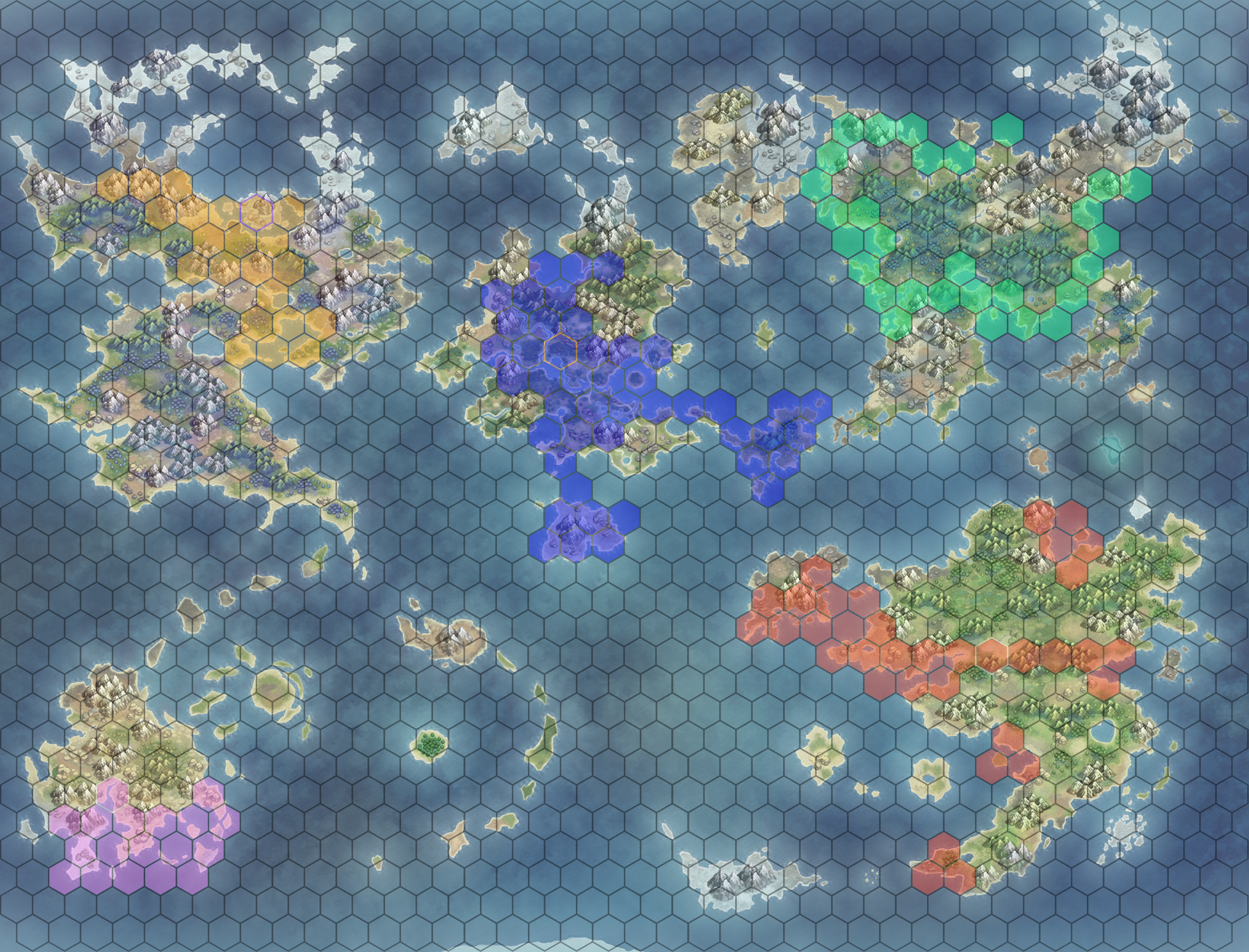
Events
Players can expect each update to include an event for the leadership to make a decision over. This may be something as simple as deciding what kind of resources to purchase or planning a celebration, to something as dire and time-pressing as a famine or drought.
- Leaders might request the ruling council to follow with their ideas or suggestions on how to act. Listening can result in a Stability bonus.
Countries
There are five in total across the campaign world, however, only four are accessible for Players to act as leadership for. These are:
- The Clan Council
- It does not have a capital and is fairly decentralized. For the most part, the Air Continent is divided by the various faction heads, all content to do their own thing.
- Funding: 1 per each Summit.
- Stability: 80 (High)
- Monpower: 10
- It does not have a capital and is fairly decentralized. For the most part, the Air Continent is divided by the various faction heads, all content to do their own thing.
- Rantrum
- A capital situated in an impenetrable mountain fortress, Rantrum was forged through conquest and strength: the epitome of what it means to be Pokémon.
- Funding: 3 per each Summit.
- Stability: 35 (Low)
- Monpower: 30
- A capital situated in an impenetrable mountain fortress, Rantrum was forged through conquest and strength: the epitome of what it means to be Pokémon.
- Ho'oha
- A flying temple that symbolizes life and rebirth, famous for its lively celebrations and strong culture. Priests wield significant power as they represent Ho-Oh.
- Funding: 5 per each Summit.
- Stability: 25 (Very Low)
- Monpower: 15
- A flying temple that symbolizes life and rebirth, famous for its lively celebrations and strong culture. Priests wield significant power as they represent Ho-Oh.
- Ava-lu Empire
- Ruling over the waters and with the capital built upon the waters, Ava-lu rivals Liokio as the economic power of the world. They have an impressive navy, too!
- Funding: 6 per each Summit.
- Stability: 50 (Stable)
- Monpower: 25
- Ruling over the waters and with the capital built upon the waters, Ava-lu rivals Liokio as the economic power of the world. They have an impressive navy, too!